One Irrational Triangle Angle Makes the Full Billiard Flow Ergodic
An OpenAI preprint claims that the full position-and-direction flow of a billiard is ergodic in every nondegenerate triangle with at least one angle that is an irrational multiple of π. The authors unfold the reflected paths onto a flat surface with cone points, then use an analytic argument to control the angular Fourier modes of any invariant set. Irrationality forces every nonzero mode to vanish, leaving only invariant sets of probability zero or one.
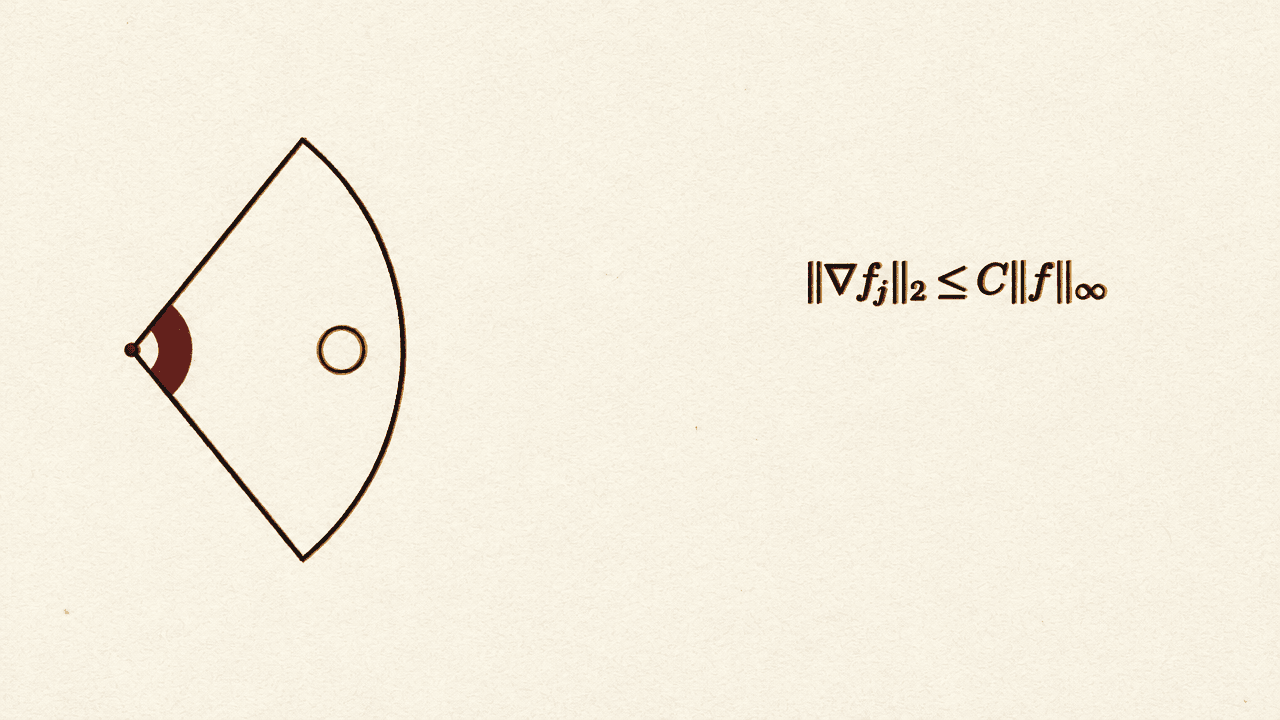
Ergodicity is about invariant sets, not how tangled a path looks
A billiard trajectory can look complicated without being ergodic. The relevant state includes both the ball’s position and its direction. Ergodicity asks whether a measurable set of these states can remain unchanged under the flow while having probability strictly between zero and one. If every invariant set has probability zero or one, the flow is ergodic.
The manuscript’s Theorem 1 claims that the full position-and-direction flow is ergodic for every nondegenerate triangle with at least one angle whose ratio to π is irrational. It requires no genericity assumption or special condition on how well that angle can be approximated by rationals.†
The setting is a unit-speed ball reflecting specularly from the triangle’s open sides: at an edge, tangential velocity is preserved and normal velocity reverses. Position is distributed uniformly by area and direction uniformly around the circle. Trajectories that hit a vertex in either time direction are excluded; this exceptional set has measure zero.
The theorem does not assert that every orbit behaves typically, that trajectories converge quickly, or that the flow is mixing. It concerns invariant measurable sets under the full position-and-direction flow.
Unfolding turns reflections into geometry around cone points
To analyze the billiard, the proof reflects the table rather than the ray. Across one side, a reflected path continues straight into a copy of the triangle. The manuscript glues two copies along all corresponding sides, with opposite orientations. Folding this doubled surface back recovers the billiard.
The sides become regular points on the doubled surface; the vertices remain cone points. At a vertex with triangle angle α, the doubled surface has total angle 2α. Away from the cone points, the surface is flat, so directions can be transported through local coordinates without turning.
This construction isolates the geometric obstruction that matters later: taking a direction once around a cone point can change it. The proof turns that change into a restriction on the angular Fourier modes of any invariant set.
The hard step is controlling a rough invariant function
Take an invariant measurable set and represent it by its indicator function: one inside the set, zero outside. Lift this function to the doubled surface and call it f. It is bounded, but it may be very rough; the proof cannot assume it is smooth.
At each position, decompose its dependence on direction into angular Fourier modes, with integer index j. The zero mode is the angular average. Because f is unchanged along the billiard flow, its transport derivative vanishes. In Fourier coordinates, that equation couples spatial derivatives of neighboring modes.
The goal is to show that every coefficient has zero spatial gradient. That conclusion cannot simply be read off from the transport equation, given the limited regularity of f. The manuscript’s technical argument first smooths in position where it can stay away from cone points, then cuts off small neighborhoods around them. A cutoff derivative costs on the order of 1/ε, while the transition annuli have area on the order of ε². An energy inequality uses this balance to bound the gradient of each coefficient uniformly in j. This is a bound for each mode, not a bound on the sum of gradient norms over all modes.
The proof then adds modes of the same parity—m, m+2, m+4, and so on—so that transport terms cancel in pairs, leaving an endpoint term B. The remaining task is to show that B vanishes.
That requires two limits in a specific order. The manuscript averages along long segments that stay clear of small cone neighborhoods, with length T = s/ε. First ε tends to zero while s is fixed. The resulting limit satisfies the local transport equation, but the coefficient bound deteriorates as s shrinks. The proof therefore reapplies the earlier bounded-function estimate to obtain a new bound independent of s, and only then lets s tend to zero. The ordered limits force B to vanish.
The resulting proposition is that every angular coefficient has zero flat gradient. The technical estimates and weak-limit arguments behind this step are omitted; this is the analytic bottleneck.
Irrational holonomy eliminates every nonzero mode
Once a coefficient has zero gradient, it is constant in each flat chart. But constants in neighboring charts must agree when transported around a cone. This compatibility after one loop is the holonomy condition.
Around a cone of total angle 2α, carrying a direction once around the tip rotates it by −2α, modulo a full turn. For angular mode j, the corresponding coefficient acquires the phase e2ijα. If c is the coefficient in a chart, returning to that chart requires
For a nonzero mode with c ≠ 0, this requires e2ijα = 1, so jα/π must be an integer. Since j is a nonzero integer, that would make α/π rational. If α/π is irrational, no nonzero mode can survive: every coefficient with j ≠ 0 vanishes.
The zero mode has no such phase obstruction. Its gradient is zero, and the doubled surface is connected, so it is constant as well. Fourier completeness then makes f constant almost everywhere. Because f is an indicator, its constant value is either zero or one. Folding back to the table gives the theorem: every invariant set has probability zero or full probability.
The final algebraic step is short; its weight depends on the analytic result that makes each coefficient parallel. Irrationality then turns the cone’s holonomy into the elimination of directional variation.
The spectral corollary concerns density-one subsequences
The manuscript also reports spectral consequences for Dirichlet or Neumann eigenbases. Under a real-valued hypothesis, it derives growing nodal-domain counts along density-one subsequences—a fraction tending to one—not necessarily for every eigenfunction. The spectral arguments are not given here.
An animated trajectory illustrates the billiard rule; it does not establish the theorem. The claim rests on the invariant-set argument and its analytic control of the Fourier modes.