Weak Reversibility Prevents Extinction and Runaway Growth in Mass-Action Networks
An OpenAI preprint proves that, for finite weakly reversible reaction networks with mass-action kinetics, every trajectory starting at positive concentrations remains bounded above and bounded away from zero for all future time. The authors use a concave function to construct a region that traps each trajectory. The bounds may depend on the initial concentrations; the result does not establish convergence to equilibrium or a common bound for an entire compatibility class.
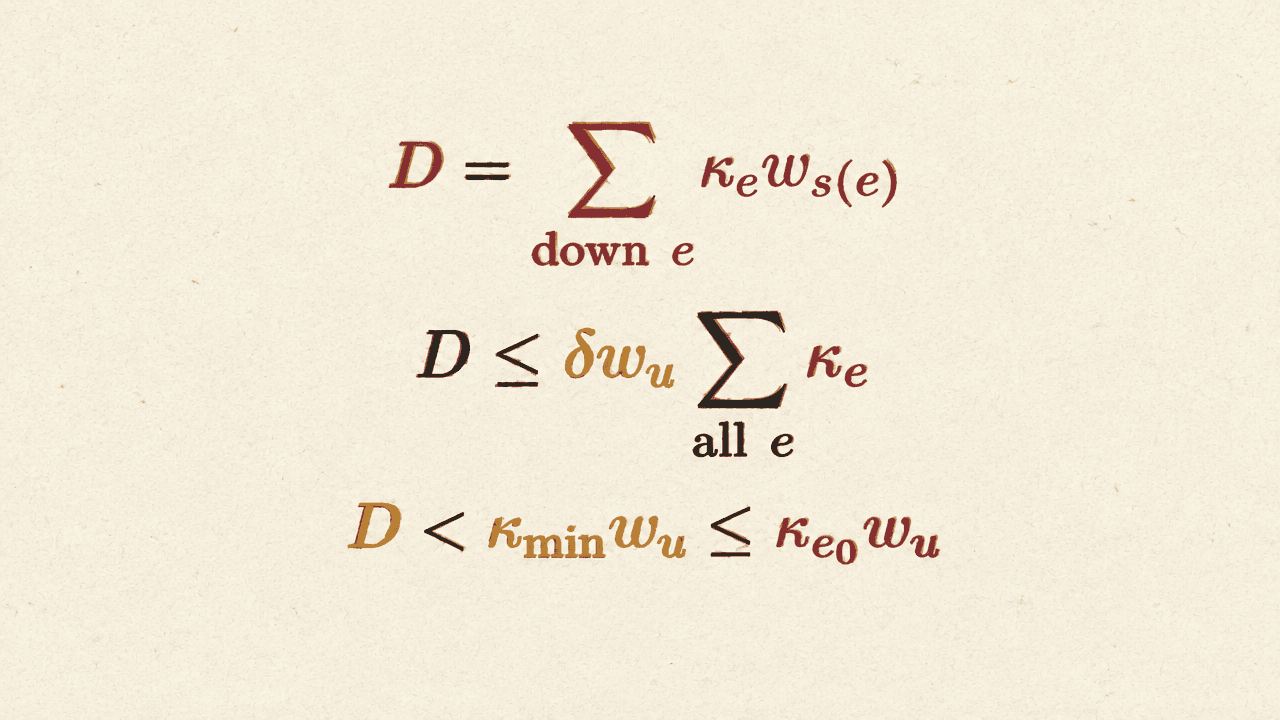
Weak reversibility rules out extinction and runaway growth
A concentration can remain positive at every finite time and still approach zero asymptotically. Preventing that kind of extinction does not, by itself, prevent concentrations from growing without bound. The manuscript’s theorem addresses both failures for finite, weakly reversible reaction networks governed by mass-action kinetics.†
Weak reversibility is a condition on the reaction graph. For every reaction, there must be a directed path from its product complex back to its starting complex. A complex specifies how many molecules of each species participate—for example, 2A or A+B. The return path may take several reactions; it need not be a single reverse arrow.
The result applies to the mass-action equations themselves, not to every dynamical system that happens to share the same graph. For a reaction from complex y to y′, its rate is a positive constant times the concentration monomial x^y, and its contribution to the changing concentrations points in the direction y′−y. For 2A ⇌ B, with concentrations a and b, the forward rate is ka², while the reverse rate is lb. Thus ȧ = −2ka² + 2lb and ḃ = ka² − lb.
Under the theorem’s assumptions, each positive initial state has a trajectory that exists for all future time and stays uniformly bounded above and away from zero. More precisely, there is an ε in (0,1) such that every species concentration satisfies ε ≤ xᵢ(t) ≤ ε⁻¹ for all t ≥ 0. The bound can depend on the network, the fixed reaction rates, and the initial state.
That dependence matters. The theorem does not assert a common eventual bound for all initial states in a compatibility class, even when that class is unbounded. Nor does it claim that every trajectory converges to an equilibrium.
An unbounded class can still contain bounded trajectories
The network A ⇌ 2A, with both rate constants equal to one, illustrates the distinction. Its compatibility class is the full nonnegative axis, which is unbounded. Yet its equation is ẋ = x − x² = x(1 − x). Below one, the concentration increases; above one, it decreases; at one, it remains fixed. Uniqueness prevents a trajectory from crossing that equilibrium. Any positive initial concentration therefore stays between its starting value and one—including a trajectory that starts exactly at one.
This example verifies the conclusion for one simple system; it is not the proof for arbitrary networks. The general argument has to handle many reaction directions at once.
Return paths constrain the net flux across a cut
The proof compares reaction rates by writing concentrations as xᵢ = h^pⁱ, with 0 < h < 1. A complex y then has weight xʸ = h^(p·y), so a lower exponent gives a larger weight. The construction chooses directions that order the complexes and separates the weights: for sufficiently small h, a higher-level complex has weight at most a small factor δ times that of a lower-level one.
Consider a cut dividing those levels. If a reaction crosses downward, weak reversibility guarantees a return path that crosses upward somewhere. The weight separation lets one such upward reaction outweigh the combined downward flux: the latter is bounded by δ times the upward source’s weight and the sum of the rate constants. Choosing δ small enough makes that bound smaller than the contribution of the upward reaction. If no reaction crosses downward, the net flux is already nonnegative.
Thus every cut has nonnegative net flux. Summing those comparisons with their positive level gaps shows that the vector field has nonnegative dot product with the chosen direction. Equal-level reactions contribute nothing. The cut argument supplies the local control; turning it into a bound for a whole trajectory requires a further construction.
A concave function traps each trajectory in a positive region
The manuscript builds a concave function F, the minimum of finitely many affine functions. At any point, the functions attaining that minimum are active. The construction must ensure that every active slope passes the flux test. This matters at ties: the right derivative of the minimum is the smallest derivative among the active functions, so checking only one branch would not suffice. The proof handles this through induction on dimension and finite gluing; the explainer omits those technical arguments.
The function defines a region around each positive initial state. A constant affine branch is active there, setting a ceiling M. The set K = {x : F(x) = M} contains the initial point and is convex. It is also kept away from the boundary of the positive box [h, h⁻¹]ᵈ; convexity then places all of K inside that box.
While a solution remains in the box, F cannot decrease. Since it starts at M and cannot exceed that ceiling, it stays on K; it therefore cannot make a first contact with the box boundary. The resulting region is compact, which permits continuation for all future time. This is how the proof obtains bounds above and away from zero for each positive initial state, without requiring the entire compatibility class to be bounded.
The result is boundedness and persistence, not a general convergence claim or a common classwide bound. The example checks a special case; the affine construction is what extends the argument to the networks covered by the theorem.