Self-Similar Measure Dimension Is Set by Distinct-Map Entropy
An OpenAI manuscript on self-similar measures on the line argues that Hausdorff dimension is determined not by the entropy of the choices used to generate a point, but by the information that survives after histories producing the same affine map are merged. It gives the dimension as the smaller of one and the rate of that map information divided by the average contraction rate, including cases with unequal or orientation-reversing contractions.
The dimension depends on maps that remain distinct
A self-similar measure is built by repeatedly choosing from a finite set of contractions. Each choice shrinks and moves the current interval; an infinite sequence selects a point. The resulting measure records not only where points can land, but how probability accumulates around them. Its dimension describes how that mass scales under finer zooms.
The difficulty is that different choice histories can produce the same map. An OpenAI manuscript gives the Hausdorff dimension as the smaller of one and the ratio of two rates: the entropy rate of the distinct composed maps, divided by the average contraction rate. The cap at one reflects that the measure lies on the line.
The numerator, h_RW, counts information per choice that remains after identical maps are merged. The denominator, χ, is the average of minus the base-two logarithm of each map’s absolute contraction, weighted by its probability.
A duplicate-map example makes the distinction concrete. Let A and B both send x to x/3, each with probability one quarter. Let C send x to x/3 + 2/3, with probability one half. The three labels have 1.5 bits of symbol entropy per choice. But A and B do the same thing: together they select the left third with probability one half. Merging them leaves the measure unchanged.
At depth n, the effective left-right choices give 2^n distinct maps, each with probability 2^-n. Their intervals are separated, so the map entropy is exactly n bits and the rate is one bit per choice. Since χ is log base two of 3, the dimension is 1 divided by log base two of 3, approximately 0.631. The extra label raises the symbol entropy but adds no information to the measure.
The formula applies to finitely many affine maps of the form φ_i(x) = r_i x + t_i, with real translations, positive probabilities summing to one, and 0 < |r_i| < 1. Contractions may differ in size; a negative slope reverses orientation.
The entropy rate counts exact map outcomes
For a word of n choices, compose the maps and count the complete affine outcome: both its signed slope and translation must match for two histories to count as the same map. Add the probabilities of histories that produce that outcome, then take the Shannon entropy H(G_n) of the resulting distribution, in bits. The rate is the limit of H(G_n)/n as n grows.
The manuscript gives a short reason this limit exists. A composed map from two consecutive blocks is determined by the maps from each block, and applying a function cannot increase entropy. Thus H(G_(n+m)) is at most H(G_n) + H(G_m); the limiting rate is the infimum of the finite-block ratios.
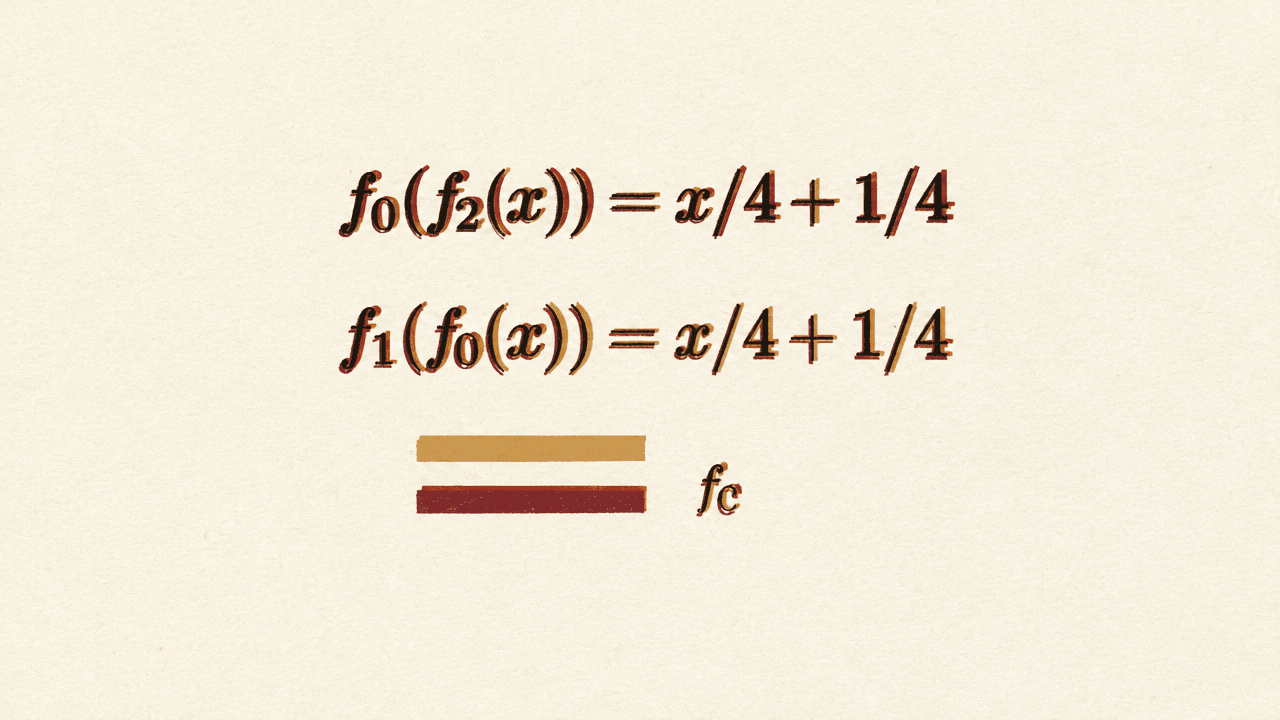
Exact collisions can arise even when no generators are duplicates. Take three distinct maps that all shrink by one half, with translations zero, one quarter, and one half. Composing the zero-translation map after the one-half-translation map gives x/4 + 1/4. Composing the one-quarter-translation map after the zero-translation map gives the same expression. The two histories therefore merge.
Maps that are merely very close do not merge: different translations remain different map outcomes, even if a finite-resolution picture cannot distinguish them. The manuscript’s proof must show that arbitrarily close maps do not cause additional dimension loss beyond the entropy rate.
The proof turns hidden information into a contradiction
The proof roadmap addresses its hardest case: information that may be hidden inside extremely small grid cells. If the dimension were below the proposed value, the argument says, the measure would have a uniform entropy deficit across one-bit scale windows. A finite-law estimate detects hidden information through equally weighted pairs of possible translations, even when their separation is extremely small. At a suitable scale, such a pair can create an entropy gain against that deficit.
One preliminary step handles unequal and negative contractions. Group choices into blocks of length b, and record each block’s type: how many times each of the m symbols occurs, regardless of order. There are at most (b + 1)^m types, so recording one costs at most m log base two of (b + 1) bits. Once the type is known, the signed slope is fixed; only the translation can vary. The manuscript uses this to bound the map entropy conditional on type from below by the block entropy minus the type cost. Since block entropy is at least b times h_RW, the cost per choice vanishes as block length grows.
The conditioning matters: after revealing a block, the unobserved future must be averaged back to the original measure. The proof does not claim that every individually conditioned tail has the same entropy deficit.
It must also avoid counting one gain repeatedly. The manuscript describes choosing successive block lengths so that the retained fine-scale windows are disjoint. Their gains telescope and stay bounded at any fixed observation scale. Averaging over observation scales, however, yields a fixed positive gain from each band. Enough disjoint bands would exceed the fixed bound, giving the contradiction. These steps are a proof roadmap, not a replacement for the technical estimates that connect finite map information to the dimension of the infinite measure.
Dimension one does not mean a density
With no exact overlaps, every word gives a different map, so h_RW is the ordinary entropy of the symbol probabilities. With overlaps, the numerator is instead the entropy rate of the surviving maps.
The manuscript claims the formula for the finite systems described above, including unequal and orientation-reversing contractions. Dimension one does not imply that the measure has a probability density. The exact examples illustrate the formula; they do not establish the general theorem.