A Continuous Collar of Caustics Forces a Smooth Billiard Table to Be Elliptical
An OpenAI manuscript proves a rigidity theorem for smooth, strictly convex billiard tables: if a continuous family of caustics fills a collar just inside the boundary, the table must be an ellipse, including the circular case. The authors stress that the hypothesis requires every intermediate caustic in the collar; a handful of caustics or closed trajectories is not enough. Their proof turns periodic billiard orbits into constraints on the boundary, then uses analytic continuation and growth estimates to establish the result.
A complete collar, not a handful of trajectories, forces an ellipse
A billiard ball travels in straight lines and reflects from the boundary at equal angles. A caustic is an interior curve touched by every segment of a trajectory. It is not a reflecting wall; reflection still occurs only at the table’s boundary.
The manuscript’s rigidity theorem says that, under specific smoothness and convexity assumptions, a continuously filled collar of caustics just inside the boundary determines the entire table: its boundary must be an ellipse, with circles included. The claim depends on a complete collar, not merely on several caustics or a few closed billiard paths.
The table must be bounded and strictly convex, with an infinitely differentiable boundary whose curvature is positive everywhere. Each caustic must also be a smooth, simple, closed curve bounding a strictly convex region. These curves must form a continuous family, with every intermediate leaf present as the family runs inward from the boundary.
Continuity does not mean the leaves vary differentiably across the collar. Smooth individual curves do not by themselves make a smooth family, and a Cantor family accumulating at the boundary can leave gaps. Confocal ellipses illustrate a filled collar; the theorem does not require caustics to fill the table’s deeper interior.
Reflection is a stationarity condition
A local calculation connects the billiard rule to a variational one. Fix two neighboring impacts, (A) and (B), and let the middle impact (P) move along the boundary. The sum of the two chord lengths is
where (s) is arc length along the boundary. Differentiating in the direction of the unit tangent (T), the derivative is the incoming velocity’s tangential component minus the outgoing velocity’s tangential component. At a stationary point, those components agree.
Both velocities have unit length, so equal tangential components require opposite normal components. That is the equal-angle reflection law. Stationarity does not mean the path is globally shortest; it gives the local condition for reflection.
A filled collar supplies whole families of periodic orbits
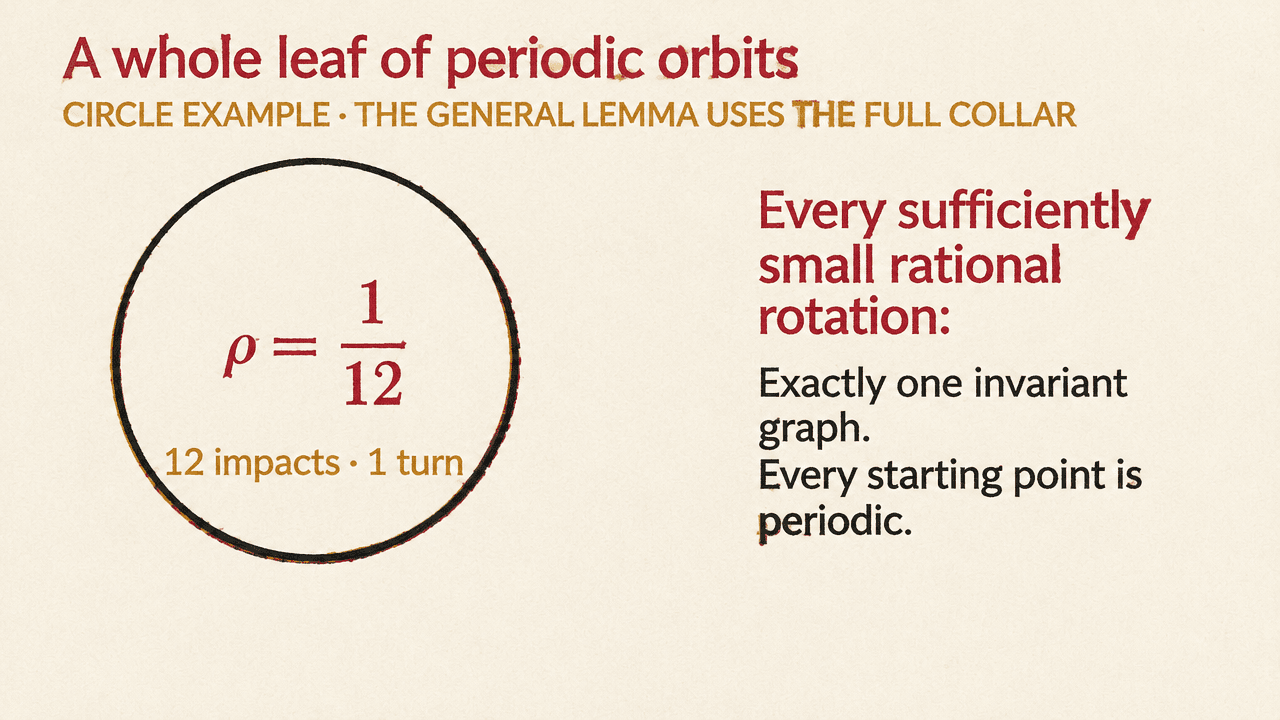
A rotation number measures the average fraction of a turn made per reflection. For a circle, rotation number (1/12) gives twelve impacts in one circuit. A general table need not have equal steps between impacts, so the circle is only an illustration.
The manuscript claims that every sufficiently small positive rational rotation number occurs on exactly one invariant graph—a curve in the space of boundary positions and travel directions preserved by the billiard dynamics. Every point on that graph is periodic. Thus, for sufficiently large (q), rotation number (1/q) gives an entire family of (q)-step periodic orbits, not just one closed polygon.
Nesting, a twist inequality, and area recurrence establish this result. Together, these properties control the ordering and evolution of nearby trajectories.
Periodicity makes the action constant on each leaf
For one periodic leaf, the manuscript describes successive oriented lines using a normalized angle coordinate (X). After a circuit, (X) advances by (2\pi). Each step has a normalized generating action (D), whose stationarity equations encode reflection; summing the step actions gives a total action (W_q).
As the starting phase varies, each interior coordinate contributes two terms to the derivative of (W_q), from the neighboring steps. The stationarity equations make those terms cancel. The endpoint terms cancel because the orbit closes. Therefore (W_q) is constant along that periodic family, and its nonzero Fourier coefficients vanish.
This is a leaf-specific constraint: the action is constant along one fixed periodic leaf, not across different leaves. The vanishing coefficients constrain a normalized function encoding boundary curvature; they do not mean the boundary itself has no higher harmonics.
The proof first upgrades smoothness to analyticity
The theorem assumes a smooth boundary, not an analytic one. The distinction matters because the next stage continues functions describing the boundary and reflected lines into a complex variable. The manuscript first has to establish the analyticity that makes this continuation possible.
The action constraints provide the starting point. Above a sufficiently large frequency cutoff, the derivative of the constraint system is the identity plus a small operator, with the remainder bounded in norm by (1/2). A controlled inverse and an analytic Newton construction then upgrade the smooth boundary to a real-analytic one. A separate construction establishes joint analytic dependence for the grazing dynamics, using both function values and first parameter derivatives at rational resonances.
The complex continuation is of the functions describing the boundary and reflected lines, not of a billiard ball moving through an imaginary table. In a finite reflected chain, the intermediate lines are determined algebraically by derivatives of the two endpoint lines. The manuscript’s continuation result rules out a local joint meromorphic extension through the first finite boundary of the complex domain. In other words, that proposed first boundary cannot be crossed by extending all the relevant functions together, even allowing poles.
That obstruction leaves a fork. If the complex normal has a zero or a pole, the manuscript derives the ellipse conclusion. If neither occurs, it introduces a common shape coordinate and studies two analytic fields. Growth estimates then rule out the non-circular infinite-strip case, infinite growth order, and every finite order except the critical one. The source presents this as a proof roadmap; the technical estimates behind these exclusions are not reproduced.
The last case fails because the required escape becomes too unlikely
The remaining case needs a different kind of control near the possible complex boundary. The manuscript combines moment estimates with an independent exclusion result to obtain an angle budget. A fixed odd periodic chain transfers that control to stopped Brownian paths in the analytic coordinates.
The key comparison concerns a row chosen so that the relevant field is robustly small or large except on a set whose relative size tends to zero. Either alternative suppresses an impact’s subsequent motion. Yet for the chain to reach a closer row, its last site must escape a small protective disk and approach the alleged boundary.
The estimates make that escape probability tend to zero; the setup requires it to stay bounded away from zero. The two requirements conflict, eliminating the final case. This is the role of the probability argument in the roadmap: it rules out the last possible boundary after the earlier analytic and growth arguments have narrowed the possibilities. The stopping rules and estimates needed to establish the comparison are omitted.
Under the stated smoothness, strict convexity, and positive-curvature assumptions, the manuscript concludes that a continuously filled caustic collar forces the table to be an ellipse. A few trajectories or numerical checks do not establish that theorem.
†