A Full Band of Grazing Billiard Trajectories Forces Elliptic Tables
The preprint *Continuous Phase Foliations Create Analytic Caustic Collars* argues that a complete band of invariant billiard states near grazing motion forces a smooth, strictly convex planar table to be an ellipse. Its proof turns the foliation into exact action identities, uses them to establish analytic caustics near the boundary, and then applies a companion theorem to obtain rigidity. The hypothesis requires leaves throughout the band; isolated invariant curves or families with gaps do not meet it.
A complete band of grazing motion forces rigidity
A billiard trajectory moves in straight lines and reflects with equal incoming and outgoing angles. In an ellipse, certain trajectories remain tangent to the same inner curve, called a caustic. The manuscript Continuous Phase Foliations Create Analytic Caustic Collars asks what organized motion near a table’s edge can imply about the table itself.
For a bounded, strictly convex planar table with an infinitely smooth, simple closed boundary and positive curvature, the conclusion is rigidity: a continuous foliation of all sufficiently grazing states forces the table to be an ellipse, including the circular case.
A billiard state is specified by its position, (s), around the boundary and its outgoing angle, (\delta), measured from the positive tangent. Grazing states have (\delta) close to zero. The hypothesis requires a continuous foliation of an open annulus containing every state with (\delta) between zero and some positive (\eta). Each leaf is a simple closed curve winding around the phase cylinder, and one bounce keeps a state on the same leaf.
Full foliation ≠ a family with gaps.
The band may be arbitrarily thin, but it must include every sufficiently grazing state; many invariant curves with gaps between them do not suffice. The leaves need not initially be smooth, and the hypothesis does not require smooth dependence from one leaf to another.
The proof’s bridge from phase-space curves to physical curves has two stages. Periodic motion on invariant graphs yields exact action identities, which support the analytic construction. The resulting analytic line graphs then define nested physical curves, and invariance establishes their caustic property. A companion physical-collar theorem supplies the final implication from that collar to an ellipse.
Periodic motion turns invariance into exact action identities
In oriented-line coordinates, (\theta) specifies a line’s normal direction and (p) its signed distance from the origin. The proof shows that each leaf is a graph: for every (\theta), there is one value of (p).
The full foliation provides a wholly periodic graph at every sufficiently small positive rational rotation. On such a graph, a stationary chain of billiard segments with small positive angular steps can close after whole turns. Because the chain stays on one invariant graph, matching endpoint angles also matches endpoint momenta; the chain closes.
Now vary a closed chain through a continuously differentiable family while keeping its bounce count and winding number fixed. The action’s derivative has contributions from the interior reflections and from the endpoints. The interior terms cancel by stationarity. The endpoint terms cancel because the endpoint momenta agree and the endpoint angular variations match. The action is therefore constant along the family.
These are exact identities, not approximate statements about the order of a trajectory. The manuscript uses them to derive high-frequency equations for the boundary. Companion estimates show that, on high Fourier modes, the relevant derivative is close to the identity. Convergence and uniqueness arguments then establish analyticity of the original boundary.
Joint analyticity takes additional work. At rational resonances, the construction uses both residual values and first derivatives with respect to a parameter—called first parameter jets. Those jets are assigned at individual rational parameters; they are not obtained by differentiating the continuous foliation.
An invariant line graph defines an envelope
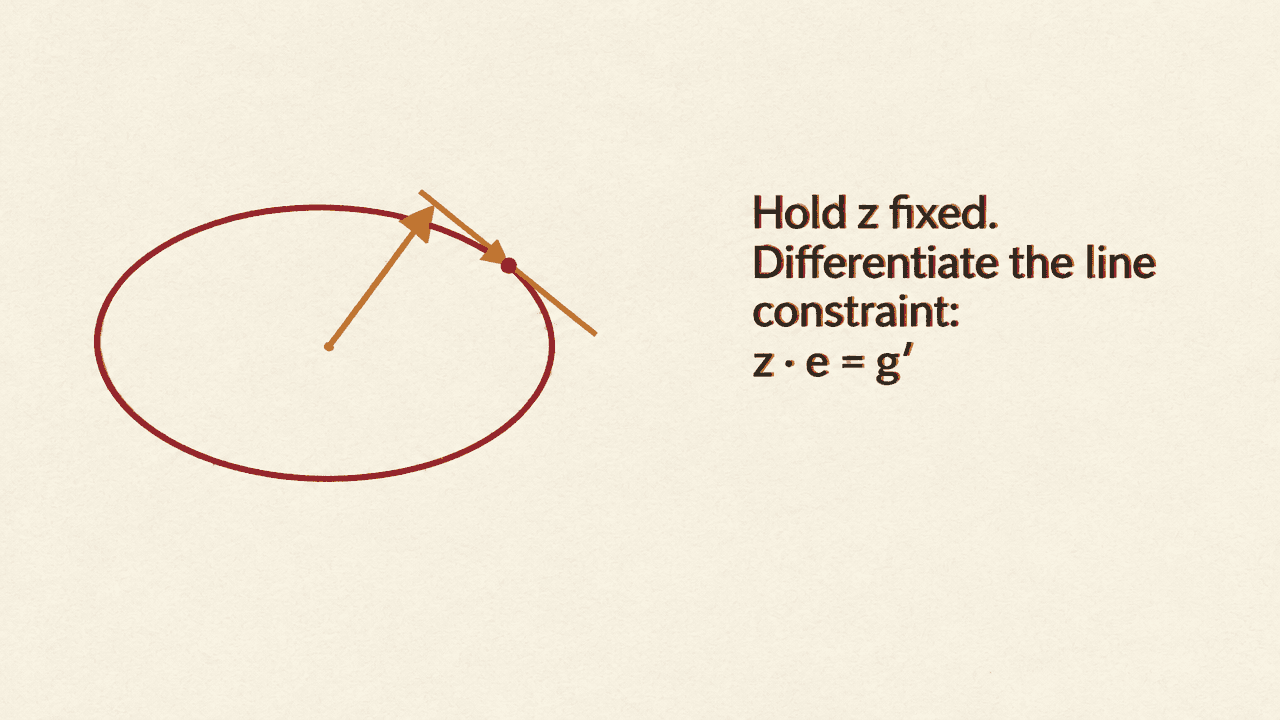
Once an analytic family of line graphs has been constructed, the proof must show that each graph corresponds to a physical curve, rather than merely a collection of lines. Freeze one member of the family and write its graph as (p=g(\theta)). Let (n) be the unit normal to a line and (e) its counterclockwise perpendicular. A line in the family satisfies (z\cdot n=g), where (z) is a point on the line.
An envelope point is where the line constraint and its derivative with respect to (\theta) both hold, with (z) held fixed. The first condition gives the point’s normal coordinate, (g); the second gives its tangent coordinate, (g'). In vector form, the envelope is [ \Gamma=g n+g'e. ] Differentiating, and using (n'=e) and (e'=-n), cancels the normal terms: [ \Gamma'=(g+g'')e. ]
The proof establishes that (g+g'') is positive, so the envelope is regular. But regularity alone does not show that this is the entire convex boundary.
Support inequalities identify the whole convex boundary
For a fixed normal direction (\alpha), the projection of the envelope onto that direction has derivative equal to (g+g''), multiplied by (\sin(\alpha-\theta)). It rises to a unique maximum at (\theta=\alpha), where its value is (g(\alpha)). Thus the curve lies in every supporting half-plane specified by the line family.
Conversely, any boundary point of their intersection must touch a support line. At that contact, the support slack and its derivative vanish, giving the same two coordinates as the envelope point at (\alpha). The envelope is therefore the whole strictly convex boundary, not just a candidate curve.
Nested supports fill the collar, and tangency makes it a caustic
The physical curves must also fill a collar without overlapping or leaving gaps. The construction is even in its translation parameter (t), so it uses (\lambda=t^2). Its support function has the form (h-c\lambda+O(\lambda^2)), where (h) is the outer boundary support and (c) is positive everywhere. For a sufficiently small parameter interval, the supports move strictly inward, producing strictly nested bodies.
Consider a point in the closed table but outside the closed inner body. Its minimum support slack varies continuously and strictly decreases as the bodies move inward: it begins non-negative and ends negative. It has exactly one zero, possibly at (\lambda=0). Thus each point lies on exactly one curve. The resulting map from the closed parameter cylinder is continuous and one-to-one; compactness gives a continuous inverse. Removing the inner leaf leaves a physical collar.
Convexity by itself does not make these curves caustics. The additional fact is that the lines defining them are invariant line states: a bounce preserves tangency. The proof also uses inverse motion and velocity reversal to establish tangency at either endpoint and in either direction. A unit-circle calculation checks the construction: the caustic radius is (\cos(t/2)), so its inward displacement begins at (t^2/8). That is a consistency check for the example, not the proof of the general result.
The rigidity conclusion depends on the full continuous grazing foliation. Once that hypothesis yields an analytic physical caustic collar, the companion theorem implies an ellipse, circles included. Families with gaps remain outside the stated conclusion.