A 16-Million-Cylinder Cover Falls Below the Half-Area Bound
An OpenAI preprint gives a finite cover of a regular tetrahedron by angular cylinders whose total projected area is strictly less than half its minimum orthogonal shadow area. The margin is exceptionally small: the stated example uses 16 million cylinders and improves the normalized cost by just over 5 × 10⁻¹⁰. The authors’ proof establishes both complete coverage, including the boundary, and that the area saving exceeds the cost of the adjustments needed to make the cover work.
A finite cover beats one half, but by less than one-billionth
The manuscript’s counterexample uses 16 million cylinders to lower the normalized cost by a little more than 5 × 10⁻¹⁰. The saving is strict, but too small to see in a scale drawing. Its proof has to do two things at once: reduce the total area and leave no point of the tetrahedron uncovered, including points on its boundary.
The starting point is a regular tetrahedron with edge length two, oriented so that a bottom edge runs along the x direction and the opposite top edge along y. Write its vertical coordinate as z = √2 t, with 0 ≤ t ≤ 1. At height t, the horizontal slice satisfies |x| ≤ 1 − t and |y| ≤ t.
An x-directed cylinder covers the lower half, and a y-directed cylinder covers the upper half. Each has a triangular base of area √2/4, so together they cost √2/2. The manuscript establishes that the tetrahedron’s smallest orthogonal shadow has area √2. The two-cylinder cover therefore costs exactly half the minimum shadow area. The finite counterexample perturbs this equality case.
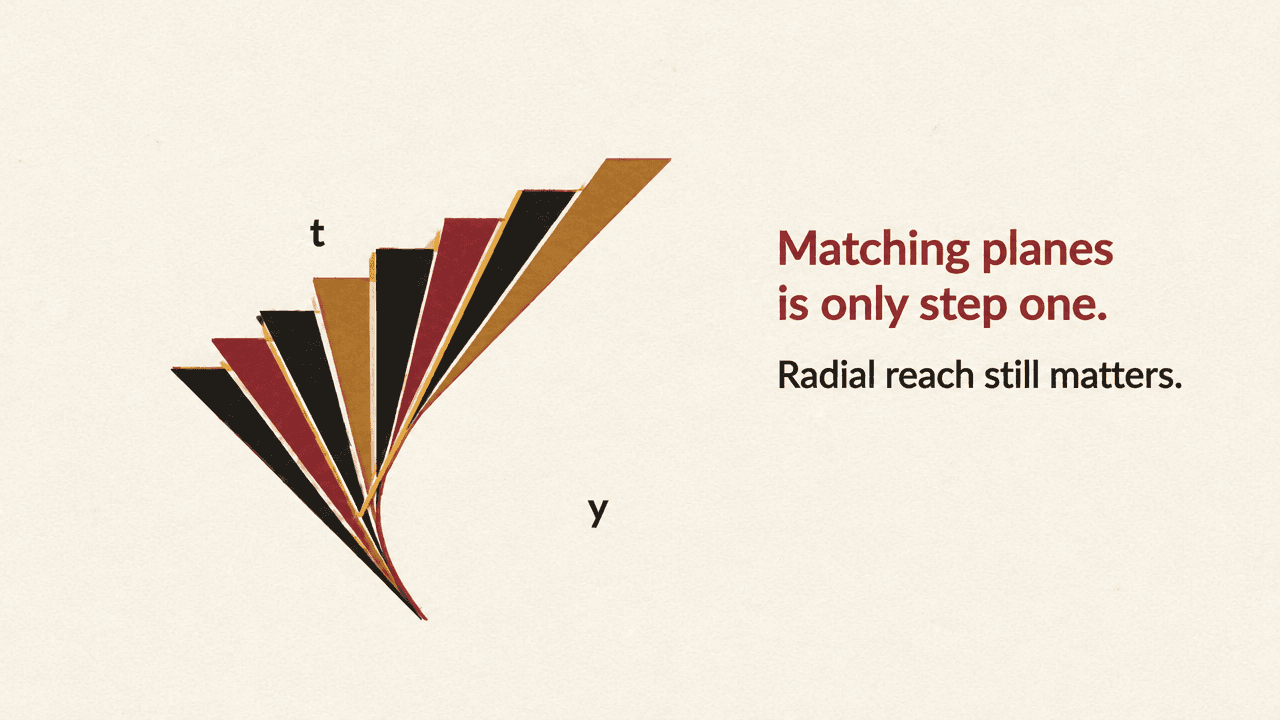
Matched seams make the tilted sectors fit together
In the lower family, a sector is indexed by the ray y = qt, with a small positive tilt parameter ε. The construction prescribes the displacement at each sector endpoint using the same function:
φ(q) = (1 − q²)/4.
For each sector, axis coefficients α and β are chosen so that α − qβ = φ(q) at both endpoints. Neighboring sectors therefore place their shared side in the same plane. Because φ(−1) = φ(1) = 0, the outer boundaries stay fixed.
Matched seams do not by themselves show that every point lies in a sector’s angular range. Fix a point in the tetrahedron and evaluate the finite list of displaced boundary planes there. The first and last values are −t and t, which bracket the point’s y-coordinate. Scan from the first interior value and take the first one at least as large as y. Its predecessor is no larger than y, so the two neighboring values bracket the point. The list need not be increasing: the argument uses the first crossing, not a global ordering.
After subtracting the selected axis displacement, the bracket becomes qⱼt₀ ≤ y₀ ≤ qⱼ₊₁t₀. Since the sector width qⱼ₊₁ − qⱼ is positive, this implies t₀ ≥ 0. The point is in a valid angular sector. The upper family has the corresponding crossing argument. These steps establish angular membership; a separate radial check remains.
Opposing shifts keep the radial repair quadratic
Each sector’s radial cutoff is raised slightly above one half, to Tⱼ = 1/2 + ε²Mⱼ. The allowance includes a safety margin and a sector-dependent term d(q) = q²(1 + q²)/16.
A quadratic allowance can suffice because the two candidate families shift in opposite directions. If both candidates missed a point, the lower intercept’s first-order shift would be −εxy, while the upper one’s would be +εxy. Those contributions cancel when the heights are added. The remaining comparison includes the exact nonnegative square (p² − q²)²/16.
That square alone is not the coverage proof. The manuscript bounds the remaining terms; together with the quadratic cutoff allowance, those error estimates rule out two simultaneous misses. At least one candidate cylinder must cover the point. The proof uses closed inequalities, so coverage includes faces, edges, and vertices.
The projection saving exceeds the cutoff cost
The tilted intercept triangle is not the cylinder’s base. The base is its projection onto the plane perpendicular to the axis. For a sector, the projected area is multiplied by 1/√(1 + ε²(αⱼ² + 2βⱼ²)). Summing across both families gives a quadratic saving, while enlarging the radial cutoffs adds a quadratic cost.
With safety margin η = 1/1000, the normalized total area is
S/A_min = 1/2 − (13/6000)ε² + R, |R| ≤ 2ε⁴.
The negative quadratic term dominates the bounded fourth-order remainder for every 0 < ε ≤ 1/2000, yielding a strict reduction below one half. At ε = 1/2000, the construction uses 2⌈2/ε²⌉ cylinders, or 16 million. The normalized saving is a little more than 5 × 10⁻¹⁰. The explicit remainder bound, not the drawing, establishes the result.
The affine-invariant claim uses a different normalization
The manuscript also considers a directionwise normalization: divide each base area by the tetrahedron’s shadow area in that cylinder’s own direction, then sum. For the regular tetrahedron, this sum is below one half. Each directional shadow is at least the minimum shadow, so replacing the common minimum in the denominator with the shadow in each direction cannot increase the sum.
This directionwise ratio is preserved under an invertible affine map. Stretching or shearing changes each base and its corresponding shadow by the same area factor after reprojecting perpendicular to the new axis. Since every nondegenerate tetrahedron is an affine image of a regular one, the directionwise half-bound fails for every nondegenerate tetrahedron.
That conclusion is distinct from the single-minimum-shadow formulation. The affine-invariant result concerns normalization by each cylinder’s own directional shadow; the manuscript asserts the single-minimum-shadow result here for regular tetrahedra.