Gaussian Partitions Have a Sharp First-Moment Bound in Every Dimension
An OpenAI preprint proves that, in every positive dimension, the sum of the squared first-moment vectors of any finite partition of Gaussian space is at most 9/(8π). The bound is attained by dividing a plane into three 120-degree sectors and extending them across any remaining dimensions. The paper’s main argument rules out a better partition by reducing a hypothetical improvement to geometric constraints on the moments and probabilities of its cells; it also derives a sharp bound for the expected maximum of finitely many centered Gaussian scores.
Three sectors attain the bound
For every finite measurable partition of standard Gaussian space, the sum of the squared lengths of its cell first-moment vectors is at most 9/(8π), in every positive dimension. Equality is attained when the dimension is at least two and there are at least three labels. The construction needs only three 120-degree sectors in a plane.
For a cell A, its first-moment vector is the integral of x over A with respect to Gaussian measure. It is not divided by the cell’s probability. The theorem allows unequal probabilities and empty cells.
In a sector symmetric about the horizontal axis, vertical contributions cancel. In polar coordinates, the horizontal moment separates into a radial integral, equal to √(2π)/2, and an angular integral equal to twice the sine of the half-angle α. Including the Gaussian density, the moment has length sin(α)/√(2π). With α = π/3, the three squared lengths sum to 3 sin²(π/3)/(2π) = 9/(8π).
In higher dimensions, extend each sector across every remaining coordinate. Those extra Gaussian coordinates have mean zero, so they add no components to the moment vectors. Extra labels can be empty. This establishes that the bound is attainable; it does not establish that no other partition can do better.
A minimal maximizer turns improvement into a geometric constraint
The upper-bound argument starts by enlarging the problem without changing its objective. From dimension d and k labels, the manuscript passes to dimension n = max(d, k − 1, 4), then uses n + 1 labels, adding empty cells as needed. Suppose this enlarged problem has an attained maximum C greater than 9/(8π). Among its maximizers, choose one with the fewest active cells—those with positive probability.
This choice rules out any pair of active-cell moment vectors with a nonnegative dot product. If vectors z and w have positive dot product, merging their cells changes the objective by 2⟨z,w⟩ and improves it, contradicting maximality. If their dot product is zero, merging preserves the objective but reduces the number of active cells, contradicting the minimal choice. Thus distinct active vectors have strictly negative dot products.
Optimality supplies another constraint: each point belongs to the cell whose moment vector has the largest dot product with it. The manuscript derives this score rule using norm duality; ties occur only on negligible boundaries. The active vectors sum to zero, and if there are m of them, their span has dimension m − 1. With at most four active cells, the problem therefore lies in at most three dimensions, where an established propeller bound of Heilman, Jagannath, and Naor applies. The new case to rule out is five or more active cells.
The smallest moment links cell probabilities to a determinant bound
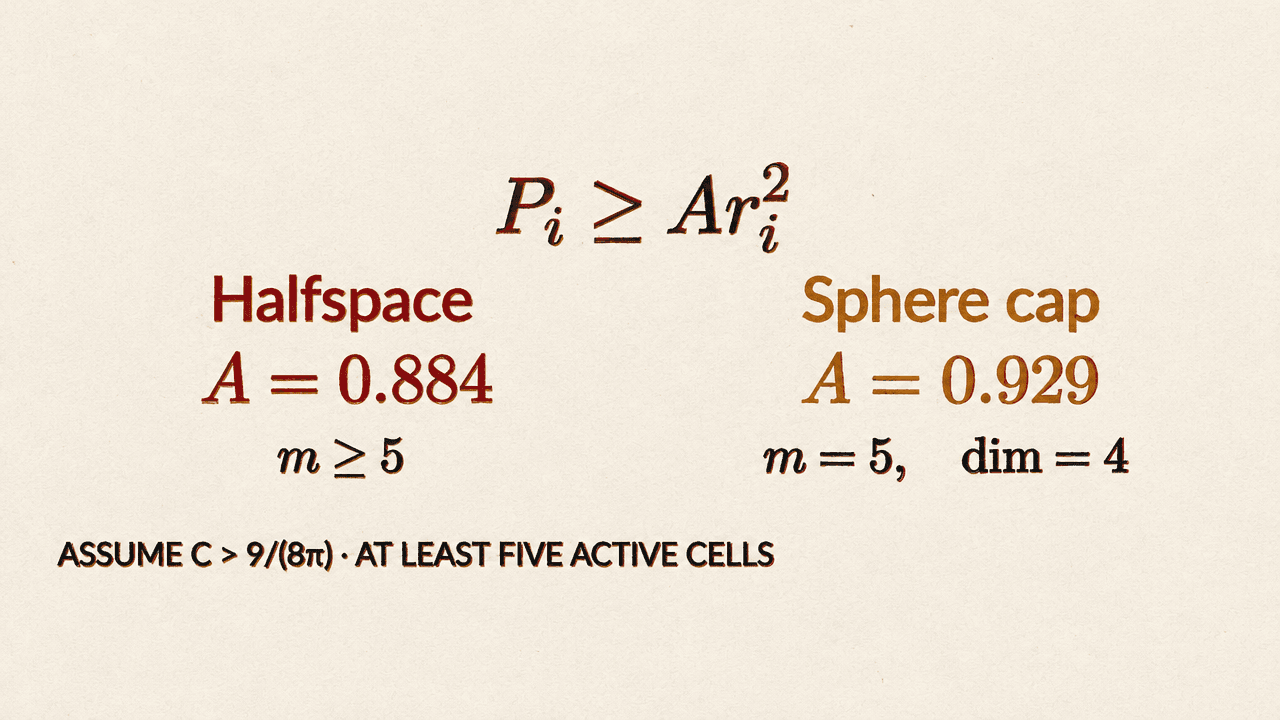
For a hypothetical maximizer with at least five active cells, normalize each moment length by √C and call it rᵢ. The squared normalized lengths sum to one, as do the cell probabilities Pᵢ. The manuscript bounds each probability below in terms of its normalized length: a Gaussian half-space comparison gives Pᵢ ≥ .884rᵢ². In the five-cell case, a spherical-cap comparison in the four-dimensional span raises the coefficient to .929. A further estimate, using Ehrhard’s inequality, compares deleting one score with translating its winning cone. Together, these estimates constrain how the total probability of one can be distributed.
A second constraint comes from the cell with the smallest normalized moment length, t. Resolve a Gaussian point into a coordinate T along that cell’s moment and an orthogonal residual. Two rescaled residual scores, U and V, are independent of T, though they may be correlated with each other. Within the chosen cell, T is nonnegative and U and V are each at most T. Their first-moment integrals over the cell vanish. Those facts let the proof bound the cell’s integral of T using the positive part of T + U + V over a larger region.
At a fixed T = s ≥ 0, that positive part is supported on a triangle in the (U,V) plane: U ≤ s, V ≤ s, and s + U + V > 0. The unweighted integral of s + U + V over the triangle is 27s³/6. This is an area calculation, not a Gaussian probability. To bound the Gaussian expectation, the manuscript multiplies by the maximum density of the residual pair, a quantity controlled by its covariance determinant, and then averages over T. Comparing the resulting upper bound with the chosen cell’s first moment gives a determinant constraint for each pair of residual scores.
Applied to scores associated with the three largest moment lengths, these pairwise constraints combine with the negative dot products: the relevant covariance determinants cannot all be small. The result is a global constraint that can be compared with the probability bounds.
The final elimination is summarized rather than proved in full by the explainer. Let c be the square of the third-largest normalized length. The probability bound and one determinant constraint force 0.066 < t < 0.12 and c > 2.6t. A second determinant constraint requires 3/2(c − t²)² ≤ 90/π² · t². Substitution makes the left side greater than 9.2256t², while the right side is approximately 9.1189t². Since t is positive, the inequalities cannot both hold. The manuscript says the omitted elimination uses exact rational enclosures, not just sampled numerical evidence. A maximizer above 9/(8π) is therefore ruled out.
The bound also controls maxima of Gaussian scores
The manuscript gives a sharp bound on the expected maximum of finitely many centered Gaussian scores: it is at most 3/(2√(2π)) times the square root of the sum of squared distances of the score vectors from their average. The displayed corollary does not require the jointly Gaussian scores to be independent. A kernel-clustering application additionally uses results of Khot and Naor and a companion Unique Games Theorem; those complexity inputs are separate from the geometric bound.
The accompanying explainer says its reproducible package checks the displayed constructions, algebra, and selected finite comparisons, but does not independently certify every analytic argument. A Lean reproduction was not run.