A Missing Factor Reverses the Claimed Simplex Counterexample
An OpenAI preprint argues that the product of two 10-dimensional simplices exceeds the normalized projection-body volume of a 20-dimensional simplex, presenting the result as a counterexample to the simplex maximum. But the manuscript’s stated benchmark and comparison are inconsistent: correcting the benchmark introduces a missing factor of 20 and makes the product’s score lower, not higher. The calculation therefore does not establish the claimed counterexample or the larger-dimensional extension built on it.
The stated calculation does not establish a counterexample
The manuscript’s stated conclusion is that the product of two 10-dimensional simplices has a normalized projection-body volume about 1.52% greater than the 20-dimensional simplex benchmark. But the formulas presented for the benchmark and for that comparison do not agree. Correcting the benchmark changes the comparison: the exact ratio implied by the geometric derivation is less than one, not greater. The supplied argument therefore does not establish the claimed counterexample.
The score is built from shadows
For a compact convex body with non-empty interior in dimension , project onto the hyperplane perpendicular to each unit direction . The projection body, written , encodes the -dimensional volume of each shadow: its support function in direction equals that volume. For a non-unit vector, the support function scales by the vector’s length.
The score is the volume of divided by . This removes size, and the source says the score is invariant under every invertible affine transformation. The quantity at issue is the volume of the projection body itself, not its polar.
Facet projections give a formula for polytopes
For a full-dimensional polytope, each facet contributes its area multiplied by the absolute cosine between its outward unit normal and the viewing direction. Summing the projected facet areas counts almost every point in the shadow twice: a line through the shadow enters the polytope through one facet and exits through another. Convexity makes the intersection a single interval. Facet boundaries and facets parallel to those lines account only for measure-zero exceptions, so the sum is divided by two.
Each facet also contributes the support function of a centered segment whose generator is half its area-normal vector. Support functions add under Minkowski addition—the operation of adding one vector from each body—and determine a convex body uniquely. Thus the projection body is the Minkowski sum of those centered segments.
The simplex calculation needs the factor of two
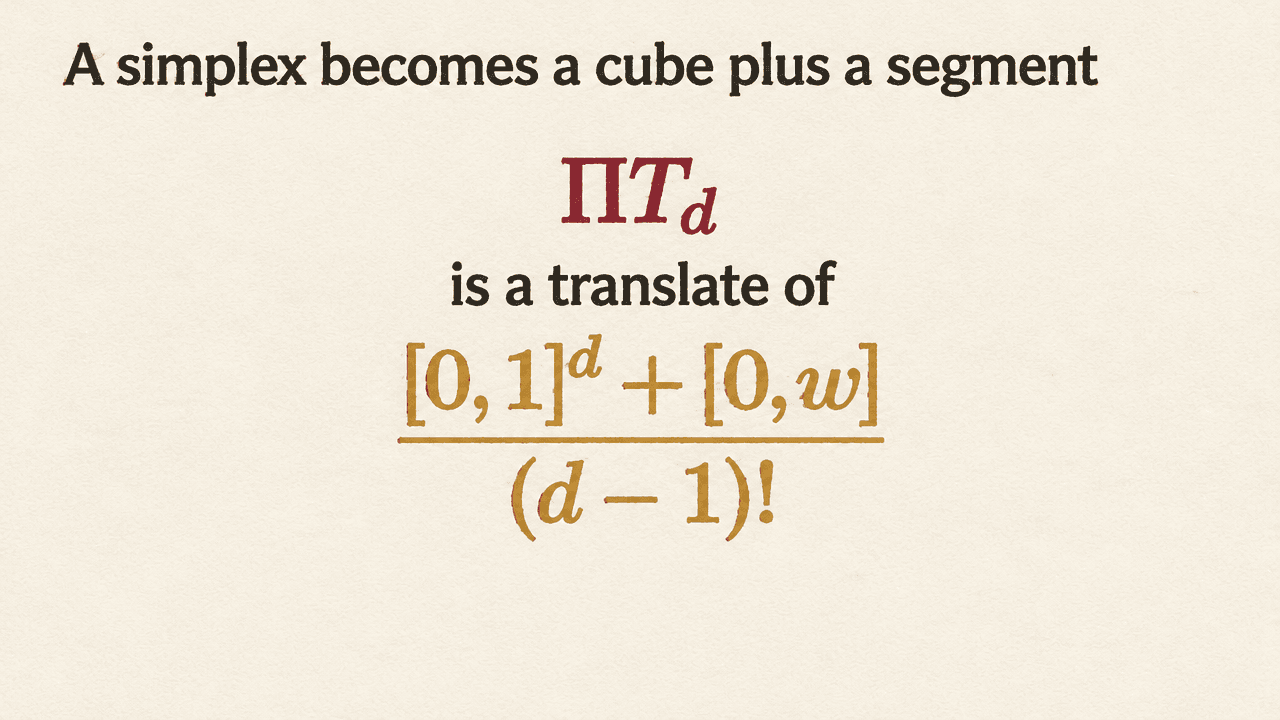
Take the standard simplex , whose volume is , and let . Its coordinate facets have area-normal vectors ; the remaining facet contributes . In the facet formula for the projection body, each vector is halved. Consequently, up to translation, is a cube plus a segment in direction , scaled by .
Before scaling, the cube has volume one. Adding the segment extends each nonempty fiber parallel to by . The extra volume is the cube’s support function evaluated at ; the facet formula gives . The unscaled total is therefore . Scaling in dimension gives
Dividing by yields the benchmark
The factor comes from scaling the projection body by one half in each of its dimensions. Every full-dimensional simplex is an invertible affine image of the standard one, so the source’s affine-invariance claim makes this the benchmark for all such simplices.
The product identity preserves the discrepancy
Let and be full-dimensional polytopes in orthogonal spaces of dimensions and , with . A facet of is a facet of one factor times the entirety of the other; if both factors were proper faces, their product would have codimension at least two. The facet formula gives
Taking volume and dividing by cancels the volume factors, as the source states:
For two 10-dimensional simplices, the product score is therefore . Using the corrected benchmark above, the ratio to the 20-dimensional simplex benchmark is
This is less than one: its numerator is the source’s stated , while the denominator is . The source’s reported ratio omits a factor of 20 in the denominator. Its claimed 1.52% excess does not follow from the facet formula and normalized score as given.
The larger-dimensional claim depends on the same benchmark
The source also describes repeating 10-dimensional factors and adding a simplex of dimension 10 through 19. It says this yields, for all sufficiently large dimensions, products whose normalized scores exceed the simplex benchmark by an exponential factor. But the argument described relies on the claimed excess from a 10-dimensional block. Since the corrected comparison above does not supply that excess, the stated extension is not established by the calculation presented here. The source notes that its threshold argument is omitted, credits earlier counterexamples in every dimension at least 9, and says the optimal upper bound remains open.