The Volume Product of General Convex Bodies Is Minimized by Simplices
An OpenAI preprint on the Mahler conjecture claims a sharp lower bound for the volume product of every convex body, without requiring symmetry or a smooth boundary. The bound is \((n+1)^{n+1}/(n!)^2\), attained exactly by simplices. The manuscript reduces the geometric claim to an inequality for weighted cone integrals and outlines Gaussian projection estimates for proving it, while noting that the full estimates and technical arguments are not reproduced.
The minimum is attained by simplices
The manuscript states a sharp lower bound for the volume product of any convex body: a compact convex set with nonempty interior. The product pairs the body’s volume with the volume of its polar after translation by its Santaló point—the interior point that minimizes the polar’s volume. Translation matters: move the body, and its polar changes.
Equality holds exactly for simplices: segments in one dimension, triangles in two, tetrahedra in three, and their higher-dimensional counterparts. The result is stated without requiring symmetry or a smooth boundary. The manuscript treats the sharper constant for symmetric bodies as a separate problem, not as part of this theorem.
In one dimension, take an interval whose endpoints lie distances a and b from an interior point z. After moving z to the origin, the interval is [−a, b], and its polar is [−1/a, 1/b]. The product of their lengths is (a + b)(1/a + 1/b) = 4 + (a − b)²/(ab). It is at least 4, with equality only when a = b. In this example, the midpoint is the centering that minimizes polar volume.
A triangle makes the two-dimensional bound concrete. Put its centroid at the origin; for a triangle, this is also its Santaló point. For the illustrated triangle, the vertices impose the polar inequalities u ≤ 1, v ≤ 1, and u + v ≥ −1. They suffice because every point in the triangle is a convex combination of its vertices. The resulting polar has area 9/2, while the triangle has area 3/2, giving a product of 27/4—the stated bound when n = 2. This example shows that a simplex attains the proposed value; by itself, it does not establish the lower bound for every body.
The cone reduction isolates the inequality the proof must establish
The proof’s first reduction lifts a translated body into a cone one dimension higher. At height t > 0, the slice is the body scaled by t, so its volume is tⁿ|K|. Weighting the slices by e⁻ᵗ and integrating gives |K|∫₀∞ tⁿe⁻ᵗ dt = n!|K|. The factorial follows by repeated integration by parts.
The positive dual cone encodes the polar. At height t, its slice is a reflected, t-scaled copy of the polar. Weighting those slices by e⁻⁽ⁿ⁺¹⁾ᵗ gives (n!/(n + 1)ⁿ⁺¹)|(K − z)°|. Thus the product of the two weighted cone integrals is (n!)²/(n + 1)ⁿ⁺¹ times the body’s volume product. The desired geometric bound follows if the cone integrals satisfy the inequality
χ_C((0, 1)) χ_D((0, n + 1)) ≥ 1,
where C is the lifted cone, D its positive dual, and χ denotes the corresponding weighted integral over the cone. This is the proof’s pivot: the reduction explains the theorem’s constant, but the cone inequality still has to be proved.
Gaussian projections turn the cone inequality into a matrix problem
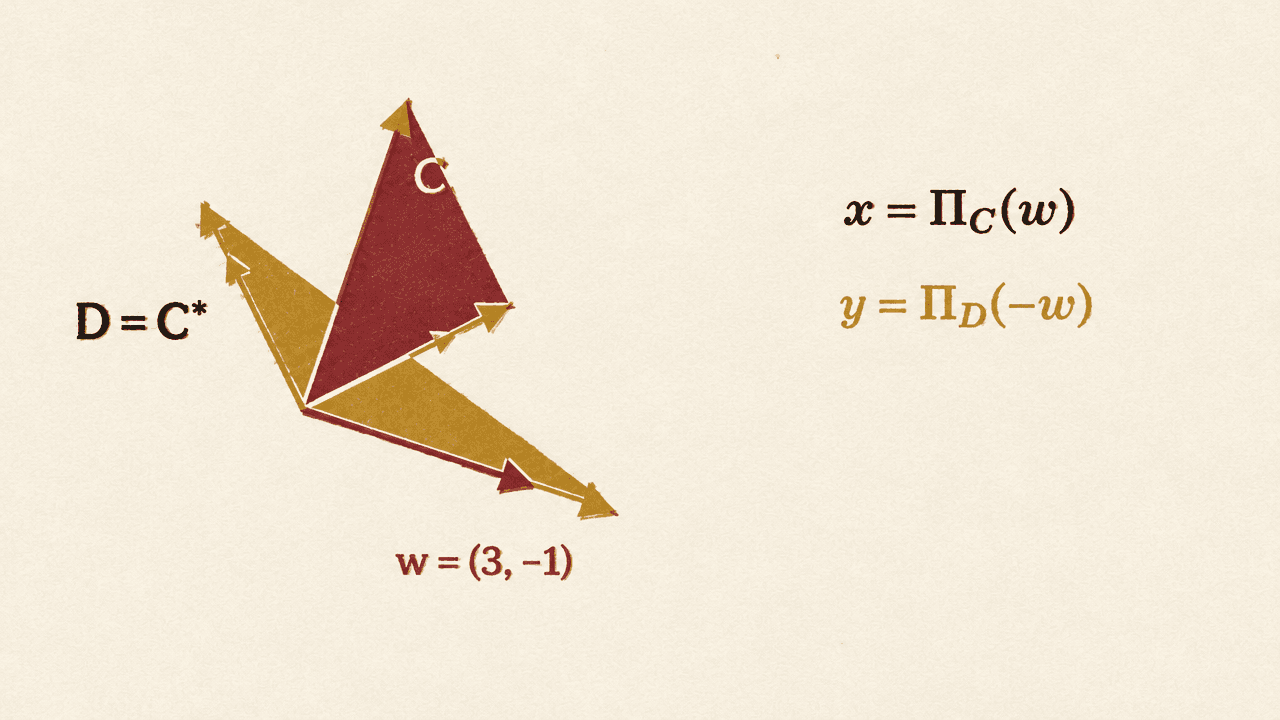
To establish the cone inequality, the manuscript studies nearest-point projections onto a cone and its positive dual. Moreau’s decomposition says that projecting an input onto one cone and the negative of that input onto the dual produces orthogonal vectors whose difference is the original input.
The proof uses biased Gaussian inputs and layer-dependent projections. The bias is chosen so that the mean projection follows a prescribed interior ray; the coordinates and Gaussian covariances are selected together. Weighted, smoothed maps into the cones allow the authors to use change of variables and Jensen’s inequality. The resulting Jacobian estimates give a lower bound for the logarithm of the product of the weighted cone integrals.
The difficulty is that derivatives of these projections are symmetric contractions, but they need not be projection matrices, form a nested family across layers, or commute with one another. The manuscript therefore compares the derivative family with spectral thresholds of a linear Gaussian matrix rather than assuming a common set of directions. A Hermite expansion separates the degree-one Gaussian part from higher-order terms, while retaining errors due to non-commutation. A matrix derivative formula then reduces the remaining comparison to averages of scalar profiles between pairs of eigenvalues.
The scalar-profile estimates must hold over whole intervals, not just at selected points. The appendices combine exact arithmetic at finitely many nodes, interpolation between them, and bounds on the unbounded tails. Checking the nodes alone would not establish the inequality across the real line. The source gives a roadmap rather than reproducing the estimates and technical existence and limit arguments needed for the full proof.
Equality in the comparison forces a simplex
The strict terms in the comparison also constrain equality. If the cone product is exactly one, the relevant coefficient matrices must commute, and the projections separate in a single fixed coordinate basis. In that basis, each factor is a half-line, so the normalized cone is an orthant.
Undoing the linear transformation gives a cone with n + 1 independent generating rays. Its section at height one consists of nonnegative ray coefficients that sum to one. That section is the convex hull of n + 1 affinely independent points: a simplex. The equality analysis thus recovers the geometric equality cases stated in the theorem.
The manuscript also derives functional and entropy-transport consequences, but presents them as downstream of the geometric theorem, not as ingredients in its proof.