A Fixed-Slope Trilinear Hilbert Transform Maps Three L³ Inputs to L¹
An OpenAI preprint proves an \(L^3\times L^3\times L^3\to L^1\) bound for the trilinear Hilbert transform at the fixed slopes 1, 2 and 3. The result is specific: it does not settle every exponent or version of the transform. The paper’s proof tackles the multiscale interactions that defeat direct estimates, using quadratic structure to obtain bounds uniform across dyadic depths.
The theorem is a fixed-slope L³-to-L¹ estimate
The trilinear Hilbert transform samples three functions at positions that move together: (x-t), (x-2t), and (x-3t). It multiplies those values, divides by (t), and integrates over (t) in the principal-value sense. The singularity at zero is handled by removing equal intervals on either side and shrinking them toward zero, allowing positive and negative contributions to cancel.
The manuscript’s claim is specific: for the fixed slopes 1, 2, and 3, the output has an (L^1) norm bounded by a constant times the product of the three inputs’ (L^3) norms. The constant is independent of the input functions. The paper first states the inequality for smooth, rapidly decreasing functions. It does not claim a result for every exponent or settle every version of the Hilbert transform conjecture.
The difficulty is not just the singularity at (t=0). Oscillations in the inputs can interact across many scales, and their product need not retain the cancellation one might expect from looking at each input separately.
A quadratic phase can cancel across four positions
To estimate the output’s total size, the proof pairs it with a bounded test function (f_0). This produces a four-input form. After changing the sign of (t), the relevant positions can be written as (x, x+t, x+2t, x+3t).
At these equally spaced positions, the weights (-1, 3, -3, 1) annihilate every polynomial of degree at most two. For the square function, the cancellation is exact:
[ -(x)^2+3(x+t)^2-3(x+2t)^2+(x+3t)^2=0. ]
Expanding the squares shows why: the coefficients of (x^2), (xt), and (t^2) each sum to zero. This is a third finite difference. It does not annihilate a cubic; applying the same weights to the cube function gives (6t^3).
That identity also explains a source of difficulty. If the four factors carry phases built from the same quadratic, multiplying the phases adds their angles. The weighted quadratic sum is zero, so the product of the four phases is exactly one. Smooth, rapidly decreasing amplitudes can be attached without removing that phase cancellation. The example shows why rapid oscillation in individual factors does not guarantee oscillation in their product. It is an illustration of the obstruction, not a proof of the bound.
The central challenge is preserving structure across scales
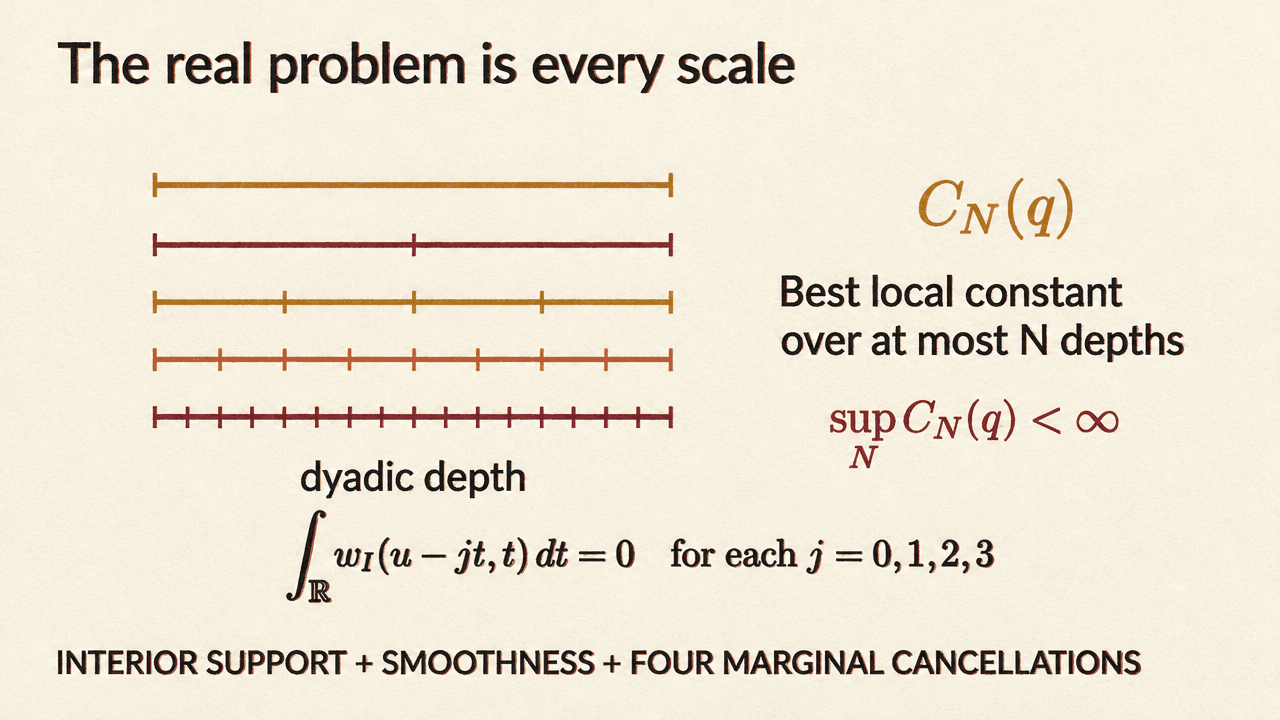
The proof reduces the problem to local four-input forms on intervals. Repeatedly halving an interval moves through dyadic depths. Let (C_N) denote the best constant controlling the local sum over at most (N) consecutive depths. A direct estimate, using maximal averages to measure local input size, gives a bound proportional to (N). That controls any finite range of depths, but provides no uniform bound as the range grows. The local kernels also have cancellation conditions along each of the four progression coordinates; the reduction depends on those conditions.
The central mechanism is to detect quadratic structure and preserve its coefficients without paying separately for every depth. A quantitative inverse theorem of Leng, Sah, and Sawhney helps detect that structure, which the paper represents with continuous quadratic charts. The proof assigns private orthogonal coordinates to selected structured functions, keeping their coefficients recoverable even when their visible parts coincide.
Several supporting estimates make that preservation useful across scales. A compression estimate controls inherited products of projections without charging for each spatial depth. The proof groups compatible curvatures and expands each matched column once; frequency graphs separate square-summable errors from persistent components. A sparse counting estimate then limits how much those components can contribute across scales. The phase identity motivates why quadratic structure matters, but these constructions and estimates—not the identity alone—are what address the multiscale problem.
Uniformity in depth is what closes the proof
After localization and a stopping argument, the paper obtains an inequality of the form (C_N \leq B+\varepsilon C_N), where (B) is finite and independent of (N), and the parameter choices make (\varepsilon\leq \tfrac12). Since the earlier estimate has already shown (C_N) is finite, the term can be absorbed to give (C_N\leq 2B), uniformly in (N).
The algebra is brief; arranging the estimates so that the parameters are independent of (N) is the hard part. The argument uses an auxiliary exponent strictly between 2 and 3. With the uniform local estimate in hand, the outer reduction reconstructs the original kernel. The fact that the auxiliary exponent is below 3 gives the required maximal-operator bound on (L^3); Hölder’s inequality and the bounded test function then yield the (L^1) estimate.
Approximation extends the operator uniquely to three (L^3) inputs. That extension is a norm statement, not an additional claim that the principal value converges pointwise for every such input.
The source states that its exact checks verified the displayed algebra, not the entire research proof, and that no matching formal proof was found in the pinned formalization catalog. Those checks are distinct from the manuscript’s theorem: the conclusion depends on the full multiscale estimates, not on the verified identity alone.