Near-Full-Measure Sets Can Avoid Every Copy of a Fixed Geometric Progression
An October 5, 2026 OpenAI manuscript claims that, for any fixed ratio between zero and one, a compact subset of the unit interval can have measure arbitrarily close to one while containing no translated, nonzero-scaled or reflected copy of the corresponding infinite geometric progression. The result concerns the entire sequence: positive measure guarantees copies of every finite prefix, but the manuscript constructs a set in which every such infinite copy has at least one term missing. Its proof organizes small holes to catch every center and scale, then uses convergence of the progression to cover centers missed by finite tests.
The theorem is about every point in one infinite copy
A set can occupy arbitrarily close to all of the unit interval and still avoid every translated, scaled, or reflected copy of a fixed infinite geometric progression. That is the claim of OpenAI’s October 5, 2026 manuscript on the geometric case of the Erdős similarity conjecture†.
The distinction is between a finite prefix and the whole sequence. A positive-measure set contains a suitably scaled copy of every finite pattern. But for the progression 1/2, 1/4, 1/8, ..., a copy of the infinite pattern requires every point to land in the set at once. The manuscript claims that this can fail even when the set has almost the full length of the unit interval.
Precisely, fix a ratio q with 0 < q < 1, and a permitted loss of length η with 0 < η < 1. The manuscript constructs a compact set E inside [0, 1], with measure greater than 1 - η, such that for every real translation x and every nonzero real scale s, at least one term x + s qⁿ, for some integer n ≥ 1, lies outside E. The missing index may differ from one copy to another; negative scales are included.
The quantifiers are part of the result: E may depend on both q and η. The claim is not that one set works for every ratio, or that the conjecture is resolved for arbitrary infinite patterns.
Small holes are organized to hit every center and scale
The proof builds the holes first. Its intermediate target is an open set H that repeats every unit and intersects every progression x + t qⁿ, for every real center x and every scale t from one to two. Its density—the length it occupies in one period—can be kept at most 6p, for any positive p below one.
This is stronger than arranging for random holes to catch a single copy. The construction has to work for every center and a continuum of scales. Its organizing device is a finite ordered tree of random choices. A point follows the first child whose table entry is one, or takes the last child by default; a separate random entry at the final leaf selects it with probability p. That keeps the expected density of the selected set at p.
The tree assigns each edge a window of sequence indices. For a stable center, earlier routing decisions remain unchanged while nearby points get fresh chances through other branches. After conditioning on the relevant entries, the probability that all the local tests fail at a fixed scale is (1 - p/2)ᴺ, where N is the number of tests. The manuscript presents this as the route to controlling failure, while noting that the independence argument behind it is technical.
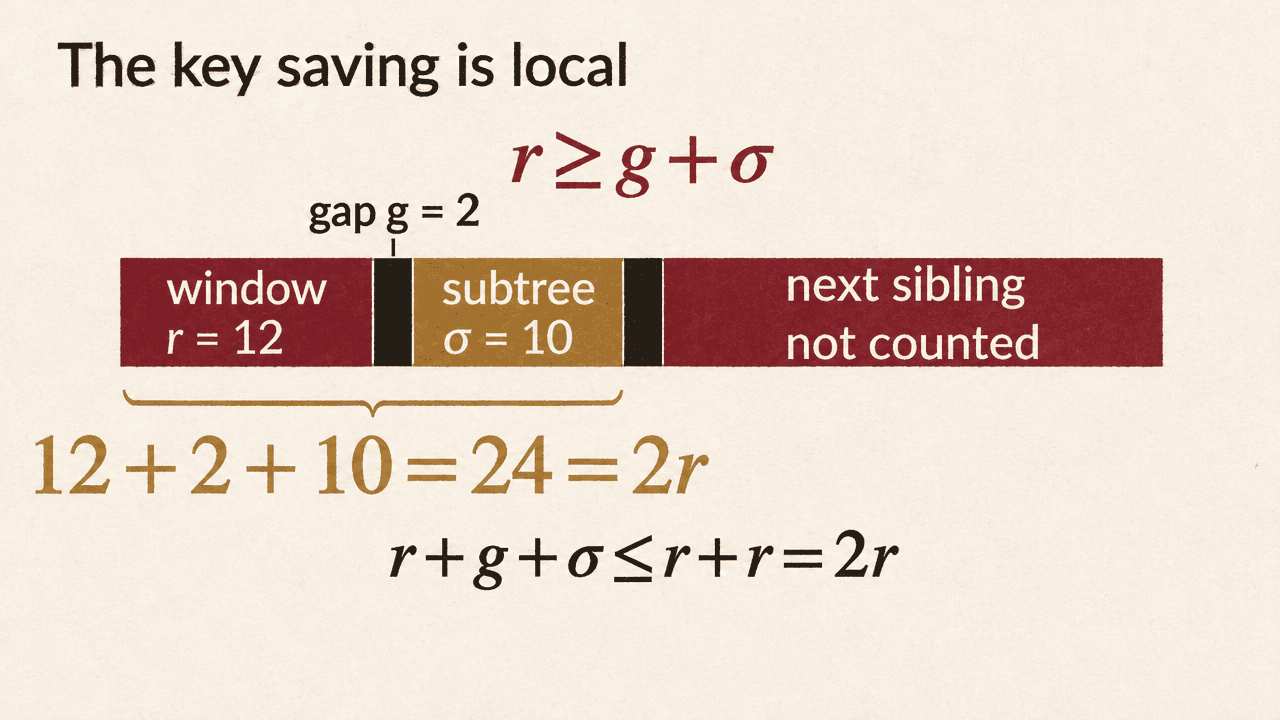
The key is to keep the number of scale checks local. An edge’s block includes its own window and, when it has a child subtree, the gap and subtree that follow it. Choosing the window long enough bounds that block by twice the window length; the next sibling lies outside it. A test therefore needs only the grids in its own block, not the finest grid used anywhere in the tree.
As the scale moves from one to two, a local grid changes at boundary crossings. The argument records those crossings, includes the endpoints, and checks a midpoint between consecutive crossings. Between those values, the local grid keys—and therefore the test outcomes—stay constant. The manuscript chooses enough branches for the failure probability to beat this local count of scales.
Convergence repairs the centers the tests miss
Finite tests do not immediately give a hitting set for every center. After slightly opening the selected cells, let R be the centers still missed at some scale among the finitely tested points. The density estimates allow the opened cells together with R to have total density at most 5p. Cover R with an open periodic neighborhood V whose density is at most the density of R plus p.
For any center x in R, openness gives an interval around x contained in V. Since t qⁿ tends to zero, x + t qⁿ eventually lies in that interval. Thus centers in R get a hit from sufficiently late terms, even if those terms were beyond the finite test windows. Centers outside R already have a tested hit. The opened cells and V together form H, which works for every center and every scale from one to two, with density at most 6p.
A summable budget extends the result to every scale
The normalized construction covers scales from one to two; the theorem needs every nonzero scale. Write each positive scale as s = 2ᵏt, where k is an integer and 1 ≤ t < 2, and use a separate periodic hitting set Hₖ for each k. Apply its hitting property at center 2⁻ᵏx and scale t; dilating the resulting hit by 2ᵏ catches a term in the original progression. For a negative scale, use the positive-scale result at center -x and scale -s, then reflect the hit.
The holes from all these sets must still leave most of [0, 1] intact. Assign scale k the budget pₖ = (η/64)4⁻|k|. For k ≤ 0, the unit interval contains an exact whole number of periods of the dilated set, so the measure removed there is bounded by its density. For k > 0, the unit interval fits inside one period, and the bound is 2ᵏ times that density. Including both signs, the total removed measure is at most 12 ∑ₖ pₖ max(1, 2ᵏ). The two geometric series give 7η/16, less than η.
Removing this open union from [0, 1] leaves a compact remainder with measure greater than 1 - η. Every translated, scaled, or reflected infinite progression with the fixed ratio q loses at least one point. The proof’s central strategy is to organize small holes so their tests can cover all centers and scales, then use convergence to repair the centers the finite tests leave behind.