A Scale-Independent L³ Bound for the Dyadic Triangular Hilbert Form
An OpenAI preprint proves a scale-independent \(L^3\) bound for a dyadic triangular Hilbert form built from three functions sharing variables around a cycle. The authors show that the sum of the absolute local contributions is at most 40 times the product of the functions’ \(L^3\) norms, regardless of which finite set of scales is used. Their proof charges each contribution to a nonnegative increase in matrix energy, then telescopes those increases across scales.
The bound does not grow with the number of scales
The manuscript proves a bound for three functions arranged around a cycle of shared variables: , , and . The overlap matters: the factors cannot be treated as unrelated averages.
At each dyadic scale, the sum runs over triples of equal-length intervals whose integer addresses have bitwise exclusive or zero. For example, addresses 3, 5, and 6 form an admissible triple because , so their three-way exclusive or is zero. On each interval, the Haar sign is on the left half and on the right. For an admissible triple , the local contribution is the integral of the three functions multiplied by their Haar signs over , divided by the common interval length.
For real-valued inputs on non-negative coordinate pairs, each measured in , the theorem says that for any finite set of scales,
Here is the set of admissible triples at scale . The constant does not depend on the number or choice of scales. Each local term may also be multiplied by its own coefficient , provided | arepsilon_I|leq 1.†
The absolute values are taken after each local integral. Cancellation within an integral still matters; cancellation between different local contributions is not needed.
Four children preserve the address rule, but their signs are correlated
The three functions form a variable-incidence cycle: each function depends on the two variables at one edge of the triangle, and together the edges close the loop. Halving all three intervals creates eight possible choices of left or right child. Only four preserve admissibility. Label left by and right by ; the surviving choices are , , , and .
For an admissible parent, its old address bits already satisfy the exclusive-or condition. The child is admissible exactly when the three newly appended bits also have exclusive or zero—that is, when an even number of them are . Equivalently, the three child Haar signs multiply to . Each admissible child has one quarter of the parent’s squared-length weight, a factor that later makes the energy accounting exact.
The four choices are not independent. Fix the first sign . The other two signs are correlated: when , they agree; when , they are opposite. But each, considered separately, is still equally likely to be positive or negative. Thus , even though the conditional average of their product is not zero.
That distinction matters in the matrix calculation. Joining two incident edge matrices as a block row gives , with no cross term between the edges. The proof can use the separate conditional averages; it does not need the neighboring signs to be independent.
A matrix energy makes each local term an energy gain
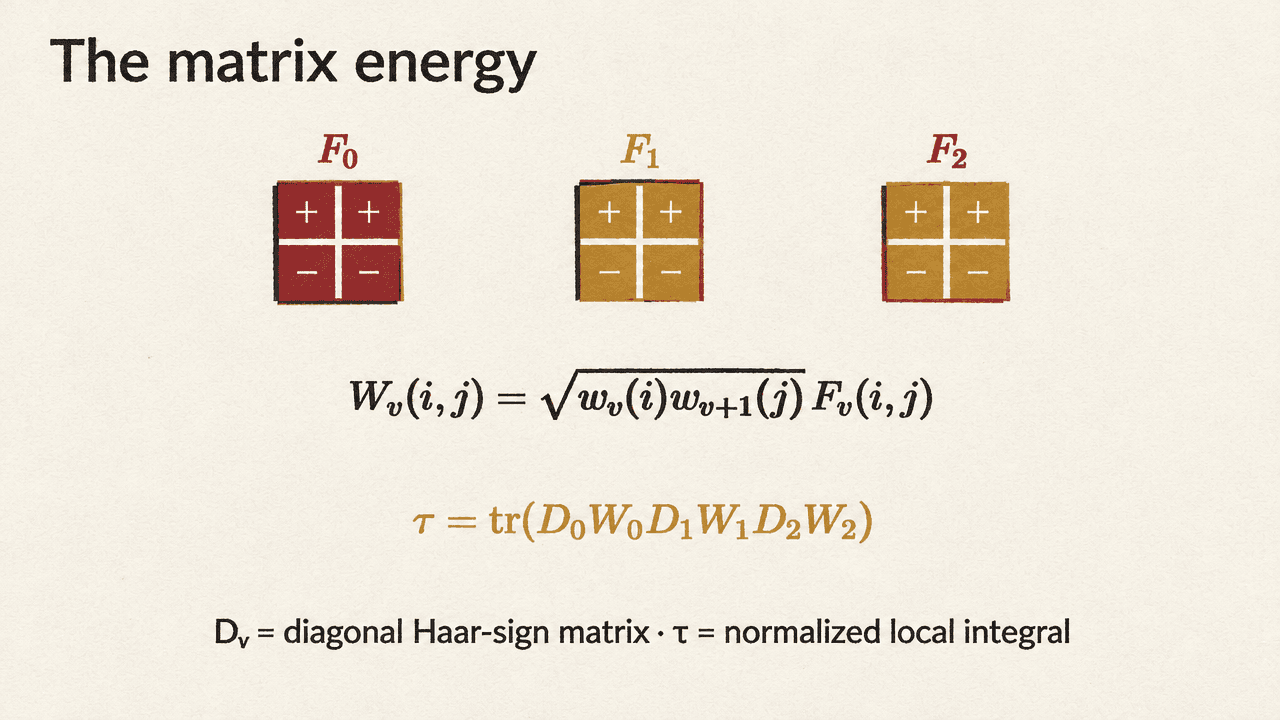
For functions constant on small dyadic squares, the proof represents their values as finite matrices , with square-root probability weights attached. A cyclic matrix trace gives the normalized local integral. At each vertex, the two incident edge matrices are joined into a block row ; its energy is
where are the singular values. The total energy is the sum of the three vertex energies.
The key proposition defines as the average energy of the four admissible children minus the parent energy. It establishes both that and that the absolute normalized local integral is at most . The argument relies on matrix convexity and a dimension-independent trace estimate; the technical matrix proof, including singular cases, is not reproduced here.
The local estimate therefore charges each normalized integral to a nonnegative increase in energy under refinement.
The scale sum telescopes into a bounded budget
The local integral is the normalized trace multiplied by the squared interval length. Define as the sum of interval energies at level , each weighted by that squared length. Every admissible child has exactly one admissible parent, and its squared-length weight is one quarter of its parent’s. Consequently, the weighted sum of energy gains at a level equals the difference between the corresponding values:
Adding these differences across consecutive levels cancels every interior term. If the chosen finite set of scales has gaps, the proof inserts the missing levels: their gains are nonnegative, so filling the gaps cannot weaken the bound. The number of scales therefore does not create a larger budget.
The endpoint is controlled by the manuscript’s estimate
The telescoping sum is bounded by the endpoint energy because each is nonnegative, so the difference between the coarse and fine endpoints cannot exceed the coarse endpoint. The stated reason for the estimate on is local: each row energy is controlled by its two incident edge sizes; each edge is counted twice; and any two interval addresses determine the third uniquely.
Combining the local factor with the endpoint factor gives times the sum of the three cubed input norms. Normalize each nonzero input to have norm one. That sum is then three, yielding
The result is for the dyadic model
The final step extends the estimate from dyadic step functions to arbitrary real inputs. The required approximation must control the sum of the absolute local contributions. Convergence of only a signed total would not suffice; a one-scale estimate ensures convergence in the absolute-sum norm.
This is a theorem about the dyadic model, not a proof of the distinct continuous triangular Hilbert transform estimate. Its mechanism is the combination of four admissible children, a matrix energy that accommodates their correlation, and a telescoping sum across scales. Finite checks illustrate these constructions but do not certify the general theorem.