Bochner–Riesz Multipliers Are Bounded on L³ for Every Positive Smoothing Order
An OpenAI preprint argues that in three dimensions, the Bochner–Riesz multiplier is bounded on \(L^3\) for every positive smoothing order \(\delta\), though the bound need not stay uniform as \(\delta\) approaches zero. Its proof uses cancellation in oscillatory wave packets to improve the decay of the operator on distant spatial shells; summing those bounds gives the result. The manuscript also derives a strict range of bounds for other exponents, but does not establish the sharp-cutoff case.
At p = 3, any positive smoothing gives a bound
The manuscript’s central claim is that in three dimensions, the Bochner–Riesz multiplier is bounded on L³ for every fixed smoothing order δ > 0. The bound may depend on δ, but not on the input function. It does not claim that the bound remains uniform as δ approaches zero.
For a smooth, rapidly decreasing function f, the operator takes its Fourier transform, multiplies it by (1 − |ξ|²) raised to δ inside the unit frequency ball, and transforms back. Outside the ball, the multiplier is zero; inside, it fades toward the boundary. The theorem asserts that ||Tδ f||₃ ≤ Cδ ||f||₃.
The challenge is that the corresponding convolution kernel oscillates. Far from the origin, it has two oscillating components whose amplitudes are bounded by a constant times r⁻²⁻δ. On a physical-space shell of radius λ, the volume is on the order of λ³. If one ignores oscillation, the resulting shell estimate grows like λ¹⁻δ, whose sum over doubling shells converges only for δ > 1. The proof must use cancellation to recover nearly one additional inverse power of the radius.
Cancellation has to account for both geometry and phase
The first stage controls geometric growth while setting oscillation aside. The manuscript models a particle with two-dimensional position A and velocity V; at time c, its position is A + cV. It tracks what increasingly fine rectangular observations reveal about the particle. An information-based score rewards resolution, charges for particle information, and accounts for uncertainty in time.
A key geometric input is the Ren–Wang planar Furstenberg theorem, adapted to weighted projections. In broad terms, sufficiently spread-out points and directions cannot all produce tiny projections. The argument treats both nearly round and eccentric observations, including a special case in which two resolution rates coincide.
Geometry alone is not enough. Wave packets have phases, so their amplitudes can reinforce or cancel: two unit amplitudes can sum to 2, with squared magnitude 4, or cancel to zero. In either case, adding their separate squared magnitudes would give 2. The packet argument therefore cannot replace oscillatory sums with positive particle counts.
The manuscript uses finite packet decompositions and controls their tails, distinguishing a retained superposition from the full packet class assigned to it. At an uncertainty boundary, an earlier packet may not be localized finely enough to identify a later position cell; the missing precision is tracked as fine velocity information. This bookkeeping links projection geometry to cancellation and ultimately controls a cubic sum, matching the L³ norm.
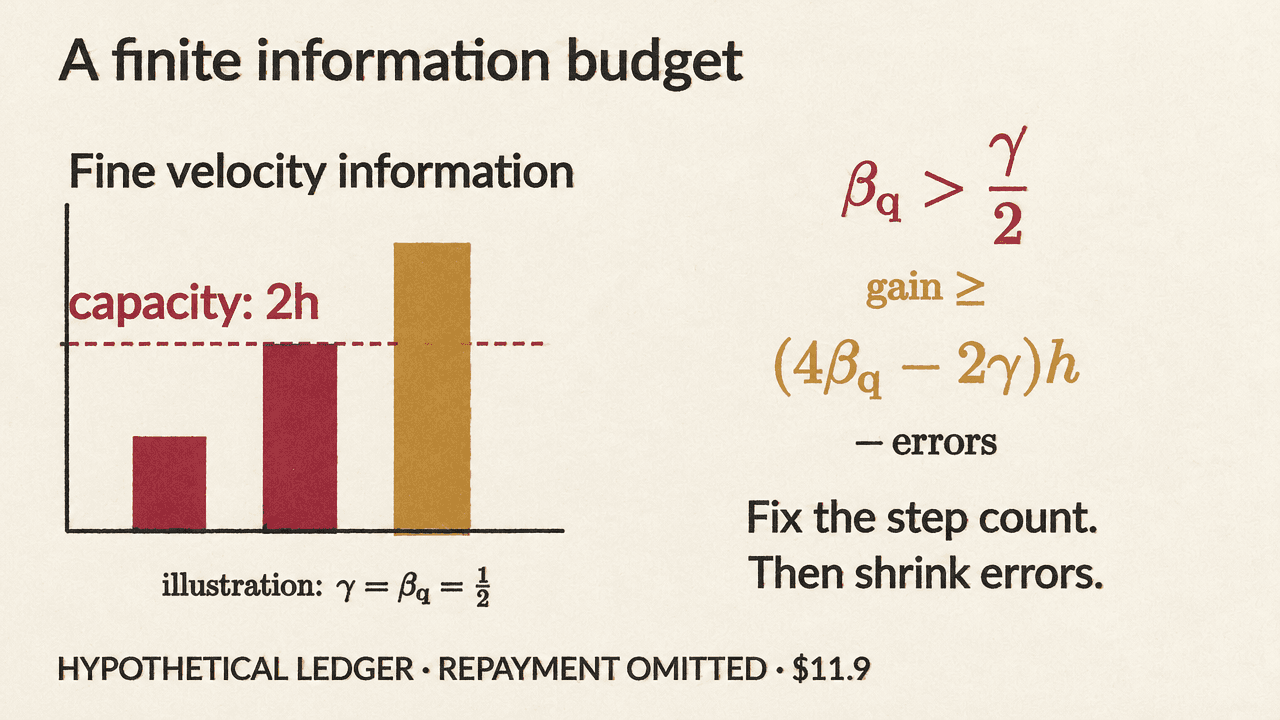
The contradiction behind the packet-growth bound uses a tuning parameter 0 < γ < 1 and step length h. Suppose the maximal score growth rate βq exceeds γ/2. Each backward step would then add roughly (4βq − 2γ)h to a ledger of fine velocity information, while the ledger’s capacity is at most 2h, apart from controlled errors. Fix enough steps first, then make the errors small: the supposed growth would require more information than the ledger can hold. This yields βq ≤ γ/2. The one-step repayment estimate that makes the ledger valid is a technical part of the argument.
A small loss turns shell decay into convergence
The packet theorem gives an oscillatory estimate with an arbitrarily small positive loss ν. For fixed admissible phase and amplitude classes, the manuscript bounds the L³ operator norm by Cν λ⁻¹⁺ν. It checks that the estimate applies uniformly across shells, including after changing variables for the distance phase and modifying the phase outside the integration region.
Rescaling a shell to unit size makes the factors visible. The kernel amplitude contributes λ⁻²⁻δ, the shell volume contributes λ³, and oscillation contributes λ⁻¹⁺ν. Together they give λ⁻δ⁺ν; the input and output dilation factors cancel in the operator norm.
For any fixed δ > 0, choose ν = δ/2. At doubling radii λ = 2ʲ, the shell norms are bounded by a constant times 2⁻ʲδ/². These bounds form a convergent geometric series. The triangle inequality controls finite sums of shell operators, and the same series bounds the remaining tails, so the shell sum converges in operator norm. The central kernel piece is bounded because it is integrable. The manuscript identifies the resulting operator with the Fourier multiplier on smooth, rapidly decreasing inputs, then extends the bound to all of L³ by density.
At δ = 0, the argument loses its positive margin: there is no longer a choice of ν with 0 < ν < δ. The result therefore does not establish boundedness for a sharp spherical cutoff.
Interpolation gives a strict range, not its boundary
The manuscript also derives bounds for other exponents using complex-order estimates, analytic interpolation, and duality. Its stated range is strict: for 3/2 ≤ p ≤ 3, every δ > 0 is included; at p = 1 or p = ∞, the condition is δ > 1. The boundary of the stated region is not asserted. The classical order-zero obstruction remains, apart from the separate case p = 2.
The final step is concise, even if the estimates leading to it are not: control packet growth with an arbitrarily small loss, choose that loss below the smoothing order, and sum the resulting shell bounds. That summation establishes the claimed bound for every positive smoothing order; it does not supply the technical estimates needed to earn the shell decay.