Fourier Extension on the Sphere Is Bounded for Every p Above Three
An OpenAI preprint establishes an \(L^p\) bound for the Fourier extension of bounded complex data on the three-dimensional unit sphere when \(p>3\). A constant-data example shows that the estimate fails at and below the cubic threshold. For the positive result, the manuscript controls wave-packet concentration through elliptic-capacity estimates and a selection argument that retains more than any fixed negative power of the scale, asymptotically, without assuming velocity and position are independent.
The estimate holds above, but not at, the cubic threshold
The manuscript’s main claim is an Lp bound for the extension of bounded complex data on the unit sphere in three dimensions. If g assigns a complex weight to each direction, the extension operator adds the corresponding waves, including their phases, across space. For every real p greater than 3, the manuscript says that the Lp norm of Eg is at most Cₚ times the L∞ norm of g, where Cₚ depends only on p. The result applies to bounded measurable complex weights, not only to smooth or positive data.
The strict inequality matters. Set every weight equal to one. By rotational symmetry, the resulting extension depends only on distance r from the origin. Integrating the sphere in horizontal slices gives 2 sin(2πr)/r, with limiting value 4π at the origin. In the Lp integral, spherical shells contribute a factor of r², leaving a tail involving r to the power 2 − p times an oscillating sine factor. The oscillation cannot make that tail converge at p = 3: on a fixed fraction of each period, the absolute sine is at least one-half. The endpoint diverges logarithmically, and smaller exponents diverge as well. The source’s plot of this constant-density example shows the damped oscillation against radius; the calculation explains why the theorem starts above three, but does not establish the bound for arbitrary g.
Propagation controls concentration without assuming independence
To reach the positive result, the manuscript turns to wave packets. On a small patch of the sphere, a frequency label determines a packet’s velocity and a position label determines its starting point. The packet center follows a straight line; the parameter t is a spatial coordinate, not physical time. Curvature separates velocities, but many packets may still pass through the same region. The issue is to control repeated concentration without treating complex phases as independent or discarding interference.
The geometric statement uses ellipses to measure concentration. If an ellipse has long radius L and short radius W, its capacity weight is LW times a small positive power κ of its aspect ratio, with κ less than one-tenth. This is area-like, but gives an eccentricity bias. A joint test asks whether a velocity lies in one translated ellipse and its starting position in another. The ellipses share shape and orientation, but their centers are chosen independently. Crucially, the hypothesis bounds the probability of each such joint event; it does not assume the velocity and position have independent distributions. Their remaining correlations can be arbitrary.
There is also a time-distribution condition. At every dyadic depth, after conditioning on a label that fixes the line, the number of occupied time bins and the largest bin probability must satisfy matching power bounds, with an exponent s that is positive and at most one. Given these assumptions, the theorem selects a sublaw of the original distribution. It retains more than any fixed negative power of the scale M, asymptotically, and on that retained mass gives stronger bounds for terminal time bins and ellipse tests. The velocity ellipse keeps its size; the position ellipse is shrunk by 1/M. The available exponents lie strictly below 1 + 2s − 10κ, provided the time error is sufficiently small; the allowed input and output widths differ.
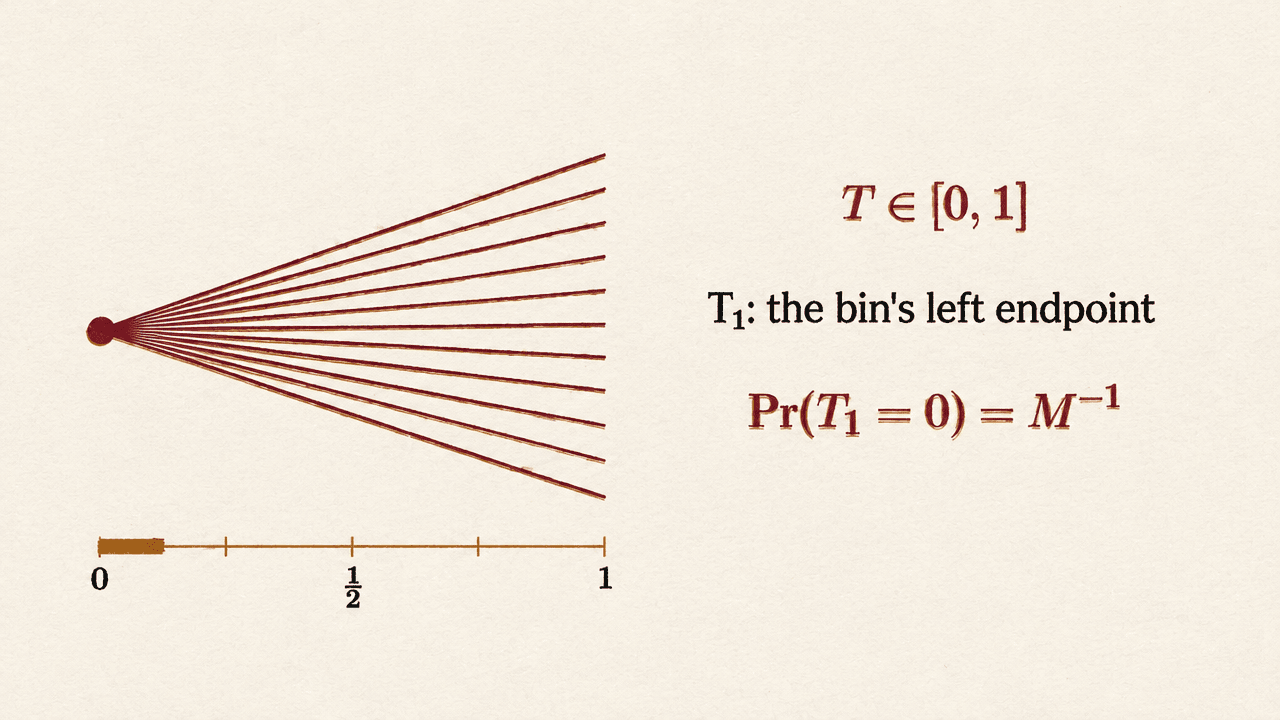
The selection is not cosmetic. In the source’s schematic illustration, velocities are uniform on a unit disk, every line starts at zero, and time is uniform and independent. In the first time bin, using its left endpoint puts every line at the origin. A unit-velocity test then captures probability 1/M, too much concentration for a near-cubic gain. Retaining only times from one-half to one keeps half the mass. At such a time, landing in a position ellipse shrunk by 1/M restricts velocity to an ellipse shrunk by 1/(Mt). Its area is reduced by the square of that factor, giving a bound of at most four times M to the power −3 times the original area-like weight. This illustrates why the theorem needs to pass to a sublaw; it is not a proof of the general result.
Packet estimates turn the geometric gain into a global norm
The proof connects geometric propagation to oscillatory waves through exact analysis and synthesis maps and a norm combining capacity with squared-coefficient mass. The packet theorem is stated for arbitrary finite complex arrays with fixed phase, windows, and complexity bounds. Coordinate masks may remove whole coefficients, but not selected terms within a retained coefficient. An extremal selection argument produces the conditional time distribution needed for the geometric result.
One local estimate shows how the concentration losses cancel. After normalization, set a = M to the power 1 − s. Capacity contributes a times the square root of h, where h is a positive amplitude parameter. A second-moment estimate bounds the remaining mass by 1/a², while refined decoupling gives a second bound, 1/h. Taking the smaller bound and setting z equal to the square root of h divided by a, the product is min(z, 1/z), which is at most one. The time-support deficit therefore cancels, leaving a small scale loss depending on κ.
That local control is only one part of the argument. The manuscript converts packet estimates into cubic estimates on separated balls, then uses sparse covering to bound the volume where a normalized patch extension exceeds a sufficiently small threshold μ by a constant times μ to the power −3 − α. For p greater than 3, one can choose α positive and smaller than both 1 and p − 3, so layer integration converges near zero. At other thresholds, the argument uses a uniform L4 estimate and then a uniform pointwise bound. Together, these steps yield the global Lp estimate.
The manuscript also derives diagonal estimates on the sphere. Its broader surface application is a separate companion result.