Every Sufficiently Large Degree Admits an Ultraflat Real Littlewood Polynomial
An OpenAI manuscript dated October 5, 2026, claims that for every sufficiently large length \(N\), one can choose \(+1\) and \(-1\) coefficients so that the resulting real Littlewood polynomial has modulus uniformly as close to \(\sqrt N\) as desired at every point on the unit circle. The paper’s argument first builds a nearly flat continuous wave, then uses its energy to show the wave’s Fourier coefficients are close on average to signs and a discrepancy lemma to round them with uniformly controlled error.
The theorem requires the modulus to stay flat everywhere
A real Littlewood polynomial has coefficients chosen from (+1) and (-1):
“Real” describes the coefficients; on the unit circle, the polynomial’s values are generally complex. As (z) travels around that circle, its powers rotate at different speeds, and their signed contributions interfere. The question is whether the length of their sum can remain almost constant throughout the rotation.
The four-term example (1+z+z^2-z^3) does not: its modulus rises and falls. It illustrates the problem, not a solution.
There is an exact reason to expect a flat modulus to sit near (\sqrt N). Expanding the squared modulus pairs every term with every other term. The (N) diagonal pairs contribute (N); each off-diagonal pair contains a nonzero integer power of (z), which averages to zero over a complete turn. Thus, for any choice of signs,
This is Parseval’s identity in this setting. The average squared modulus is automatic. The hard part is keeping the modulus uniformly close to (\sqrt N), rather than allowing it to fluctuate while preserving the same average.
The October 5, 2026 manuscript claims that for every tolerance (\epsilon) between 0 and 1, there is a cutoff (N_0(\epsilon)) such that every integer (N) at least that large admits signs with
at every point of the unit circle. Both bounds apply to the same polynomial, including at (z=1) and (z=-1). The signs can be chosen afresh for each length; the polynomials need not be successive prefixes of one infinite sequence. The relative error can be made arbitrarily small.†
A nearly flat wave creates coefficients that can be rounded
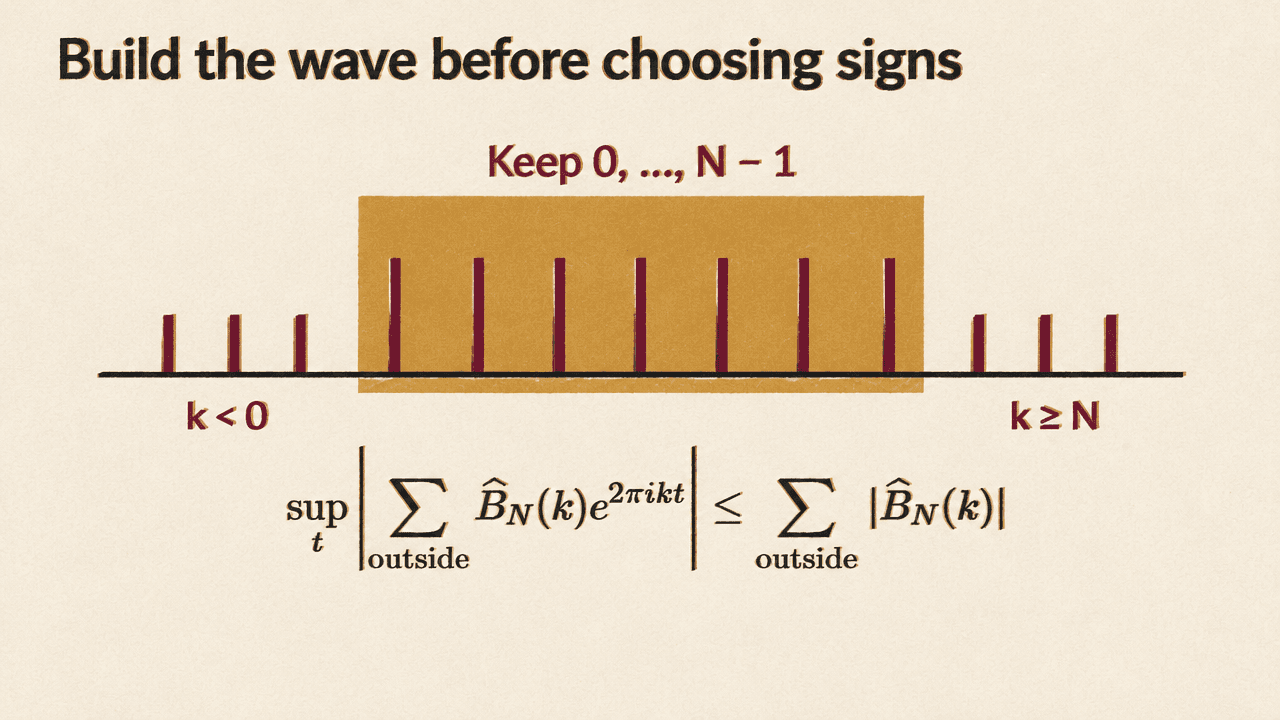
Rather than guess a successful sign pattern, the proof first constructs a continuous complex-valued wave (B_N(t)). Its modulus must stay close to 1 everywhere; its Fourier coefficients at indices 0 through (N-1) must be real and bounded in size by roughly (1/\sqrt N); and the sum of the absolute values of all coefficients outside that range must be small.
That last condition controls the discarded frequencies uniformly. Removing them changes the wave by at most the sum of their coefficient magnitudes—not merely by a small amount on average.
The construction uses an auxiliary real trigonometric polynomial on a higher-dimensional torus. Its coefficients are balanced against positive frequency weights, and each supplies an oscillating wave on a short arc. Stationary phase identifies the leading contributions: after scaling by (\sqrt N), their combined sum is a value of the auxiliary polynomial multiplied by a factor between 0 and 1. Controlling the combined sum, rather than adding the absolute sizes of all its terms, is what keeps the construction bounded. The auxiliary construction and interval-packing lemma are technical inputs; the source presents this step as a roadmap, not a proof of those inputs.
At arc endpoints, fading the wave to zero would violate the lower bound on its modulus. Instead, the construction keeps the modulus constant while increasing the phase curvature, making endpoint contributions small through oscillatory-integral estimates. Across gaps, it matches wave values and leading phase derivatives, which cancels first boundary terms in an integration by parts. A second integration bounds what remains and gives a small exterior Fourier tail. These estimates are presented as part of the technical route, not worked out in full.
The wave’s energy bounds the cost of rounding
Once the retained Fourier coefficients are rescaled to real numbers (Y_k) in ([-1,1]), the proof gets a short averaging step. The wave’s lower modulus bound and small discarded tail imply, through Parseval, that the average of the (Y_k^2) is at least (1-r), for a small energy deficit (r).
For any number (Y_k) in this range, (Y_k^2\leq |Y_k|), so
Averaging gives
The manuscript calls half the total distance from the nearer sign the defect, (\mu). Consequently, (\mu/N\leq r/2): on average, the coefficients are close to signs.
That conclusion is limited: it does not say every coefficient is close to a sign. Nor is it enough to round each coefficient independently to its nearer sign. Individual errors could accumulate around the circle.
Joint rounding turns average defect into uniform control
A discrepancy lemma is used to choose signs jointly and bound the resulting error uniformly around the circle. Writing (q=\mu/N), the source gives a normalized error bound of an absolute constant times
The second term tends to zero as the relative defect (q) tends to zero. If (q=0), the coefficients already are signs, so no rounding error is needed. The lemma also includes an analytic step to pass from a finite grid to the entire circle; sampling alone would not establish the uniform bound.
The choices must be made in order. First, given (\epsilon), choose the construction parameter (\delta) small enough to control rescaling error and relative defect. Next fix the auxiliary dimensions, intervals, and leading phases. Then take (N) sufficiently large to control the remaining errors. Uniformly close complex values have uniformly close moduli, by the reverse triangle inequality, so the rounded sign polynomial inherits both bounds. The source directly demonstrates the averaging and defect steps; the technical construction and joint-rounding lemma supply the remaining route to the manuscript’s claim.