A New Falconer Theorem Claims Positive-Measure Distances Above d/2
An OpenAI manuscript dated September 23, 2026, claims that any compact set in ℝᵈ with Hausdorff dimension greater than d/2 determines a set of distances with positive Lebesgue measure. The result addresses the unpinned Falconer distance conjecture in every integer dimension d ≥ 2, but does not cover the equality case or distances measured from a fixed point. The proof combines frequency estimates with a multiscale argument to obtain a distance measure with an integrable density.
The theorem asks how much dimension is enough
For a compact set E ⊂ ℝᵈ, with integer d ≥ 2, the September 23, 2026 OpenAI manuscript claims that dim_H E > d/2 implies that the set of distances between pairs of points in E has positive Lebesgue measure.† Positive measure means positive total length; it does not mean the distance set contains an interval.
| Condition | What the manuscript claims |
|---|---|
| Set | Compact E in ℝᵈ |
| Dimension | Hausdorff dimension strictly greater than d/2 |
| Conclusion | The unpinned distance set has positive Lebesgue measure |
| Not asserted | The equality case or the result with one endpoint fixed |
The strict inequality matters: the theorem makes no claim at dimension d/2. It is unpinned, meaning both endpoints may vary; it does not establish the same conclusion when one endpoint is fixed. The stated result assumes no product structure, regular density, or Fourier decay.
The proof ultimately needs to turn geometric information about E into a measure on its distances with enough regularity to force positive length. Its intermediate frequency-shell estimates are the bridge: they control the distance measure at successive frequency scales, before a reconstruction argument combines those scales.
The frequency estimate is borderline, so scale bookkeeping matters
Choose an exponent s strictly between d/2 and dim_H E. Frostman’s lemma supplies a probability measure on E whose mass in any ball of radius r is at most a constant times rˢ. This turns dimension into a quantitative limit on concentration at small scales.
The construction uses two separated pieces carrying such measures. Auxiliary projections help control directions, but the final distances are still measured between original points in the original space. In odd dimensions, an exceptional affine-plane case is handled separately using a classical distance estimate.
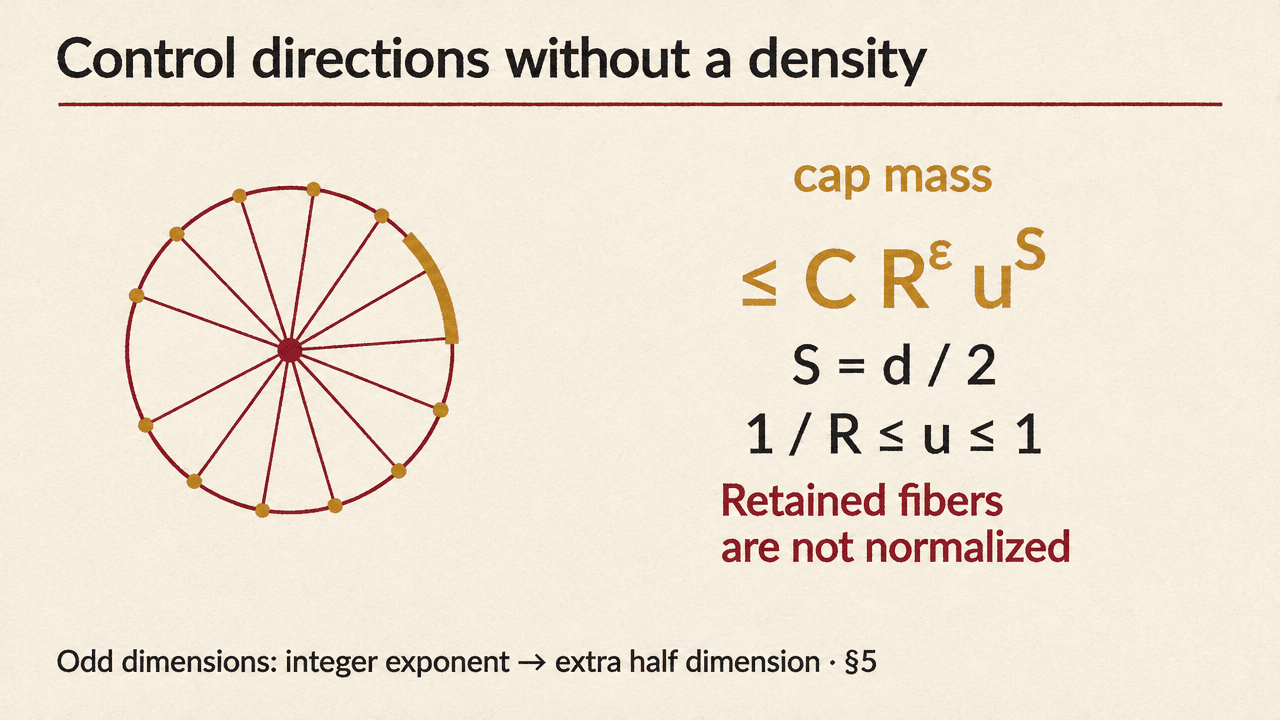
Looking outward from a point gives a distribution of directions on a sphere. In higher dimensions, that distribution need not have a surface density, so the proof instead bounds how much mass enters a small spherical cap. After carefully bounded deletions of pairs, it obtains a cap-mass estimate with exponent s = d/2, up to a small scale-dependent loss. Odd dimensions require an additional half-dimensional improvement.
That cap bound feeds a Fourier estimate connecting directional control to projection tests. The frequency power is B^(d−2s); at the critical value s = d/2, it becomes B⁰ = 1. In practical terms, each frequency band costs a constant rather than a positive power of its scale, so summing across bands costs a logarithm. This is a borderline estimate, not a claim of Fourier decay.
The exponent calculation is (d−S) + (−S) = d−2S, with S = d/2, so B^(d−2S) = 1. Later in the proof, additional profile estimates produce decay on each distance-frequency shell; the borderline cap estimate and that later shell decay are distinct steps.
The profile bookkeeping addresses a different difficulty: mass can behave irregularly from one scale to the next. The paper divides measures into almost-uniform dyadic classes. Write R = 2ᴺ and u = n/N for normalized depth. A typical occupied cube at that depth has mass approximately R^(−m(u)). Subtracting the critical baseline Su, where S = d/2, gives the excess profile Aₙ = m(n/N) − S n/N. The excess may rise and fall, so a single low point cannot pay for every recursive cost. Instead, the argument tracks a minimum over two sufficiently separated depths:
V([a,t]) = min(Aᵢ + Aⱼ), over a ≤ i < j ≤ t with j − i ≥ 10q₀.
Here q₀ is the depth-block size. The separation requirement makes the potential reflect behavior at two distinct scales, rather than letting one favorable depth stand in for both.
A recursive cost is paid by a drop in the two-depth potential
In the suffix reduction, a parent interval runs from a to t, while its child runs from a to p. The cost is Aₚ minus the minimum of A between p and t. The point p is chosen to minimize A on a prescribed inner interval.
Take any admissible child pair i, j, separated by the required gap. That separation puts j inside the inner interval, where Aⱼ ≥ Aₚ. Replacing j by p therefore cannot increase the sum or violate the gap. Now choose r where A is smallest from p through t, and replace p by r. Since r is no earlier than p, the pair remains admissible for the parent, and its sum falls by exactly the cost.
The parent’s minimum is no greater than that new sum. Rearranging shows that the cost is at most the child potential minus the parent potential. Across repeated steps, the potential differences telescope:
C₁ + C₂ + C₃ ≤ (V₁ − V₀) + (V₂ − V₁) + (V₃ − V₂) = V₃ − V₀.
The local inequality shows how a recursive cost can be paid from a potential drop. It is one bookkeeping step in the proof, not a replacement for the analytic estimates that produce the recursive cases.
Shell decay supplies the measure with positive length
For the two starting profiles, the proof takes the last depth where either excess is at most a small positive level β. Beyond it, both profiles stay above β, apart from a vanishing boundary error. Each two-depth potential then contributes about 2β, while the entry cost is at most about β. A graph estimate and two single-profile bounds cancel the other profile terms, leaving a negative exponent. With technical losses chosen small enough, the manuscript obtains decaying Fourier energy on each distance-frequency shell. Stationary phase, the graph estimate, and other recursive cases also contribute to this step.
Different frequency shells use different retained measures. The paper constructs decreasing positive distance measures αₙ with a nonzero limit. Their shell approximants have summably small total-variation errors, and the square roots of their shell energies are summable. A monotone shell lemma then yields an absolutely continuous limit even without a quantitative rate for the decrease.
Positivity matters because the mass removed at each stage is nonnegative, and the successive losses telescope to a finite total. Smooth Fourier cutoffs organize those losses. The limit has an integrable density, so a nonzero such measure cannot be supported entirely on a set of zero length. Since it is carried by the original distance set, that set has positive length.