Koebe’s Circle-Domain Conjecture Holds Without Boundary or Countability Assumptions
An OpenAI manuscript claims to prove Koebe’s circle-domain conjecture: every non-empty connected open region on the Riemann sphere is conformally equivalent to a domain whose complementary components are round disks or points, without assumptions on boundary smoothness or the number of components. Its central challenge is showing that finite approximations by round holes do not acquire non-round defects in the limit. The proof combines energy estimates, path-based controls and a contour argument to rule out those defects; the manuscript establishes existence, not uniqueness or convergence of arbitrary finite approximations.
Finite roundings do not guarantee a round limit
OpenAI’s September 23 manuscript claims an affirmative answer to Koebe’s circle-domain question: every non-empty connected open region on the Riemann sphere can be mapped conformally to a circle domain, even without smooth boundary or a countability bound on its complementary components. In a circle domain, each missing component is a closed round disk or a point.†
“Conformal” here means a one-to-one holomorphic map with a holomorphic inverse. It preserves angles locally, not necessarily lengths. The sphere is the complex plane together with infinity.
The obstacle is not rounding finitely many holes. The finitely connected case is classical. The harder question is what happens as finite approximations converge. Track one hole through a sequence of roundings: its disks may converge, along a normalized subsequence, to a round disk, possibly of radius zero. But the entire missing component in the limiting region might be larger than that disk, with an extra protrusion. A tracked disk D can sit inside a larger component K. Round finite stages alone do not rule this out. Nor do they ensure that untracked components collapse to points.
The proof therefore has two boundary problems to solve: every unmarked component must become a point, and every marked component must equal its tracked disk—not merely contain it.
A topological quotient keeps the boundary defects in view
The argument separates bookkeeping from complex analysis. It collapses each complementary component to a label, producing a topological sphere whose boundary labels form compact, totally disconnected dust. That dust may be uncountable. The collapse does not define the conformal map: the original complex geometry inside the region remains in place, where the proof constructs analytic tests.
Those tests have finite Dirichlet energy, meaning the integral of the squared gradient over the region is finite. They also have square-summable bounds on how much their values oscillate near the holes. A further compatibility condition controls how new level sets meet continua from earlier levels at the dust.
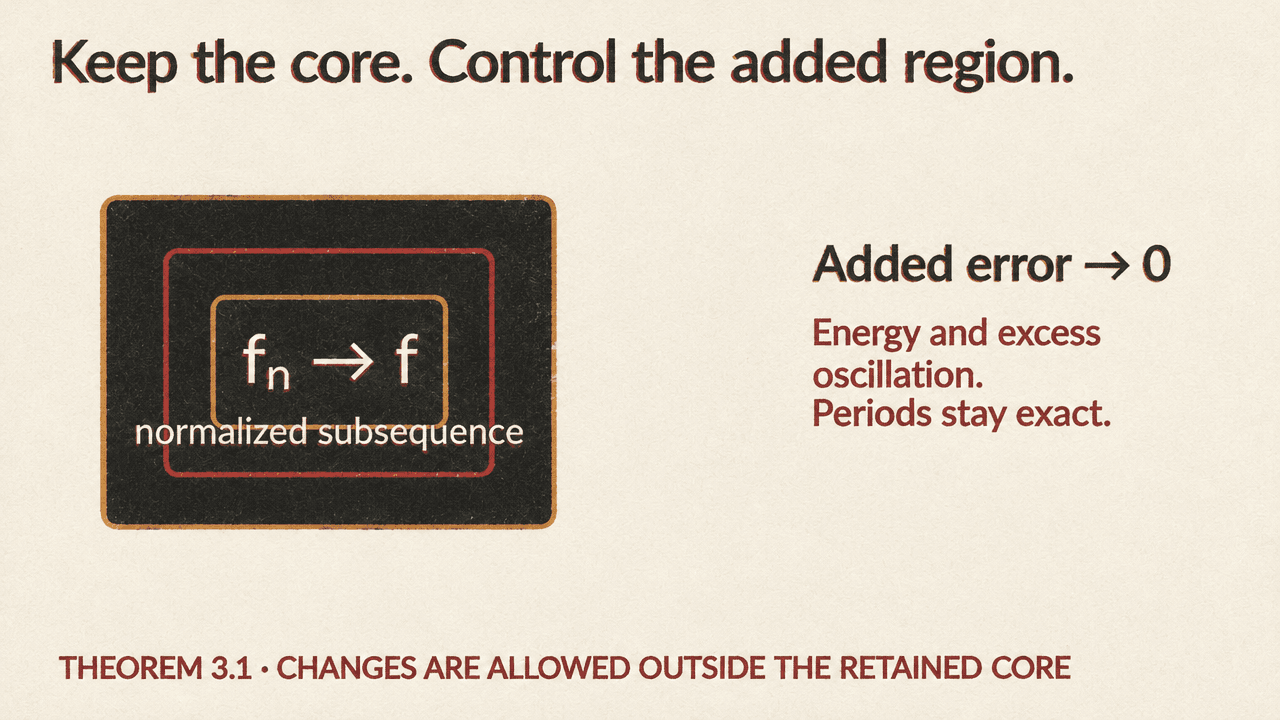
A transfer theorem uses these tests to build finite completions. On a compact core, it preserves the original conformal structure and finitely many tests exactly. Outside the core, it permits a new conformal structure on a finite completion, while making the added energy and excess boundary oscillation arbitrarily small. Periods remain exact.
The completed finite surface can be uniformized to a circle domain. Then the core is enlarged and the process repeated. Uniform bounds and normalization yield a non-constant, one-to-one subsequential limit. Because every fixed compact set is eventually retained inside an unchanged core, the limit is holomorphic in the original structure.
That establishes compactness, but not yet the desired boundary shape. The remaining tests must prevent defects from surviving in the limit.
Energy and boundary oscillation put a price on barriers
A local estimate explains why the tests can rule out defects without counting how many holes there are. Consider a smooth, finite-energy function on a finite circle domain containing infinity. Suppose its cluster values near each hole lie in an interval of width at most Aᵢ. For a segment that starts where the function is zero and ends where it is one, the total change must be paid for in two ways: by integrating the gradient along the portions inside the domain, and by crossing holes whose oscillations contribute at most their respective Aᵢ.
Now take parallel segments inside the same radius-L ball, indexed by a measurable set J of transverse positions. A disk of radius rᵢ is hit across an interval of width 2rᵢ, so its contribution is at most 2rᵢAᵢ. Tangencies and point-holes contribute zero measure. Since the disk interiors are disjoint and lie inside the radius-L ball, the sum of their squared radii is at most L². Cauchy–Schwarz therefore bounds the total hole contribution by 2L times the square-summed oscillation norm.
For the gradient contribution, integrating over the parallel lines converts the line integrals to an area integral. The relevant area is at most πL²; Cauchy–Schwarz bounds the result by √πL times the energy norm, where the energy norm is the square root of Dirichlet energy. Together, the estimate is:
There is no factor for the number of holes. If a hypothetical nontrivial limiting component required barriers across a fixed positive-width interval, the estimate would forbid their energy and oscillation budgets from tending to zero. The order matters: first take the finite-transfer limit for each fixed barrier; only then shrink the barrier norms. A fixed positive width cannot vanish.
Path probabilities leave only countably many exceptional ends
If no small compatible barrier exists, a probability law on paths supplies controlled average length density and square-summable hit probabilities. A hit probability is the chance that a path visits a component at least once; repeated visits are controlled separately on a prescribed countable set. Fusion provides control over the entire dust, not merely selected countable tests.
The argument pairs this probability control with a topological obstruction. Suppose two distinct ends, p and q, both resist small barriers. Take two paths to each end. As the paths approach their endpoints, consider the last time each visits a boundary collar. These last visits alternate around the collar, while the remaining path tails stay inside it. Joining each pair of paths through its shared endpoint forces the two connections to intersect.
The intersection contradicts the quantitative bounds if there are too many ends resisting small barriers. The argument therefore leaves a countable exceptional set S. Outside S, small barriers are available to collapse components to points. The path bookkeeping, fusion, and intersection estimates are part of the larger proof; the local barrier estimate above does not establish them by itself.
A contour test rules out protrusions beyond marked disks
Marking the exceptional ends does not by itself settle their components. For a marked end, the limiting component K might still extend beyond its tracked disk D. One possible way to exclude the excess is another small barrier. Otherwise, the proof uses averaged winding indices to construct a period-one coordinate: a counterclockwise turn adds one to the coordinate u, while its differential remains single-valued. The energy and nonsingular boundary-oscillation budgets can be made small away from the marked end; the marked budget remains one.
The contour test compares two bounds on the same finite-stage integral. It follows a retained contour around the finite-stage disk Dₙ, weighting the differential of the transferred coordinate by distance from Dₙ. Here, the transfer differential is the differential of that coordinate on the finite completion.
Suppose the finite-stage maps and disks converge to a bad pair: K protrudes beyond D. The protrusion contains a closed window separated from D by a positive distance d. The construction of the test forces the lower limit of the integral above d/2. But a Stokes estimate puts the upper limit of its absolute value below d/4. These bounds cannot both hold, so that bad limiting pair is excluded.
Each test excludes a neighborhood of bad pairs; a countable selection excludes them all. The resulting boundary conclusions are exact: outside S, every component is a point; at each marked end, the component is precisely its tracked round disk, possibly a point. These account for all complementary components, so the limiting image is a circle domain conformally equivalent to the original region.
The manuscript’s conclusion is existence—not uniqueness, and not a guarantee that arbitrary finite approximations will have the right limit. The explainer gives a local barrier estimate and outlines how the larger proof controls limiting boundary defects; it does not reproduce that full proof, and formal verification was not independently run.