Irrational Levels Yield a Global Quantum Langlands Equivalence
An OpenAI manuscript claims a global equivalence between the full twisted D-module categories for a simple complex group and its Langlands dual at every irrational complex level, with the two parameters related by a negative reciprocal scaled by the groups’ lacing number. The authors’ argument uses irrationality to eliminate local modes that would otherwise survive, then combines a categorical cutoff with reconstruction and global comparison results to establish the equivalence. The local calculation is only one part of that proof.
Irrational twisting is the condition behind the claimed equivalence
At every complex level outside the rationals, the manuscript claims an equivalence between the full twisted D-module categories for a group and its Langlands dual, with the parameters related by a negative reciprocal. The irrationality condition matters: in the local calculation that supports the argument, it prevents any integer mode from becoming invariant under the twist. The manuscript’s global equivalence depends on additional reconstruction and comparison results, not on that calculation alone.†
The theorem concerns a smooth, projective, connected complex curve X and a connected simple complex algebraic group G. It compares the twisted derived category of D-modules on Bun_G(X) with the corresponding category for the Langlands dual group G∨, changing the parameter from c to −1/(rc). Here r, the lacing number determined by root lengths, is 1, 2, or 3, and c may be any complex number outside the rationals.
These categories concern principal bundles and their symmetries. Their derived structure retains homological information as well as differential-equation data. The claim is about the full categories, including all components—not selected objects or a single component.
The setup retains the given global forms of the groups: the dual is determined by the full root datum. Fixed pinnings and a theta characteristic normalize the construction. The parameter also has a shifted-level convention: the determinant exponent is s = (c − h∨)/(2h∨), where h∨ is the dual Coxeter number. A complex exponent specifies twisted differential operators; it does not require a fractional line bundle.
For example, with r = 1 and c = 1 + i, the dual parameter is (−1 + i)/2. This illustrates the parameter map, not the theorem’s proof.
Non-integral twisting removes every local mode
On the multiplicative line, where t ≠ 0, consider the connection ∇ = d − α dt/t. A Laurent polynomial is a finite sum of integer powers of t, including negative powers. On a single mode, the connection acts as ∇(tⁿ) = (n − α)tⁿ dt/t. Each integer mode is scaled by one number. If α is not an integer, that number is never zero.
This also gives surjectivity. Given any Laurent one-form ω = Σ bₙtⁿ dt/t, divide each coefficient by n − α to obtain a Laurent polynomial that maps to ω. The sum remains finite, so no convergence argument is needed. The differential is both injective and surjective, and the two-term de Rham cohomology vanishes.
The integrality condition matters: if α = 2, then ∇(t²) = 0, and division by the corresponding scalar is impossible. Non-integrality is the operative hypothesis.
The argument is applied to objects on sufficiently unstable strata of the bundle stack. A central multiplicative symmetry acts on the twisting line with a fixed, nonzero integer weight m, giving Kummer exponent α = ms. If s is irrational, ms cannot be an integer; otherwise s would be an integer divided by m. Strong descent relates a constant-coefficient description to one involving the rank-one Kummer connection with exponent ms. Integrating along the symmetry gives nonzero constant cohomology on one side and zero cohomology on the other, forcing the object to vanish. The resulting categorical cutoff lets restriction to a suitable quasi-compact open preserve the entire category. It does not assert anything about compact closures of underlying supports.
The cutoff enables reconstruction, but coherence does the work
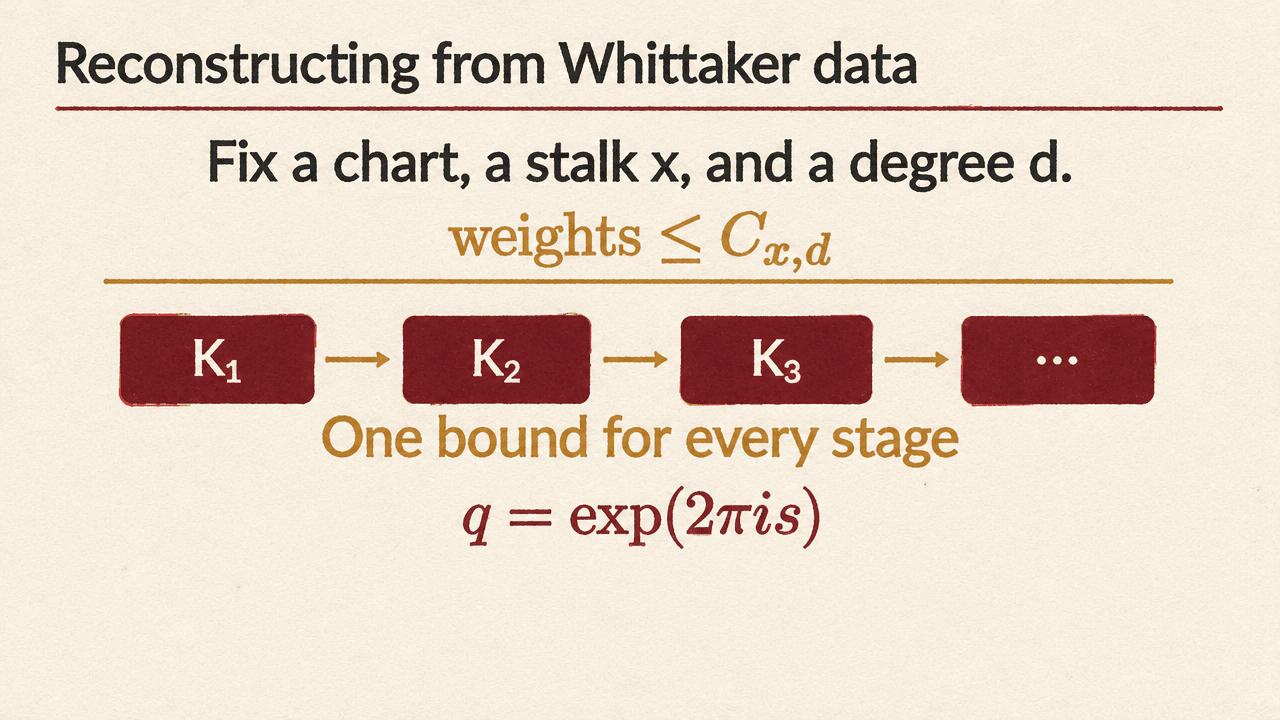
The cutoff removes objects from sufficiently unstable strata; it does not by itself reconstruct the category. For that, the argument uses a Whittaker coefficient functor R, which records specially equivariant data with moving allowed poles, and a Poincaré functor J, which reconstructs from those data. It claims that JₛRₛ is the identity on the entire category at irrational exponent s. At exponent zero, a remainder can survive.
Removing that remainder after deformation requires finite Whittaker tests, control of transition maps, and a uniform bound on weights across an infinite system. The monodromy parameter is q = exp(2πis); irrational s means q is not a root of unity, including when s is non-real. A finite calculation alone cannot establish the identity for the whole category.
A separate compatibility problem arises when marked points collide. Local pairings meet in a common category built from principal W-algebras, but agreement at separate points does not settle what happens at collisions. The argument uses a low-degree cohomological gap and boundary maps to extend the comparison across them. It then integrates the period construction over the Ran space—the space of nonempty finite sets of points on the curve—to obtain a global period identity. That identity, rather than a calculation for one fixed set of points, supplies the global comparison.
Two reconstruction identities make the functor an equivalence
After localization, the period identity gives a functor Φ between normalized bundle categories A and B. The argument establishes two reconstruction identities: a candidate ΨL with ΨLΦ ≃ Id_A, and a candidate ΨR with ΦΨR ≃ Id_B.
Although the candidates begin as different functors, the identities force them to agree. Starting with ΨL, insert ΦΨR ≃ Id_B, then use ΨLΦ ≃ Id_A. The resulting natural identifications give ΨL ≃ ΨR, so Φ is an equivalence. The formal deduction is short; its force depends on the reconstruction identities established through the global comparisons. An integral determinant-line shift then returns the categories to the stated level convention.