Distinct Totient Values Have an Explicit Phase-Dependent Asymptotic
An OpenAI manuscript on Euler’s totient function gives an explicit asymptotic formula for the number of distinct values the function takes up to \(x\). The result sharpens earlier estimates by specifying the main scale and an arithmetic coefficient that varies with a logarithmic phase, rather than treating the coefficient as a universal constant. The manuscript also proves that, for every fixed \(c>0\), the count at \(cx\) divided by the count at \(x\) tends to \(c\).
The count is of distinct totient values, not inputs
Euler’s totient function, φ(n), counts the positive integers up to n that share no prime factor with n. For example, 1, 5, 7 and 11 share no prime factor with 12, so φ(12) = 4. But φ(5), φ(8) and φ(10) are also 4.
That many-to-one mapping changes the counting problem. The September 2026 OpenAI manuscript studies V(x): the number of distinct totient values no larger than x. The input n that produces a value need not itself be at most x. Up to 12, the possible values are 1, 2, 4, 6, 8, 10 and 12, giving V(12) = 7. This finite example illustrates the definition; it does not establish an asymptotic law.
Earlier work, including an estimate by Ford, established the broad growth scale with bounded multiplicative uncertainty. The manuscript sharpens this to an explicit asymptotic equivalent: a formula whose ratio to the count tends to one. Its three factors are x divided by log x, a geometric scale G_m, and an arithmetic coefficient A(1; θ). The coefficient is bounded above and away from zero, but depends on a phase θ rather than being a universal constant. The manuscript states the result in its introduction and Theorem 2.1.†
The geometric scale and phase separate size from arithmetic
The formula’s scale is defined, not fitted to observations. All logarithms are natural, and B is log log x. Positive coefficients a_j, obtained by integrating log t from j to j + 1, determine a unique ρ between zero and one through the series equation whose terms are a_j times ρ to the power j and whose sum is one. Set λ = log(1/ρ).
The same coefficients generate a sequence beginning with g_0 = 1: each later g_j is a sum of products of a_d and g_(j−d). These values enter the geometric factor G_m, which is B to the power m divided by m! times the product of g_i from i = 1 to m. The formula therefore does not use a free-fitted scale: the series fixes ρ and the sequence, and those in turn fix G_m.
The phase records how the logarithmic scale falls between successive integer values. Form z by taking log B minus log log B and dividing by λ; m is the integer part of z, and θ is its fractional part. The factor G_m captures the geometric size associated with m, while A(1; θ) carries arithmetic variation indexed by the remaining fractional phase. These definitions apply for sufficiently large x, not as an approximation for small inputs.
The proof keeps the tail exact and counts overlaps once
Order a preimage’s prime factors from largest to smallest. The proof separates them into a long prefix and a shorter arithmetic tail. It counts the largest prime using the prime number theorem, turns the other prefix coordinates into a volume calculation, and keeps the later primes and a remaining integer discrete.
The cutoff H is held fixed while x grows; only afterward is H allowed to grow. Outside a controlled exceptional set, preimages have the required structure. A separate collision estimate shows that almost all values have a unique long prefix. That is not the same as having a unique preimage: distinct tails can still yield the same totient.
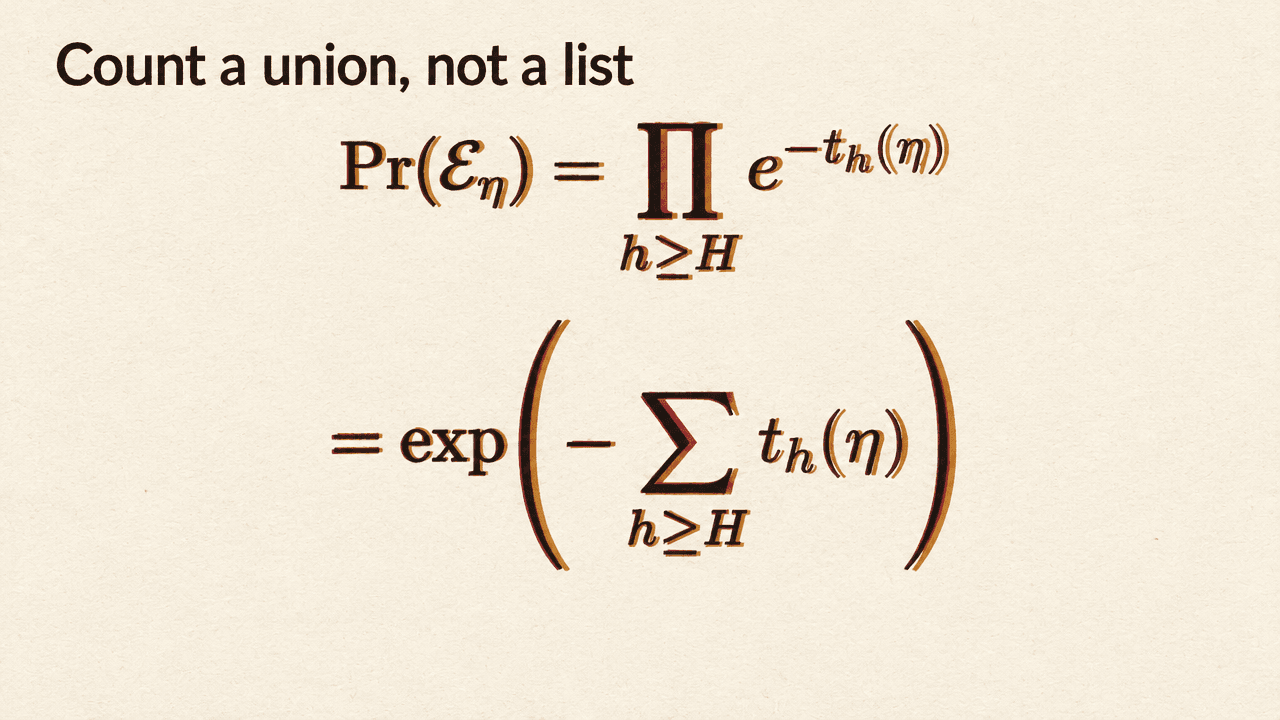
The local counting step fixes a tail totient d and considers its allowed tail witnesses. Each witness imposes lower thresholds on the prefix’s slack coordinates. In the limiting description, those coordinates are independent mean-one exponential variables. For one such variable, the probability of meeting a threshold t is e to the power −t; meeting all the thresholds for one witness therefore has probability e to the power minus the sum of its thresholds. The thresholds are summable, which justifies the infinite-coordinate limit.
If two witnesses correspond to the same d, satisfying both requires each coordinate to clear the larger of their two thresholds. Satisfying either is a union of events: add their probabilities and subtract the intersection. For more witnesses, finite inclusion–exclusion accounts for the overlaps. This is essential to the coefficient: counting witnesses separately could count the same prefix and tail value more than once, whereas the union measures the set of prefix configurations that produce the fixed tail totient.
For fixed H, the coefficient is built from a finite, explicitly bounded set of arithmetic witnesses and absolutely convergent series. Each fixed tail totient contributes its union probability, weighted by 1/d, together with a normalization factor. “Explicit,” the manuscript cautions, does not mean computationally small; it reports no numerical evaluation of the coefficient.
As H grows, these approximants converge uniformly across the entire phase interval to A(1; s). Uniformity means one error bound works for every phase. The manuscript does not assume or assert that A is continuous. Its definition uses finite arithmetic data, not the unknown count V; V enters later in proving convergence and positive bounds.
Fixed rescaling follows from a shared main term
A further result is that for every fixed c > 0, V(cx)/V(x) tends to c. The argument does not rely on assuming that the phase coefficient is smooth. Instead, it compares the same representation data at x and x/c, for c > 1. The prime number theorem supplies a common prime-counting mass at both endpoints. Subtracting the two expressions cancels that shared main term; the remaining normalized errors vanish as H grows. Ford’s lower bound ensures division by V(x) is safe. The argument extends to c = 1 directly and to smaller positive c by reciprocals.
The least-preimage result has an unresolved boundary
The manuscript also studies ℓ(v), the smallest n for which φ(n) = v. For a fixed positive integer k, it counts totient values v ≤ x whose least input lies above kx and at most (k + 1)x. If some totient d has ℓ(d) > kd, the coefficient in this count is positive, and the count has the same order of growth as V(x). If no such d exists, the count is exactly zero: every value v ≤ x then has ℓ(v) ≤ kv ≤ kx.
Positivity is established for k = 1 and k = 2; the manuscript does not classify it for all larger k.
The main theorem’s proof also depends on structure estimates, shifted-prime collision bounds, and uniform control of discarded values and representations. Those arguments are outlined rather than reproduced in the explainer. Its central architecture is concrete: approximate the long prime prefix, preserve the arithmetic tail exactly, and count overlapping witnesses as a union.