Weighted Divergence Guarantees Infinitely Many Inhomogeneous Approximations
An OpenAI manuscript on the weak inhomogeneous Duffin–Schaeffer conjecture gives a sufficient condition for infinitely many shifted rational-approximation hits for almost every real number. For a fixed shift \(\gamma\) and non-negative tolerances \(\psi(q)\), the authors prove the result when \(\sum_q (\phi(q)/q)\psi(q)\) diverges, without requiring the approximating numerators to be coprime to their denominators. The proof’s main challenge is controlling the structured overlap among approximation intervals.
Weighted divergence guarantees infinitely many shifted hits
Fix a real shift and a finite, non-negative tolerance for each positive integer . The OpenAI manuscript dated September 25, 2026, gives a sufficient condition for the inequality
to hold for infinitely many , for Lebesgue-almost every . Here means distance to the nearest integer. The condition is
The circle picture is simple: multiply by successive integers and keep only the fractional part. Each result is a point on a circle of circumference one. For denominator , the question is whether that point comes within the specified tolerance of the fixed target. The theorem guarantees infinitely many such hits, not just one.
The weight is the proportion of integers from one through that are coprime to . For twelve, those integers are one, five, seven, and eleven, so the weight is . The tolerances need not decrease or be uniformly bounded. The theorem fixes and before making its almost-everywhere claim: the exceptional set has measure zero, but may depend on both choices.
The totient weights the condition, not the solutions
Writing the inequality with an integer numerator makes “weak” precise:
There is no coprimality requirement on and . Dividing by , the condition asks whether lies within of a shifted grid point .
For , , and , the centers between zero and one are , , , and . Each interval has half-width . These are shifted grid points, not simply reduced fractions. The totient appears in the divergence condition; it does not restrict the numerators in the conclusion.
Overlapping intervals are the proof’s central obstacle
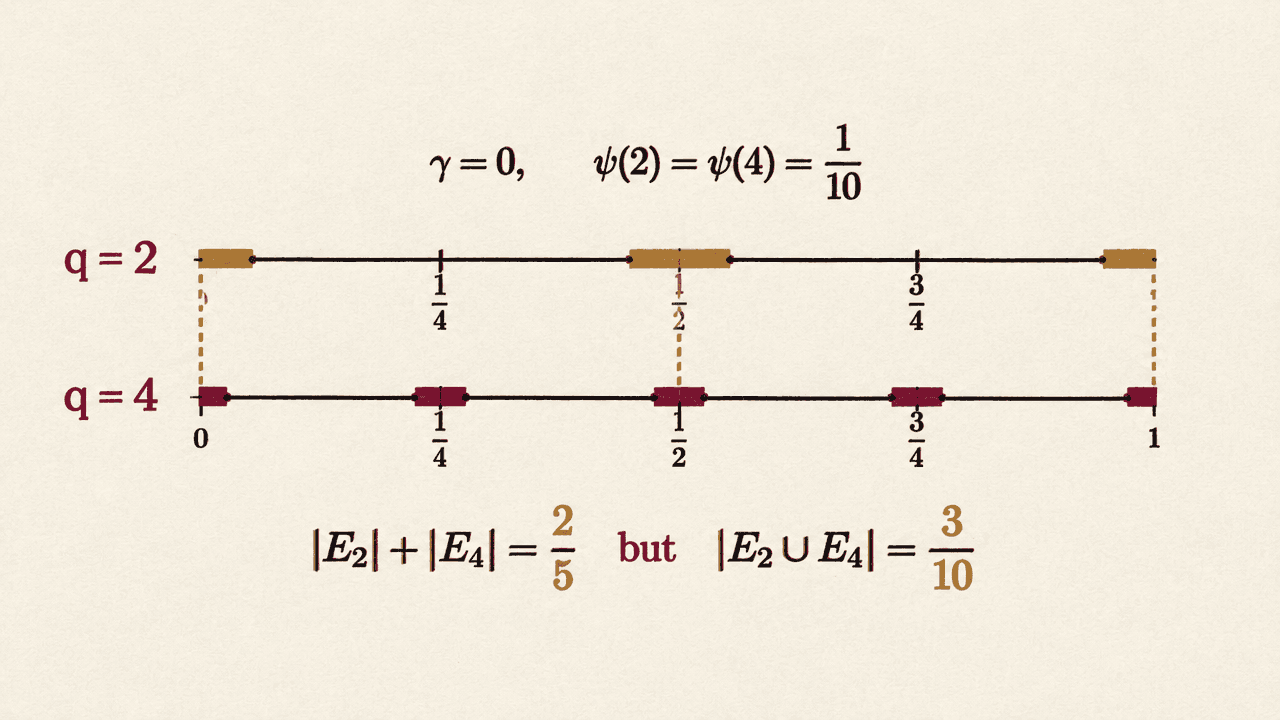
Adding interval lengths does not establish coverage if intervals from different denominators repeatedly cover the same places. In the example with zero shift and equal tolerances for denominators two and four, the rows share centers: the total of the interval lengths is , while the measure of their union is . The overlap is structured, not equivalent to independent events.
The proof first treats tolerances that do not tend to zero separately. In the remaining case, it rounds the spatial widths down to powers of two while preserving divergence, then selects arbitrarily late finite blocks whose weighted mass lies between a chosen small value and . The block is formed by adding terms until their sum first reaches ; since the final term is at most , the total is at most . This reduction lets the subsequent estimates work with finite blocks, including blocks arbitrarily far out.
For each block, the construction uses a retained weighted sum of interval indicators, supported inside the original approximation intervals, and a virtual comparison sum . uses the same realized prime-step multipliers but omits the additional deletions used to form . The proof roadmap identifies three needed properties: spreads mass evenly over fixed spatial intervals as the block moves farther out; the expected total mass discarded from to is small; and has a uniform second-moment bound. These are distinct inputs to the argument: the first two support coverage, while the third limits concentration. The source outlines further arithmetic and history-accounting estimates needed to establish these block-wide controls; the stated properties are not consequences of the local identity alone.
A local prime-step identity does not settle global overlap
One mechanism in the construction pairs a “PLUS” portion of weight with a matched “MINUS” portion at a prime step. The PLUS portion survives when its numerator passes a divisibility test; the matched MINUS portion survives when that test fails.
For prime three, the three residue states give PLUS outputs one, zero, zero, and MINUS outputs zero, one, one. Their averages, one third and two thirds, match the before-step weighted masses in the construction’s normalization. Their sum is always one and their product is always zero. This is a local identity: it preserves average mass for the matched pair without allowing the two portions to survive together. The averaging uses common translations, not independent trials, and the shift remains fixed.
That identity does not itself prove a block-wide second-moment bound. The global argument must also address close shifted points, which impose arithmetic constraints on the prime-exponent patterns of their denominators, and repeated alignments among larger collections of points. Exact coincidences and rational models receive a separate mass bound. The construction also records which labels have already been connected, so an alignment can remain part of the accounting even if an intermediate label disappears. The manuscript’s later estimates use these ingredients to control overlap across a whole block; the explainer presents them as a roadmap, not as a substitute for those proofs.
Spread and bounded concentration exclude a positive-measure set with no hits
Suppose a positive-measure set avoids every sufficiently late approximation row. Then the retained sum vanishes on . If the construction uses auxiliary jitter, replace by its average: every realization vanishes on , and Jensen’s inequality preserves the second-moment bound.
Approximate by a fixed finite union of intervals , with symmetric-difference measure . Since on , its integral over comes only from . The uniform second-moment bound and Cauchy–Schwarz give
with fixed before is chosen.
But the spread of , together with the small loss in passing to , gives a fixed positive lower bound on that same integral for sufficiently late blocks. Choosing close enough to makes the upper bound smaller than the lower bound, a contradiction. Thus each set avoiding an entire tail has measure zero. Points with only finitely many hits form a countable union of such sets, so they too have measure zero.
The result establishes infinitely many hits for almost every under the weighted divergence condition. It gives no hit rate, no converse when the series converges, and no coprime-numerator conclusion. The finite illustrations check the diagrams and local identities, not the full theorem.