Non-Central Normal Subgroups Are Exact Preimages of Local Subgroups
OpenAI’s September 2026 manuscript on the Margulis–Platonov conjecture claims that, for absolutely almost simple, simply connected groups over number fields, every non-central normal subgroup of the rational points is the exact preimage of an open normal subgroup in a finite product of compact local groups. The result does not require the normal subgroup to be closed or finitely generated. The proof reduces the classification to a finite gap between a subgroup and the closure of its local image, then rules out that gap through arithmetic and finite-group arguments.
Every non-central normal subgroup is an exact local preimage
The Margulis–Platonov conjecture asks which normal subgroups can occur among the rational points of certain algebraic groups. OpenAI’s September 23, 2026 manuscript claims a precise answer over number fields: under stated hypotheses, every non-central normal subgroup is determined exactly by finitely many local views—not merely approximated by them.†
The hypotheses matter. The group (G) must be absolutely almost simple and simply connected. Among the non-Archimedean places of the number field (k), select those where (G) has local rank zero, or is anisotropic. There are finitely many such places, and the corresponding local groups are compact. Their product is denoted (H_A). The diagonal map (\delta) sends a rational point of (G(k)) to its tuple of images in those local groups.
For any abstract normal subgroup (N) of (G(k)) that is not contained in the center, the manuscript claims there is an open normal subgroup (W) of (H_A) such that
[ N=\delta^-1(W). ]
Membership in (N) is therefore equivalent to the local tuple belonging to (W). The claim does not assume that (N) is closed or finitely generated. If there are no anisotropic non-Archimedean places, (H_A) is the one-element group; the theorem then says every non-central normal subgroup is all of (G(k)), not merely a dense subgroup.
The proof must eliminate a finite gap
The proof reduces the problem to a finite obstruction. Because (N) is non-central, it has finite index. Choose an exponent (e) that kills the finite quotient (G(k)/N), and let (R) be the subgroup generated by the (e)th powers in (G(k)). Then (R) lies inside (N).
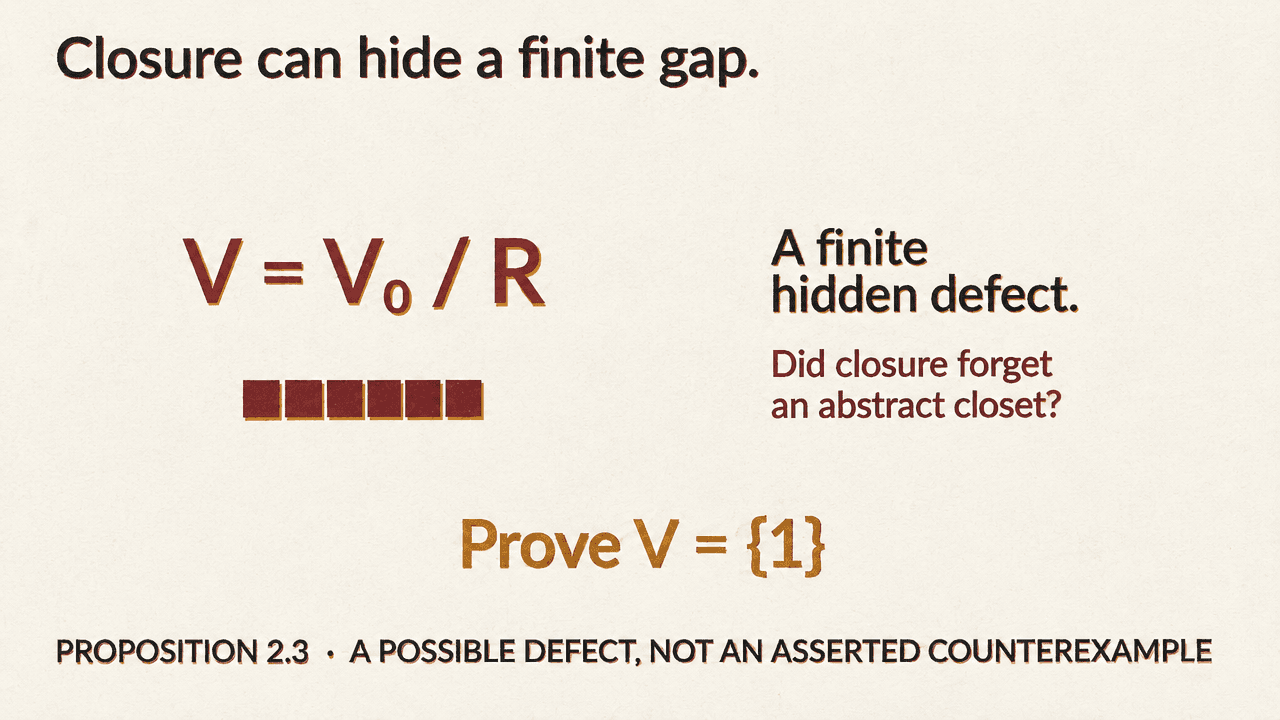
Take the closure (P_0) of the local image of (R), and pull it back to a subgroup (V_0) of (G(k)). The manuscript proves that (P_0) is open and normal. Since the local image of (R) is dense in (P_0), (V_0/R) is finite. But density does not show that this quotient is trivial: (V_0) can contain elements not in (R). The proof’s remaining task is to eliminate this finite defect.
Earlier results leave three difficult settings: anisotropic outer type (A), trialitarian (D_4), and (E_6). In the first new case, a central division algebra of odd reduced degree at least three over a quadratic extension, equipped with a unitary involution, gives special and full unitary groups. A nontrivial defect for the special unitary group would force one of two outcomes on the full unitary group: a nontrivial map to a finite abelian group, or a map to a finite non-abelian simple group (F) whose image of (V_0) is all of (F), while (R) lies in its kernel. Extending the problem to the full unitary group is part of the argument, not an automatic step.
The manuscript excludes the character-valued, or abelian, branch. In the non-abelian branch, the map to (F) would make the difference between (V_0) and (R) visible in a finite simple group: (V_0) maps onto (F), while (R) maps to the identity. The remaining argument rules out the required behavior using a finite-group obstruction tied to arithmetic.
A five-point test illustrates the finite-group obstruction
In (A_5), the group of even permutations of five points, let (v) cycle (1\to2\to3\to1), and let (B) cycle (3\to4\to5\to3), fixing 1 and 2. A permutation commuting with (B) must preserve its three-point orbit and its two fixed points. On the orbit it must be a power of (B). Swapping the two fixed points would be odd, so the centralizer of (B) in (A_5) is exactly ({1,B,B^2}). Each of those permutations fixes 1 and 2.
No centralizer elements (a,b) can make (v=a v^-1b). Apply the right-hand side to point 1, composing right to left: (b) fixes it, (v^-1) sends it to 3, and (a) keeps it among 3, 4, and 5. But (v) sends 1 to 2. This contradiction rules out all nine choices at once.
The broader point-pair test generalizes the mechanism: if the centralizer fixes both a point (P) and its image (vP), the proposed equality forces (vP=v^-1P), contrary to (v^2P\ne P). This calculation illustrates one obstruction; it does not supply the classification argument for all finite simple groups.
To connect arithmetic to finite-group behavior, the manuscript constructs a probability law on color configurations that is invariant under additive translations and gives every color equal probability. Uniformity does not mean independence, and both properties matter. Fractional transformations and a recurrence theorem connect additive returns to the required centralizer condition. The construction and recurrence proof are omitted; their stated consequence is that a non-empty proper set of colors would have to remain invariant under every left translation. But left multiplication can carry any chosen color to any other, so such a set cannot be both non-empty and proper. This eliminates the non-abelian branch.
The finite obstruction returns to the original subgroup
The remaining cases require induction on degree and separate low-degree corrections for the unitary cases, rational inverters for (D_4), and an (E_6) argument using a (D_4) subgroup and a local-to-global result for a torsor. These technical arguments are not reproduced here. The manuscript’s stated outcome is that the abelian and non-abelian possibilities for a nontrivial defect are both excluded. Thus (V_0/R) is trivial and (R=V_0).
With that equality established, density and openness identify the rational quotient (G(k)/R) with the local quotient (H_A/P_0). Since (R\subseteq N), the subgroup (N/R) corresponds to a subgroup of this finite local quotient. Its preimage in (H_A) is the required open normal subgroup (W), giving (N=\delta^-1(W)).
The conclusion is exact local visibility, not merely local density. The claim described is limited to number fields and the manuscript’s stated group hypotheses; it makes no claim about function fields. This is an original explanation of the manuscript, not an official OpenAI production.