Pi’s Irrationality Exponent Is Exactly Two
An OpenAI preprint proves that π’s irrationality exponent is 2: no fixed power stronger than the inverse-square bound can be achieved by rational approximations at arbitrarily large denominators. To rule out stronger approximations, the proof derives an arithmetic lower bound and a smaller analytic upper bound for the same determinant. The paper then uses the exponent bound to show that the Flint Hills series converges.
Exponent two rules out persistent approximation beyond the inverse-square scale
The claim that π has irrationality exponent 2 is about how rational approximations behave as their denominators grow—not about finding one unusually accurate fraction. The familiar approximations 22/7 and 355/113 show that fractions can come close, but a spectacular example answers only a finite question. The exponent describes how far a power-law error bound can be beaten infinitely often.
For an irrational number, its irrationality exponent is the supremum of the powers ν for which infinitely many reduced fractions p/q satisfy 0 < |x − p/q| < q^−ν. The manuscript’s theorem says that this supremum for π is 2. Pigeonhole approximation supplies infinitely many fractions at the inverse-square scale, so the exponent cannot be smaller. The hard direction is excluding every fixed exponent above 2.†
The theorem’s precise consequence is that for every positive ε, there is a threshold Q(ε) such that, for all q ≥ Q(ε) and every integer p,
The bound includes unreduced fractions. The proof does not compute the threshold, and it does not establish a fixed positive constant c such that |π − p/q| ≥ c/q² for all p and q. That stronger statement would amount to bounded continued-fraction partial quotients.
The proof turns exceptional fractions into an impossible determinant
To rule out an exponent above 2, the proof assumes that one such exponent succeeds for arbitrarily large denominators. It selects several successful fractions at successively separated scales and uses them to build centers near the complex periods 2πij, where j is an integer.
The next step is to construct polynomials under a shared weighted degree budget. At each center, the proof asks whether these polynomials can prescribe a finite packet of Taylor coefficients—a jet. A count of available coefficients is not enough to show that the prescriptions are independent. The manuscript establishes the required interpolation result under hypotheses involving distinct centers and carefully separated weights. Its technical arguments use a curve inequality, logarithmic residues, and algebraic geometry.
The interpolation result gives a coefficient matrix with independent rows, so a square minor using every row has nonzero determinant. The proof then bounds that same determinant in two opposing ways. The arithmetic bound says it cannot be too small; the analytic bound says it must be smaller than that. Since the determinant is nonzero, those conclusions cannot both hold.
For the arithmetic bound, a filtration-preserving truncation of logarithms makes the matrix entries rational complex numbers. Clearing denominators turns the resulting nonzero determinant into a nonzero Gaussian integer, whose modulus is at least 1. Accounting for the truncation and the denominators gives a lower bound on the original determinant.
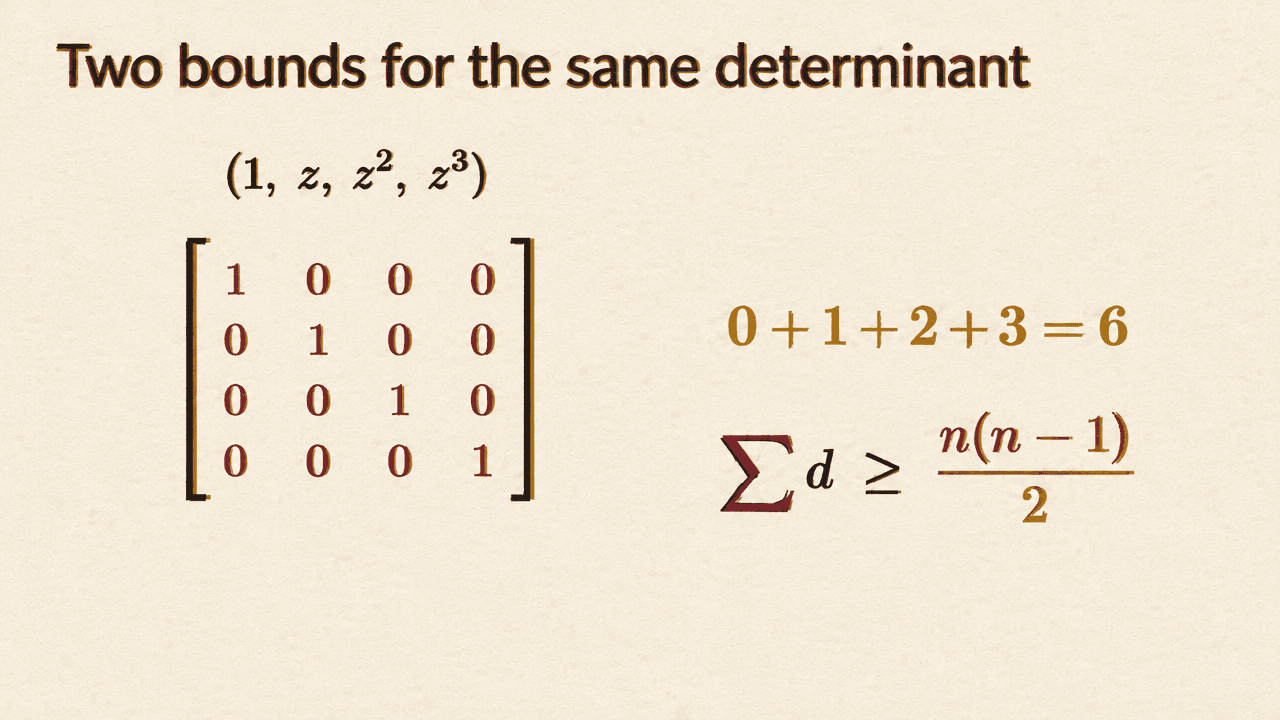
The analytic bound comes from translating the rows to the exact periods. Its key cancellation is that, within one transverse-index group, two rows that choose the same Taylor degree have identical coefficient vectors. Their determinant contribution vanishes. Four surviving rows in a group must therefore use distinct nonnegative degrees—at least 0, 1, 2, and 3—with a sum of at least 6. More generally, n rows incur a minimum total degree of n(n − 1)/2.
That quadratic degree cost makes the analytic determinant small. In each term of its expansion, either many rows have small transverse indices and crowd into too few groups, forcing the cancellation, or enough approximation-error powers remain after the truncation tails are controlled. The manuscript bounds both cases and sums the expansion. With the parameters chosen appropriately, the analytic upper bound falls below the arithmetic lower bound, contradicting the determinant’s nonzero value.
The order of choices matters: fix the exponent and auxiliary constants, then a finite dimension; choose the separated scales and centers; only then let the polynomial degree grow through allowed multiples. The weight-selection thresholds do not depend on the centers, though the final degree threshold may. This separation is what avoids circularity.
Spacing converts the exponent bound into convergence
The manuscript uses its theorem to prove convergence of the Flint Hills series,
with angles measured in radians. Near multiples of π, sine is small, so individual terms can be large. The argument needs more than a bound on the closest approach: it needs to show that close approaches cannot crowd together.
Choose ν = 9/4, between 2 and 5/2. The irrationality-exponent bound implies that, for some positive constant c,
for every positive integer q, where ||qπ|| is the distance from qπ to the nearest integer. The theorem gives this first for sufficiently large q; the finitely many smaller denominators can be absorbed into c because π is irrational and their distances are positive.
Now consider a block K ≤ q < 2K and place the fractional parts of qπ on a circle of circumference 1. Each point lies at least d = c(2K)^−5/4 from zero. Any two points are also at least d apart: their difference corresponds to the distance of (q − r)π from an integer, and 0 < |q − r| < 2K.
On either half of the circle, order the points by distance from zero. Their distances are at least d, 2d, 3d, and so on. Thus the spacing controls the whole block, not just its closest point:
Since q ≥ K throughout the block, multiplying by K^−3 bounds the block’s contribution to the distance series by a constant times K^−3d^−2, hence a constant times K^−1/2. Taking K = 1, 2, 4, 8, … gives a convergent geometric series. Therefore,
To return to the sine series, assign each positive integer n to the nearest nonnegative integer q to n/π. Then |n − qπ| ≤ π/2. Each positive q receives at most four integers, and n ≥ πq/2. The chord bound gives |sin n| ≥ (2/π)||qπ||. For each n in the group assigned to q ≥ 1, these inequalities yield
There are at most four such n for each q, so the entire q-group is bounded by 8/π times 1/(q³||qπ||²). Summing over q ≥ 1 is controlled by the convergent distance series. The q = 0 group contains only finitely many positive integers, and none has zero sine because π is irrational; its contribution is therefore finite.
The convergence argument depends on spacing, not merely on the size of the worst individual term: the exponent bound limits how close qπ can get to an integer, while the separation of the points limits how many such close approaches can occur in one block.