A Uniform Finiteness Theorem for Elliptic-Square Points on Curves in A₂
An OpenAI preprint claims that a curve in the moduli space of principally polarized abelian surfaces contains only finitely many points isogenous to the square of a non-CM elliptic curve, even when the elliptic curve and isogeny vary. The result applies to closed, irreducible curves defined over the algebraic numbers that are Hodge generic, with no boundary condition. In the proof strategy, comparisons at two auxiliary prime levels constrain the targets; height and orbit-size estimates then turn those local constraints into finiteness.
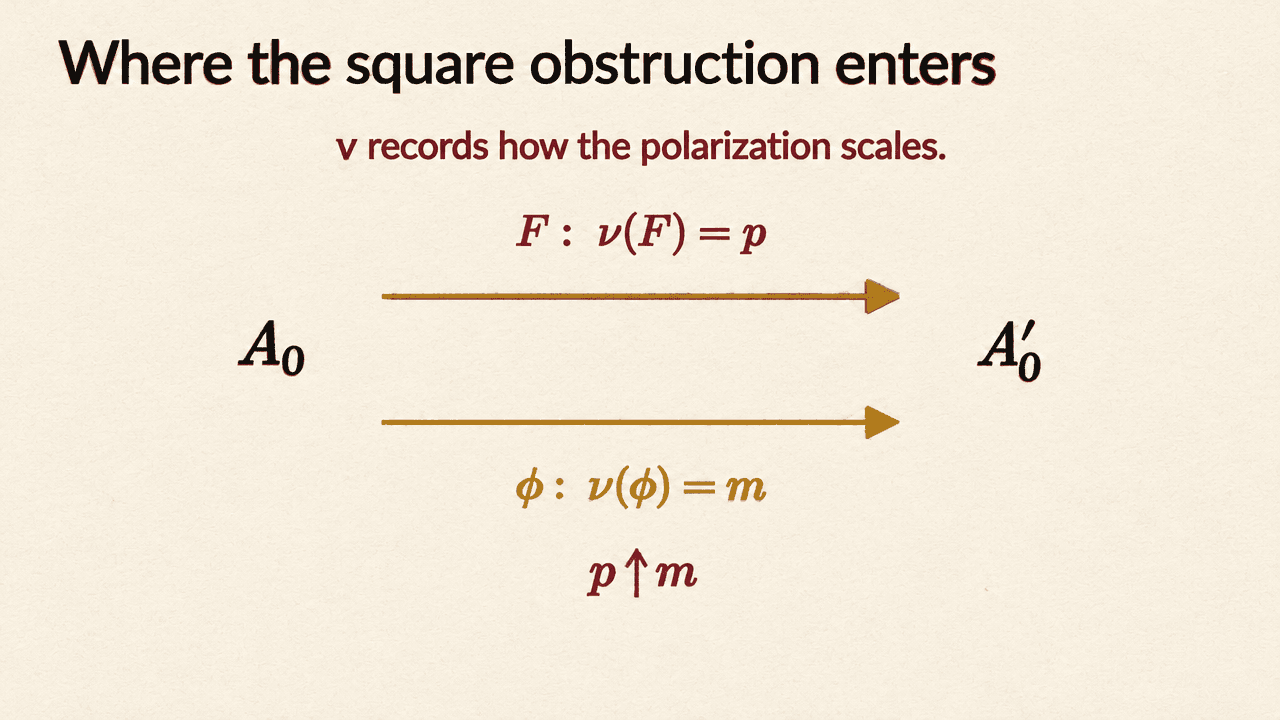
The finiteness claim allows the square to change
An abelian surface can be isogenous to the product of an elliptic curve with itself: (A \sim E \times E). Here an isogeny is a surjective algebraic group map with finite kernel, a weaker relation than isomorphism. The result concerns the non-CM case, where (E) has no endomorphisms beyond multiplication by integers.
The manuscript’s Theorem 1.1 asks how often this structure can occur along an algebraic curve in the moduli space (\mathcal A_2) of principally polarized abelian surfaces, a space of dimension three. It claims finiteness under a specified condition: the curve (C) must be nonempty, reduced, irreducible, closed, and defined over the algebraic numbers, and it must be Hodge generic—meaning it lies in no proper Shimura special subvariety.†
The finiteness is not limited to a fixed elliptic curve or a fixed isogeny. The elliptic curve, isogeny degree, and principal polarization may all vary; the isogeny need not preserve the polarization. Nor does the theorem impose a boundary condition, so complete curves are included.
That scope matters. Finiteness of the intersection of (C) with each one of infinitely many special curves would not, on its own, imply finiteness across their union. The theorem’s claim is uniform: there are only finitely many non-CM elliptic-square points on (C) altogether.
Two prime-level markings rule out different configurations
To explain the proof’s strategy, the manuscript supposes there are infinitely many such points. After passing to a fixed finite cover, it chooses one point as an interior center and compares it with each varying target using endomorphisms—maps from a surface to itself.
At an elliptic-square point, rational endomorphisms select a positive two-dimensional plane inside a five-dimensional quadratic space of trace-free self-adjoint operators. The proof compares the center’s plane with each target’s plane using two auxiliary prime levels as separate markings. Under the first marking, the sum of the two planes is degenerate; under the second, it is non-degenerate. Degenerate here means that a nonzero direction pairs to zero with the whole four-dimensional sum. These are separate finite-field settings, not competing pictures in ordinary space.
The second marking excludes sufficiently close targets for which the center cannot acquire good reduction after any finite extension. The first marking is used later to eliminate the negative-sign case. Each marking supplies a different constraint in the proof.
At retained finite places, after any necessary local extension, target operators are transported back toward the center and compared through trace pairings. Two labeled operators on each side give four trace values. Away from a fixed finite exceptional set, Frobenius conjugates both pairs together. Because simultaneous conjugation leaves traces of products unchanged, the resulting comparison has no explicit prime left in it.
The places can therefore be grouped by their labeled conjugate data. Although the number of primes witnessing proximity is not bounded, the number of resulting equation groups grows only polynomially with the target’s field degree. At infinity and at the retained exceptional primes, the proof uses single trace equations instead.
A prime-exponent argument rules out one exceptional identity
The trace equations must not become identities on the algebraic branches used in the later estimates. The manuscript uses monodromy—transport around loops—to control this. One exceptional case reduces to two signs.
For the positive sign, the arithmetic obstruction is explicit. The argument forces a rational endomorphism to act as a scalar (c) on first homology. Its trace is (4c), so the rationality of the trace gives (c \in \mathbb Q).
A multiplier records how a map scales the polarization. Frobenius has multiplier (p); a fixed polarized isogeny has multiplier (m), with (p \nmid m). Composing Frobenius with the inverse isogeny gives multiplier (p/m). But a scalar (c) has multiplier (c^2), so the hypothetical identity requires [ c^2 = p/m. ]
Write (c=a/b) with nonzero integers (a,b). The exponent of (p) in (c^2) is (2v_p(a)-2v_p(b)), which is always even, even if negative. In (p/m), the exponent is exactly one: (p) contributes one factor and (m) contributes none. An even integer cannot equal one. Thus no rational (c) satisfies the identity.
The negative sign requires a different argument: the first marking contradicts an integral orthogonal splitting. The explanation supplied here omits that technical proof.
Height connects local proximity to a finite orbit
To pass from local comparisons to global finiteness, the proof uses height, a measure of arithmetic size rather than position in a diagram. It writes (d=\max{2,[K(t):K]}) for the target lift’s field degree, and (h) for its shifted logarithmic height.
The interpolation argument combines substantial local closeness to the center with smaller local coordinate costs. It constructs an auxiliary polynomial; the product formula then either bounds the height or forces the target into a lower-dimensional algebraic set. Repeating that descent yields [ h(t) \le C_1 d^u, ] with constants depending only on fixed data. The relevant non-identity condition must hold on every algebraic branch used in the descent, not merely on the original curve. The estimates and graph construction behind this step are substantial; this account describes their role rather than reproducing them.
Next, an endomorphism estimate bounds (\Delta_s), the discriminant of the full geometric endomorphism order—not merely of the positive two-dimensional plane—by (C_2(dh)^v). Substituting the height bound gives a fixed power bound in (d). Since the cover has fixed degree, (d) is itself bounded by a constant times the original point’s field degree. The manuscript then obtains a polynomial lower bound on that field degree, equivalently on the number of Galois conjugates, in terms of (\Delta_s).
The Daw–Orr counting implication turns these degree and discriminant bounds into a finiteness statement for the elliptic-square locus: there cannot be infinitely many such points on (C) while the associated orbit sizes and discriminants satisfy the manuscript’s bounds. This is the cited bridge from the estimates to finiteness, not a proof of the counting implication itself. It is what strengthens the result beyond separate finiteness statements for intersections with individual special curves.
Elliptic squares are one input to the broader conclusion
The Zilber–Pink conclusion described in Theorem 1.3 covers all special subvarieties of dimension at most one, not just non-CM elliptic squares. Companion theorems handle products with a CM factor and surfaces whose full endomorphism algebra is an indefinite quaternion division algebra; André–Oort handles special points. Together with the classification of special curves, these inputs yield finiteness on (C), still without a boundary hypothesis.
The account here is an explanation of the cited OpenAI preprint, not an official production or a formal verification of the full theorem. It works through one arithmetic step in detail and maps how the manuscript connects that step to the larger claim.