Quaternionic Division Points Are Finite Across All Indefinite Algebras
An OpenAI preprint proves that a reduced, irreducible, closed curve defined over the algebraic numbers and Hodge generic in the Siegel threefold contains only finitely many points whose abelian surfaces have an indefinite quaternion division algebra as their full rational endomorphism algebra. The finiteness holds across all such algebras, rather than separately for each fixed type. The proof establishes a height bound independent of the algebra, then rules out unbounded degrees by showing they would force the curve’s period image into a locus too small to contain it.
The finiteness claim covers all quaternionic division algebras at once
In the Siegel threefold A₂, each point represents a principally polarized abelian surface. The result concerns an algebraic curve C in this three-dimensional space and points where the surface has an unusually large endomorphism algebra.
The claim is stronger than finiteness for any one specified symmetry type. There are many indefinite quaternion division algebras over Q, and the manuscript proves that only finitely many points of C have any one of them as their full geometric rational endomorphism algebra.
The hypotheses are that C is reduced, irreducible, closed, and defined over the algebraic numbers. It must also be Hodge generic: it is not contained in a proper special subvariety, including a Hecke translate. At a point s, the relevant algebra is End⁰(Aₛ): all endomorphisms of Aₛ over the algebraic closure of Q, tensored with Q. “Full” matters: the result concerns equality with the quaternion algebra, not merely an embedding into a larger endomorphism algebra. “Division” means every nonzero element is invertible; “indefinite” means the algebra becomes the two-by-two real matrix algebra over R. The split algebra M₂(Q) is excluded. No boundary or reduction hypothesis is imposed.†
Quaternionic symmetry produces a positive two-plane
The proof turns endomorphisms into vectors in a quadratic space. First cohomology of an abelian surface is a four-dimensional rational vector space. Its trace-zero operators that are self-adjoint for the alternating polarization form a five-dimensional space V, equipped with the quadratic form q(T) = one-quarter of the trace of T squared. This form has signature (3, 2).
At a quaternionic division point, the Rosati-symmetric endomorphisms give a positive-definite rational two-plane E inside V. Two independent integral vectors can be chosen to span it. These vectors encode arithmetic structure of the surface; they are not freely chosen directions in a diagram.
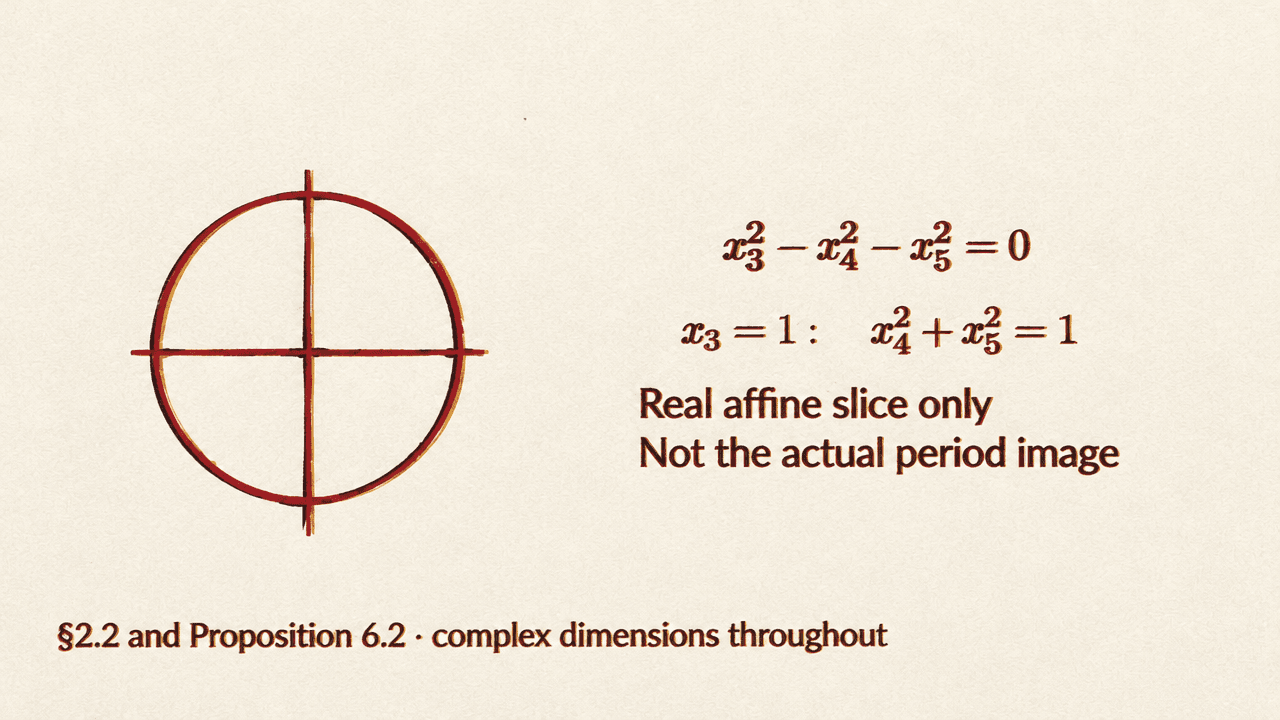
A surface’s period is represented by an isotropic line in the complexification of V, meaning a line on which q vanishes. Such lines form a three-dimensional quadric in projective four-space. At the exceptional point, the period is orthogonal to both vectors spanning E. The two independent orthogonality conditions leave a three-dimensional vector space; taking lines gives a projective plane. The remaining quadratic equation cuts that plane in a smooth conic, because E is positive definite and its orthogonal complement is nondegenerate. The circle used to illustrate the conic is only a real slice of a model, not the actual period image.
A uniform height bound is the bridge, not the conclusion
On a fixed smooth finite cover of the curve, the manuscript defines d(t) as the larger of 2 and the degree of t over a fixed number field. It defines h(t) as the larger of 2 and an ample logarithmic height on the smooth projective completion. Height measures arithmetic size, not distance in the moduli picture.
The constants can depend on the curve, but not on the varying quaternion algebra, its discriminant, or its order. That uniformity matters because the theorem ranges over all the algebras at once. The estimate is not yet finiteness: degrees could still grow without bound.
The height argument depends on constructing relations that are both locally small and globally nontrivial. Near a fixed interior quaternionic point, the proof compares endomorphisms at that center with transported endomorphisms at a target. Their four pairings form a rational trace matrix. Comparing a relation with its Frobenius conjugate cancels the rational entries and produces shared equations at conjugate local arguments. Grouping the conjugate data preserves enough weighted local smallness without requiring a bound on the number of places with supersingular proximity.
Smallness alone is not enough: if the relations were identities, they could not force a height descent. The proof handles difficult isogeny exceptions with a fixed auxiliary prime and a specially chosen marking of the two planes. A modulo-3 example illustrates why degeneracy matters: the marked planes can span a hyperplane with a nonzero radical. It is an example of the geometry, not a proof of the general lemma, which allows the quadratic form on the target plane to have rank 0, 1, or 2. The marking rules out identities even in these exceptional cases.
With nonidentity relations available on each branch, interpolation produces an auxiliary polynomial that is not identically zero on the current algebraic locus. If h is larger than a sufficiently large power of d, smallness at selected places outweighs controlled contributions elsewhere. The product formula then forces the polynomial to vanish at the target. Intersecting the locus with its zero set lowers its dimension; repeating the descent rules out the assumed large height and yields the bound. The technical estimates behind this step are omitted in the explainer.
Unbounded degree would put the period image in too small a locus
Suppose the degrees of quaternionic division points were unbounded. A point of degree d has d distinct conjugates. The height bound and endomorphism estimates give each conjugate two integral Hodge vectors whose ten coordinates are bounded by a fixed power of d. Among the finitely many period charts, one must contain at least d/J conjugates, where J is the number of charts.
For sufficiently large d, the path form of o-minimal counting supplies a nonconstant path of curve points, with the corresponding vector pairs varying semialgebraically. This is an invoked theorem, not something established by the schematic dots used in the illustration.
For each nondegenerate vector pair along that path, the possible periods lie on the conic determined by orthogonality. The path contributes at most one algebraic parameter and the conic fiber contributes one more, so the resulting algebraic locus has dimension at most two. The proof restricts to nondegenerate pairs before taking the incidence closure, preventing degenerate fibers from artificially increasing the dimension.
The nonconstant period arc lies in this locus. Analytic continuation then places the whole lifted period image there. But Hodge genericity supplies full monodromy, making that image Zariski dense in the three-dimensional quadric of periods. A locus of dimension at most two cannot contain it. Thus the degrees cannot be unbounded across the set of quaternionic division points, including points with different target algebras.
Once degree is bounded, the height estimate bounds height as well. Northcott’s theorem then gives finitely many points, and the conclusion descends from the fixed finite covers to the original curve. The result is finiteness for the full set of quaternionic division points, not just for a single prescribed algebra.