Abelian Zilber–Pink Gives Finitely Many Maximal Atypical Subvarieties
An OpenAI manuscript dated September 24, 2026, proves the abelian Zilber–Pink conjecture for abelian varieties over number fields: for any irreducible subvariety, its atypical intersections with torsion cosets are contained in finitely many maximal atypical subvarieties. The result counts maximal exceptional pieces, which may contain infinitely many points; it does not provide an effective count or a uniform bound. The proof establishes a non-density result and uses a cited reduction to control subvarieties with a defect-minimizing property.
Atypical intersections are measured against the right ambient space
The abelian Zilber–Pink conjecture concerns intersections that are larger than a dimension count would predict—and whether their exceptional parts can be organized into finitely many maximal pieces. The September 24, 2026 manuscript states this finiteness result for abelian varieties over number fields.†
The setting is an abelian variety: a projective algebraic variety equipped with a commutative group law. Its special subvarieties are torsion cosets: translates of abelian subvarieties by points of finite order. A torsion point τ satisfies nτ = 0 for some positive integer n. An arbitrary translate is not necessarily special. The theorem is stated for varieties and points defined over the algebraic numbers.
To define an atypical intersection, begin with an irreducible subvariety X, and let S be its smallest containing torsion coset, or special closure. For a special subvariety T inside S, take an irreducible component Y of X intersect T. The expected dimension is dim X + dim T − dim S. The component Y is atypical when its dimension is strictly greater than that expectation.
For example, if a surface meets a special curve inside a three-dimensional S, the expected dimension is 2 + 1 − 3 = 0. A curve component would exceed that count. This is a dimension illustration, not a constructed geometric example.
The choice of S matters. If X is itself special, then S = X, and intersecting X with itself does not make it atypical: the dimension count gives dim X, so there is equality, not a strict excess. Using a larger ambient variety instead would incorrectly change the threshold.
The theorem counts maximal pieces, not exceptional points
The manuscript’s theorem says that for every abelian variety over a number field and every irreducible X over its algebraic closure, there are finitely many maximal atypical subvarieties of X. “Maximal” means maximal by inclusion, not simply of greatest dimension. Every atypical subvariety is contained in one of the listed maximal pieces.
The list may be empty, and its members need not be points. They can contain infinitely many points. The conclusion is finite maximal structure, not a finite count of exceptional points. The theorem also gives neither an effective count nor a uniform bound.
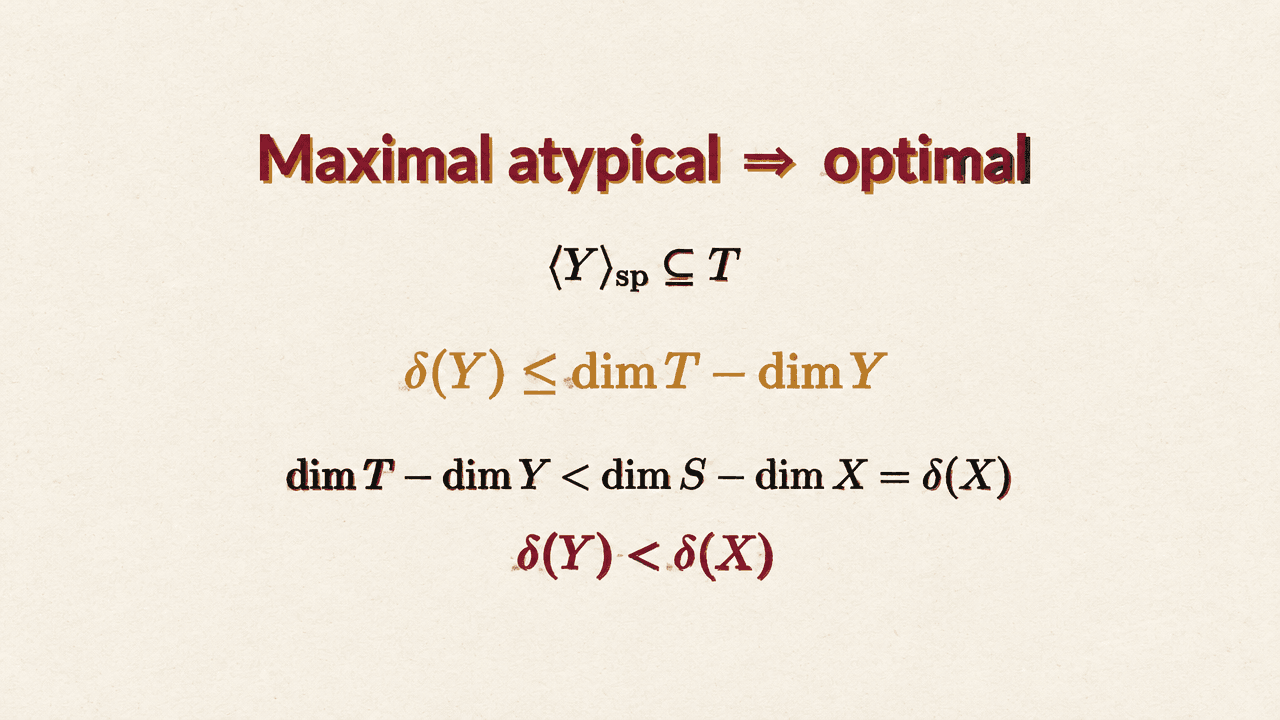
A key step in the proof connects maximal atypicality to special defect. For a subvariety Z, its defect is the dimension of its smallest special closure minus its own dimension:
δ(Z) = dim⟨Z⟩sp − dim Z.
This measures how much dimension is missing inside the smallest special variety containing Z. The manuscript calls Z optimal in X if every strictly larger irreducible subvariety U inside X has greater defect.
The local implication is that a maximal atypical Y is optimal. Suppose Y is atypical inside X, witnessed by a special T, and let S be the special closure of X. Since Y’s special closure lies in T, its defect is at most dim T − dim Y. Atypicality makes that quantity strictly less than dim S − dim X, which is the defect of X.
Now suppose Y were not optimal. There would be a strictly larger irreducible U inside X with δ(U) ≤ δ(Y) < δ(X). Let T′ be the special closure of U, and choose an irreducible component C of X intersect T′ containing U. Since dim U = dim T′ − δ(U), the defect inequality forces C to exceed the expected intersection dimension. Thus C is atypical and contains Y strictly, contradicting Y’s maximality. This proves the bridge from maximal atypicality to optimality; it does not by itself prove finiteness.
Universal non-density feeds the finiteness argument
The finiteness argument has two steps: establish universal non-density, then apply the Barroero–Dill reduction cited in the manuscript to obtain finitely many optimal subvarieties. The local implication above turns that finite control into finitely many maximal atypical pieces.
For X of dimension d that lies in no proper torsion coset, the manuscript considers points lying in torsion cosets of codimension at least d + 1. Theorem 1.2 says these points are contained in a proper closed subset of X. “Non-density” here is algebraic: the exceptional points do not fill X in the Zariski sense. For a curve, a proper closed subset is finite; in higher dimensions, it need not be.
The difficult part is proving this non-density. The proof assumes, for contradiction, that the exceptional points are Zariski dense, then selects a sequence that escapes every fixed proper closed subset. Its canonical heights—measures of arithmetic complexity—need not grow at a single rate. After passing to a subsequence, the ambient variety is split up to isogeny, meaning by a surjective group map with finite kernel, into at most one bounded-height level and several separated unbounded levels. Each level is normalized by its own height scale, so the argument can track the levels separately; torsion becomes zero in the resulting real height space. Subgroup relations yield a limiting projector that nearly kills the normalized vectors. The auxiliary sequence theorem rules out this high-codimension limit.
If every height level is unbounded, uniform geometric positivity and Dill’s height inequality force a positive quantity to be arbitrarily small. The proof fixes the comparison constant first, improves the approximation, and then takes the sequence far enough.
A bounded level remains a separate case. On repeated copies of a fixed low-factor variety, the proof compares separate outputs with consecutive differences. At a suitable diagonal point, the separate-output measure has positive density, while the consecutive-difference measure has zero density: subtracting two copies kills their common nonzero tangent direction. Uniform metric variation turns that disagreement into arithmetic positivity. Small sections and a weighted vanishing estimate then produce a proper product cut, contradicting the minimal choice of auxiliary varieties. The technical estimates behind these steps are not detailed here; the displayed dimension checks and executable examples do not formally certify the full theorem.