Primitive Sextic Fields Equidistribute Across Six-Dimensional Lattice Space
An OpenAI preprint proves that, as discriminants grow, the complete packets associated with totally real primitive sextic fields become equidistributed in the space of six-dimensional unimodular lattices. Its argument rules out concentration near smaller block structures by using arithmetic separation of embeddings to control how often packet lattices can remain close to those configurations. The result concerns volume-weighted packets built from all ideal classes and sign translates, not selected lattices.
The theorem averages complete packets, not selected lattices
For any sequence of totally real, primitive sextic fields whose discriminants tend to infinity, the associated packet measures converge to Haar probability on the space of unimodular lattices in six dimensions. Convergence means that averages of every continuous, compactly supported test function approach their Haar averages. The theorem also rules out escape of mass: eventually, a compact region contains all but any prescribed fraction of each packet. That second claim matters because lattice space is non-compact; a lattice can acquire very short nonzero vectors without changing its volume. The theorem asserts no convergence rate, and the ordering of the six embeddings may vary along the sequence.
Each lattice starts with a nonzero fractional ideal in the ring of integers. Map its elements to six-dimensional real space using the field’s six embeddings, then rescale the lattice to have covolume one. Positive diagonal matrices of determinant one act on it, and the field’s units make each resulting orbit compact. “Primitive” means there is no proper intermediate field between the rationals and the sextic field.
A packet includes the orbits from every ordinary ideal class and all coordinate sign translates, with duplicate orbits removed. It includes sign changes of either determinant sign, without attaching an extra orientation label to the lattices. Each orbit contributes its invariant probability, weighted by its volume under the diagonal action; the weights are normalized to sum to one. Completeness, signs, and volume weighting are part of the theorem’s definition. A selected sample of ideals would be a different measure.
Homogeneous limits can still hide inside two smaller block structures
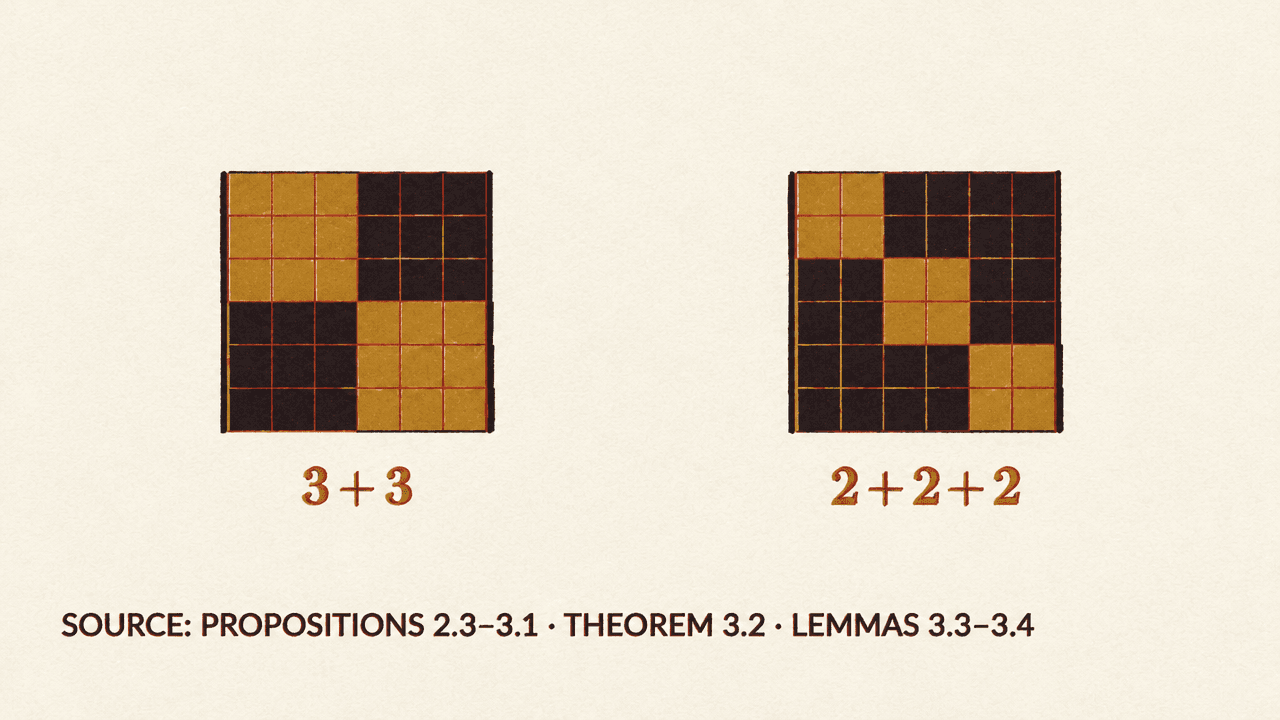
The proof’s central difficulty is that homogeneous does not mean Haar. Short-vector control prevents mass from disappearing into the cusp, while a small-ball estimate bounds the mass of a ball of radius (r) by a constant times (r^6). Together with an entropy argument and an established measure-classification theorem, these results imply that almost every ergodic component of a probability limit is homogeneous. But proper homogeneous possibilities with positive entropy remain: two blocks of size three, or three blocks of size two.
The field hypothesis of primitivity does not by itself exclude concentration near either arrangement. The proof needs a more specific connection between arithmetic and the geometry of lattices: arithmetic must make near-block configurations sufficiently scarce. The separation estimate for algebraic integers is one link in that argument.
Take a non-rational algebraic integer (\alpha) in a primitive sextic field. Primitivity forces (\alpha) to generate the whole field, so the discriminant of the order it generates is at least the field discriminant (D). That order discriminant is the product of the squared differences among the six embeddings of (\alpha). There are 15 pairs, so the product has total degree 30 in those differences.
Subtract the mean of the six embedding coordinates. This centers the resulting vector without changing any pairwise difference. If its length is (R), each difference is at most (2R). Hence (D \leq (2R)^30), and (R \geq \tfrac12 D^0.03333333333333333). As the field discriminant grows, non-rational integers therefore stay away from the line where all six coordinates are equal.
Separation matters because it makes two-sided block-like motion rare
The separation estimate is transferred to a fine, trace-zero lattice in the codifferent: the set of field elements whose trace pairing with every algebraic integer is integral. Coordinatewise products of vectors from the original lattice and its dual give the embeddings of such an element.
Consider a cut dividing the six coordinates into two groups. If a lattice stays close to a block structure on both forward and backward diagonal motion, the entries crossing the cut must be exponentially small. For vectors (v) and (y) whose coordinatewise products represent codifferent elements, summing (v_jy_j) over one side of the cut gives a partial trace. The small cross-cut terms make that sum nearly fixed.
This turns geometric closeness into an arithmetic counting problem: there are only so many possible codifferent elements compatible with the nearly fixed partial trace. The resulting estimate bounds the packet mass of these two-sided tubes by an exponentially decaying quantity over a growing range of times. The source omits the lattice-transference and counting details; the role of the estimate is to prevent a substantial part of the packet from persisting near a proper block structure.
The estimate cannot simply be applied after taking a weak limit. For a finite packet, conditioning exactly along an individual root direction gives point masses, which fail to capture the spreading detected by the tube bound. Instead, the proof conditions on small transverse cells before taking the limit, at intermediate resolutions where the conditional probabilities change little. The limiting state retains both the lattice and information about these probabilities.
A product rule then links compatible root directions. It is not supplied by weak convergence alone: contraction identifies one factor, while a conditional-information estimate identifies the other. This recorded information is what lets the proof carry the tube estimate into statements about the limiting state.
The recorded directions must compose and eventually become full
Call a root active when its recorded measure has support beyond the identity. The product rule forces active directions to compose. Suppose, in a three-coordinate example, that the directions from 1 to 2 and from 2 to 3 are active, but the direction from 1 to 3 is not. Multiplying the corresponding shears in one order creates an extra 1-to-3 entry equal to (st), where (s) and (t) are the shear parameters; multiplying them in reverse order does not. The same limiting state must give the same measure in either order. But activity in both directions gives positive mass to parameters away from zero, and their product has positive mass where (st) is nonzero. That contradicts inactivity from 1 to 3.
Composition is necessary, but it does not establish that every direction is active. The tube estimate forces activity across cuts along long segments of diagonal motion, even when the argument starts from any uniformly positive fraction of a packet. Invariance along suitable diagonal walls and a further technical argument combine these facts into full activity. The conclusion is that, at almost every limiting state, every directed root is active.
A proper homogeneous piece has a fixed-point structure that forces some crossing root to be inactive. Full activity therefore excludes the proper pieces, including the (3+3) and (2+2+2) alternatives. The remaining homogeneous limit is Haar probability. Combined with short-vector control, which rules out escape of mass, this gives the stated equidistribution.