Prime-Degree Torus Packets Equidistribute Across Arbitrary Local Types
An OpenAI preprint proves that, in each fixed prime degree \(n \ge 5\), the volume-weighted measures on complete packets of arithmetic torus orbits converge to Haar probability as the discriminants of their multiplier orders grow. The result allows arbitrary local module types, including noninvertible modules, but does not claim equidistribution for an individual orbit or cover composite degrees.
The theorem concerns complete packets, not selected orbits
A lattice can be stretched along one coordinate and compressed along another while preserving volume. The space Xₙ treats each volume-one lattice as a point; positive diagonal stretches with product one form a group A, with n−1 independent parameters. For lattices constructed from number fields, this action traces compact orbits.
The result concerns collections of these orbits. Start with a totally real number field K of prime degree n, and a full lattice M inside it. Apply the field’s n real embeddings to M, then rescale the resulting grid to volume one. The packet associated with M collects the distinct orbits from global scaling classes having the same local scaling type at every rational prime, together with the prescribed determinant-one sign changes.
That local condition is more specific than sharing a multiplier order: two lattices can have the same multiplier order and still belong to different packets. The packet’s probability measure averages the invariant probability on each orbit, weighting it by the orbit’s volume.
Theorem 1.1 fixes a prime degree n ≥ 5. If the discriminants of the multiplier orders tend to infinity, these packet measures converge to Haar probability on lattice space—the natural invariant probability there. The multiplier order is O(M) = {α ∈ K : αM ⊂ M}, and its discriminant is the field discriminant multiplied by the square of its index in the full ring of integers.
The field may vary along the sequence, or stay fixed while the order index grows. The local modules may be arbitrary, including noninvertible ones and those arising from non-maximal orders. The theorem also asserts no escape of mass: in the limit, positive probability cannot disappear into lattices with extremely short vectors.
The boundaries matter. There is no claimed convergence rate, no result for a chosen individual orbit, and no extension here to composite degrees.
Local restrictions enter the count as weights
The proof’s counting strategy preserves the local module condition rather than replacing every lattice with an ideal of the maximal order. Enlarge M using the full ring of integers R, and let q be the index between RM and M. After local normalization, the module becomes L inside the local ring, with its ring span equal to the whole ring; it need not itself be a maximal-order ideal.
For a random local unit z, consider the probability P that a given vector x lies in zL. This probability depends on the vector’s component valuations—the divisibility data at the local primes. The proof uses these probabilities as weights in an exact ideal-counting formula: it counts ideals of the maximal order while retaining, through P, the information about which vectors satisfy the original local restriction.
A local volume calculation explains the normalization. Give the local ring additive volume one. If L has index qₑ, its volume is 1/qₑ. Partition the ring into shells with fixed component valuations. Unit multiplication is transitive within each shell, so the chance that a random unit multiple of a vector lies in L is exactly the fraction of that shell lying in L. Thus each shell’s volume times its probability contributes precisely the volume of its portion inside L. Summing over the shells gives 1/qₑ; sets with zero coordinates have additive volume zero.
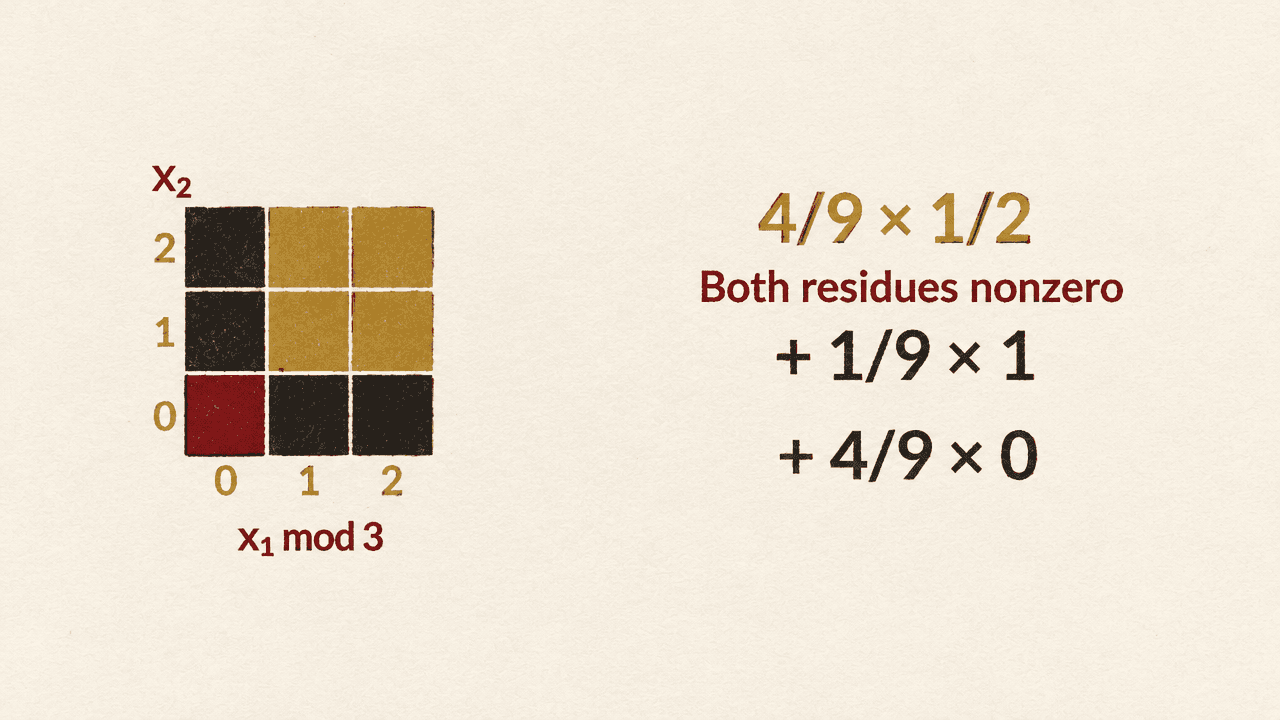
A finite example shows how the weights handle correlated coordinates without assuming independence. In the split local algebra ℤ₃⁵, require the first two coordinates to agree modulo three and leave the other three unrestricted. Of the nine residue pairs, three satisfy the condition, so the module has index three. The local calculation assigns probability 1/2 when both residues are nonzero, 1 when both are zero, and 0 when one is zero and the other is nonzero.
| Residue pair | Share of pairs | Probability under random unit scaling |
|---|---|---|
| Both nonzero | 4/9 | 1/2 |
| Both zero | 1/9 | 1 |
| One zero, one nonzero | 4/9 | 0 |
The weighted total is 4/9 × 1/2 + 1/9 × 1 + 4/9 × 0 = 1/3, as required by the index. This checks one local normalization, not global equidistribution.
Nonescape and entropy identify the limit
The local identity is one ingredient, not the whole proof. The argument also establishes a uniform bound on a small positive moment of local divisibility, with exponent s = 1/(2n). This gives a power-saving tail for contributions from large local norms. In estimating weighted ideal counts, the proof retains the field-dependent residue of the Dedekind zeta function; local normalization factors cancel against factors removed from the Euler product. The estimates use Stark’s exceptional-zero result and a uniform form of Shiu’s theorem.
These estimates control the probability of finding a very short vector. For a fixed threshold 0 < θ < 1, the limiting upper bound is at most Cₙθⁿ. Letting θ shrink drives the bound to zero. Mahler’s compactness criterion then gives tightness: mass does not escape into the cusp.
To identify a weak limit, the argument combines a local mass bound with diagonal dynamics. In any fixed compact region, the mass of a sufficiently small ball is bounded by a constant times rⁿ. A diagonal flow with distinct exponents summing to zero acts in a group of dimension n−1. A two-sided dynamical tube can be covered by at most a constant times r raised to −(n−1) balls. Combining that cover with the per-ball estimate leaves one factor of r. As the tube shrinks exponentially along the flow, an entropy criterion yields positive entropy.
That conclusion applies not only to the limit measure but to every invariant probability dominated by a finite multiple of it. This rules out a positive-weight, zero-entropy component hidden inside the limit. Prime-degree measure classification then identifies almost every ergodic component as Haar, forcing the entire limit to be Haar probability. The argument relies on a covering estimate, an entropy criterion, and a measure-classification theorem.
The packet is where the equidistribution claim holds
The proof chain depends on keeping the complete packet and its prescribed local type intact: exact weighted counting retains the module restrictions; uniform estimates prevent escape; and the resulting dynamical complexity, together with prime-degree rigidity, identifies the limit. The claim is therefore not that every individual arithmetic orbit becomes uniform. It is that, for each fixed prime degree at least five, the full packet of any prescribed local type equidistributes as its multiplier-order discriminant grows.