The Restricted Geometric Langlands Equivalence Reaches Every Spectral Component
A September 2026 manuscript argues that the restricted geometric Langlands equivalence in positive characteristic reaches every component of the spectral space under its stated hypotheses. Its proof rules out a missing component by showing that an object supported there cannot vanish under nearby cycles: Hecke tests and a degeneration to two intersecting projective lines produce detectable cohomology, contradicting the vanishing that a missing component would require.
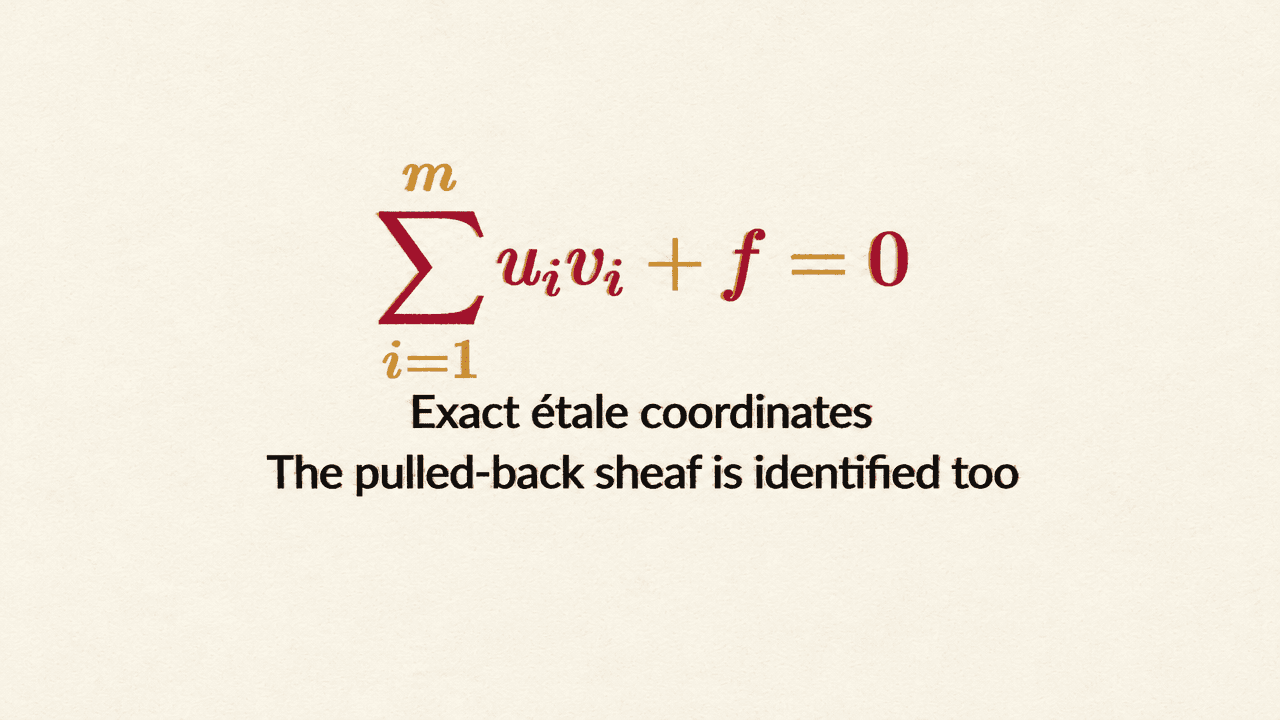
The proof turns a missing component into a vanishing contradiction
The restricted geometric Langlands equivalence in positive characteristic was known to reach a union of spectral components. The unresolved question was whether any components lay outside that union. A September 2026 manuscript claims that none do, under specified hypotheses.†
Suppose a spectral component (C) were missing. The established characteristic-zero equivalence would then supply a nonzero compact object (F) in the corresponding spectral summand. The projector (e_C) onto that component fixes (F). Geometric nearby cycles, denoted (\Psi), carry the object toward characteristic (p).
Spectral linearity lets the projector pass through nearby cycles: . But if (C) is absent on the characteristic-(p) side, the projector acts there by zero. So (\Psi(F)=0), even though (F\ne 0).
That is not yet a contradiction: a nonzero object can disappear under specialization. The proof’s central task is to show that this particular object cannot vanish. It does so using Hecke tests and a geometric degeneration that leaves a detectable cohomology class.
A degenerating conic produces a class supported on the zero locus
The test uses two Hecke modifications at the same moving point of the curve, arranged to have a common output. A Hecke modification changes a bundle at one point while identifying it away from that point. Lie-theoretic transversality supplies complementary controls: one test isolates a stalk, while another gives exact local coordinates. The manuscript stresses that the coordinates are exact, not merely a quadratic approximation, and that the sheaf itself is identified in the coordinate argument.
With one pair of variables, the local model is the projective conic (uv+fw^2=0). Where (f\ne 0), it is a smooth projective conic, hence isomorphic over the algebraically closed field to a projective line. Where (f=0), it becomes (uv=0): two projective lines meeting at a point.
The degeneration changes the cohomology in one precise respect:
| Case | H⁰ | H¹ | H² | After removing universal classes |
|---|---|---|---|---|
| Smooth conic | 1 | 0 | 1 | No residual class |
| Two projective lines meeting at a point | 1 | 0 | 2 | One extra class |
For the two lines, the gluing map on constant sections is ((a,b)\mapsto a-b). Its kernel is the diagonal, so degree zero still has one class; the map is onto, so degree one has none. Degree two has two independent classes, one per line. The hyperplane class gives the universal degree-two direction: it has degree two on the smooth conic and degree one on each component of the degenerate conic. Removing that diagonal direction leaves one additional class, present only where (f=0).
The manuscript extends this calculation from individual fibers to a comparison over the whole base. The remaining term is a constant line supported on the zero locus of (f), with a degree shift and Tate twist. The coefficients are algebraically closed (l)-adic numbers, with (l\ne p); two is invertible even when (l=2). The zero-dimensional Hecke case is handled separately. The conic calculation is part of the argument, not a substitute for its omitted coordinate and incidence steps.
A slice through nonzero support cannot have zero nearby cycles
The conic comparison, combined with the Hecke tests, forces vanishing on transverse hypersurfaces. Projective incidence extends the result to higher-codimension slices. Those extensions are additional arguments in the manuscript; they do not follow from the conic picture alone.
A dimension bound on the nilpotent cone permits a slice through the actual nonzero support of (F), with that support locally finite over the base. On this slice, nearby cycles can be computed as a finite direct sum of stalk complexes. Since the slice meets nonzero support, at least one stalk is nonzero, so the direct sum cannot vanish by cancellation.
The same slice must therefore give both zero nearby cycles, by the transverse-slice test, and nonzero nearby cycles, by the finite-support calculation. That contradiction rules out the missing component. In this comparison monodromy is forgotten: no inertia invariants are taken.
Full support holds only within the stated hypotheses
The manuscript’s conclusion is that the existing functor reaches the entire restricted spectral stack. Every component has a nonzero automorphic category, and every parameter has a nonzero coherent Hecke eigenobject. “Restricted” describes how families of local systems vary: components are indexed by semisimple local systems, while extensions and derived deformation data remain part of the space. The automorphic category consists of sheaves on the stack of (G)-bundles; the spectral category consists of ind-coherent sheaves on the restricted local-system space. Both impose nilpotent singular-support conditions.
The setup is a smooth, projective, connected curve (X) over an algebraically closed field (k) of characteristic (p>0), with a connected reductive group (G). Both theorem regimes require the same four conditions:
| Condition | Requirement |
|---|---|
| Invariant form | A symmetric, G-invariant, nondegenerate form on Lie(G), remaining nondegenerate on every Levi's Lie-algebra center |
| Chevalley restriction | An isomorphism for every Levi |
| Semisimple centralizers | Every scheme-theoretic centralizer of a semisimple Lie element is a Levi |
| Nilpotents after extension | Every nilpotent Lie element lies in the Lie algebra of the unipotent radical of a parabolic defined over the extension field |
The theorem applies in either of two regimes. In the first, (X) and a split group (G) descend to a finite field, with the descended curve smooth, projective, and geometrically connected; there is no additional Weyl-group-order condition. In the second, (k) can be any algebraically closed field of characteristic (p), provided (p) is very good for (G) and does not divide the order of its Weyl group.
The resulting object is described as ind-constructible; the manuscript makes no boundedness or perversity assertion. It treats rational-coefficient support and finite-field arithmetic separately: the rational arithmetic formula requires an additional primed comparison.