Ramified Local Components Are Tempered for Globally Generic Exceptional Groups
An OpenAI preprint on exceptional groups proves that every local component of a cuspidal, globally generic automorphic representation in its stated class is tempered, including at ramified places. The proof addresses the gap in local-global compatibility: it identifies the ramified Weil parameter but not its monodromy. The authors use global purity to produce a pure local completion, then show that hypothetical non-tempered induction would force a Frobenius determinant incompatible with purity.
The theorem reaches the places the unramified result leaves open
For a global automorphic representation, each place of the underlying function field has a local component. An earlier Ramanujan theorem controls the unramified components; the result described here addresses the ramified ones, where the local parameter contains information that unramified data do not.
The stated global theorem concerns cuspidal, globally generic automorphic representations of split, connected, adjoint, absolutely simple groups of exceptional type.
Global genericity means the representation has a nonzero Whittaker coefficient for a character nontrivial in every simple-root coordinate. The conclusion is that every local component is tempered, without a restriction on positive characteristic or ramification depth. For these unitary components, temperedness means weak containment in the regular representation.
The central problem is that local-global compatibility identifies only part of the ramified parameter. At an unramified place, a Satake class describes it. At a ramified place, the relevant object is a Weil–Deligne pair, (r, N): r is the semisimple Weil representation, while N is a nilpotent monodromy operator. Compatibility identifies r, but not N. The proof must therefore compare possible monodromy operators sharing the same Weil data.
The Weil part alone does not determine the local factor
Write Q for the size of the local residue field and use geometric Frobenius. If Φ = r(Fr), the compatibility relation is ΦN = Q⁻¹NΦ. Thus, when N carries an eigenvector to another nonzero vector, the corresponding Frobenius eigenvalue falls by a factor of Q.
That relation matters because a tempered completion need not have a bounded Weil part r. Requiring every Frobenius eigenvalue to have absolute value one would therefore test the wrong thing. The monodromy operator affects how the eigenvalues fit together.
A two-dimensional example makes the distinction explicit. Set Q = 4, take trivial inertia, and let Frobenius have eigenvalues 1/2 and 2. If N sends the eigenvector with eigenvalue 2 to the one with eigenvalue 1/2, and kills the latter, the drop is exactly division by four. This completion is pure of weight zero: its two degrees are +1 and −1. Set N = 0 without changing Frobenius, and the pair remains a valid Weil–Deligne pair but is no longer pure. Its local L-factor changes as well; the extra denominator vanishes at s = 1/2.
The example is illustrative, not a proof of the exceptional-group theorem. It shows why matching r is insufficient: the same Weil data can admit different monodromy and different local behavior.
Purity supplies a useful constraint on completions. In a pure weight-zero representation, the monodromy filtration has graded pieces in degrees j and −j with equal dimension. Frobenius eigenvalues on degree j have absolute value Q^(j/2). The positive and negative powers therefore cancel when multiplied, giving an absolute determinant of one. A Weil–Deligne direct summand inherits purity, since the monodromy filtration respects direct sums. The proof applies this determinant constraint to a particular subspace of the adjoint representation, not to the whole representation.
Local-factor ratios preserve the comparison the proof needs
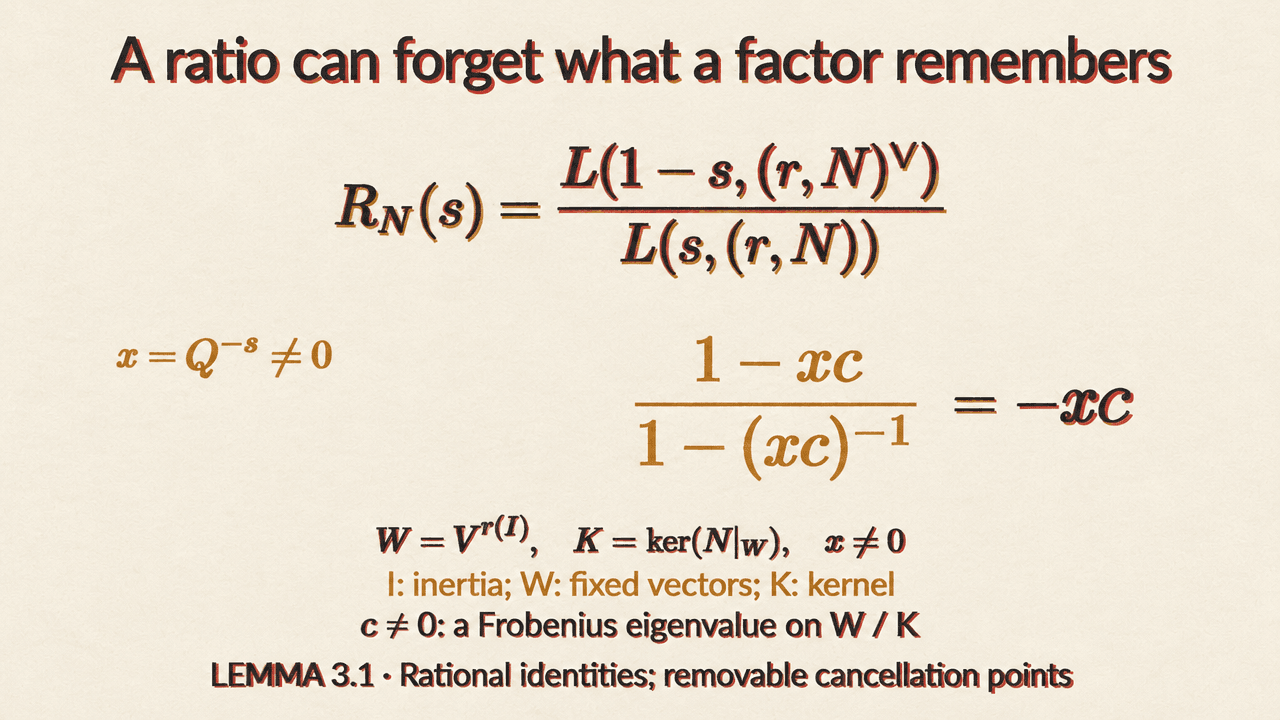
The paper’s comparison does not assume that individual local L-factors stay fixed when N changes. Instead, it uses the ratio of the dual L-factor at 1 − s to the original L-factor at s.
Changing monodromy alters this ratio only by a nonzero monomial in x = Q^(−s). For each relevant Frobenius eigenvalue c, the correction is (1 − xc) divided by (1 − (xc)⁻¹), which simplifies to −xc. Such a factor has no zero or pole for x ≠ 0. The ratio’s zeros and poles are therefore retained even when the individual L-factors change.
This is the input to a comparison involving two candidate monodromies. Suppose a generic local representation were not tempered. By the Langlands classification it would be a quotient of an induced representation from tempered data on a proper Levi subgroup, with a strictly positive real exponent. The inducing data give one monodromy operator, N_M. Separately, suppose the same r admits a completion N_* whose adjoint is pure. Here “adjoint” refers to the action on the dual group’s Lie algebra; an adjoint-pure completion is one for which this adjoint Weil–Deligne representation is pure of weight zero.
Purity makes the adjoint L-factor regular at one for N_. The local-coefficient comparison gives the same regularity at one for N_M, using genericity and the inducing data. Regularity is the shared condition to which Proposition 3.3 applies: it places both operators in the unique open orbit under the centralizer of r. The proposition—not regularity by itself—yields that orbit conclusion. Since the operators are conjugate, adjoint purity passes from N_ to N_M.
The comparison uses multiplicativity, rank-one factors, globalization, and a functional equation.
The positive inducing exponent forces a contradictory determinant
Consider the positive dual nilradical: the positive root-space directions outside the Levi subgroup, inside the dual Lie algebra. Because the Weil action and N_M stay in the Levi, this subspace is a Weil–Deligne direct summand. It inherits purity, so the absolute value of Frobenius’s determinant on it must be one.
Now compute the same determinant from the inducing data. Before twisting, each central Weil block has determinant of absolute value one. The strictly positive exponent twists every eigenvalue in block b by Q^(−b(ν)), with b(ν) > 0. Multiplying across blocks, including their dimensions, gives D = Q^(−Σ_b b(ν) dim V_b), which is less than one.
The determinant calculation tests the same Frobenius action in two ways: purity forces its absolute value to be one, while the positive twist forces it below one. The parabolic is proper, so its positive nilradical is nonempty and the strict inequality applies. The contradiction rules out the non-tempered assumption.
The resulting local criterion is that a generic representation of a split, adjoint, absolutely simple group over a local function field is tempered if its Weil data admit an adjoint-pure weight-zero completion.
Global purity supplies the missing local completion
To apply the local criterion at a ramified place, the proof first needs such a pure completion. Global genericity gives local genericity at every place. The companion Ramanujan theorem makes the unramified components tempered; their Satake eigenvalues make the adjoint local system pointwise pure of weight zero on an open part of the curve.
Deligne’s local monodromy theorem for curves then supplies a pure adjoint completion at each missing place. Semisimple local-global compatibility matches the completion’s Weil part r_v to the local representation’s Weil parameter. It does not identify monodromy. The local criterion handles that remaining comparison and yields temperedness at the chosen place. Since the place was arbitrary, it yields temperedness everywhere.
The bridge is not to treat ramification as if it vanished. It is to use unramified purity to produce a local completion, then compare its monodromy with the monodromy forced by hypothetical non-tempered induction. Purity and a strictly positive exponent impose incompatible values on the same determinant.