A Conditional Theorem Assembles Local Arthur Data Into One Global Enhancement
The OpenAI preprint *Global Arthur Enhancements of Cuspidal Excursion Parameters* argues that, assuming a finite-level Ramanujan Arthur decomposition, local Frobenius data can be assembled into a single global enhancement of a cuspidal parameter. Its conditional theorem constructs an algebraic SL₂ map and a commuting Weil-group map that recover the parameter after one fixed conjugation, including its action on inertia. The manuscript emphasizes that matching local data alone does not guarantee this global factorization; its proof must establish coherence across the parameter’s values.
The conditional theorem produces one global enhancement
Assuming the stated finite-level Ramanujan Arthur decomposition, Theorem 1.1 supplies local information: at each good closed point, it describes a semisimple Frobenius class as a degree-dependent diagonal factor from SL₂ times a commuting factor. It also supplies a common nilpotent orbit determining the SL₂ type at every good point. These data do not themselves assemble into one global homomorphism. The later construction must establish that the local pieces fit together coherently.
Theorem 1.2 gives the conditional global conclusion: the manuscript constructs one algebraic SL₂ and one commuting map from the Weil group, which together recover the original parameter on the entire Weil group, including inertia. This is a global enhancement of the parameter at the original curve and full level, not a conclusion that follows automatically from matching local data.†
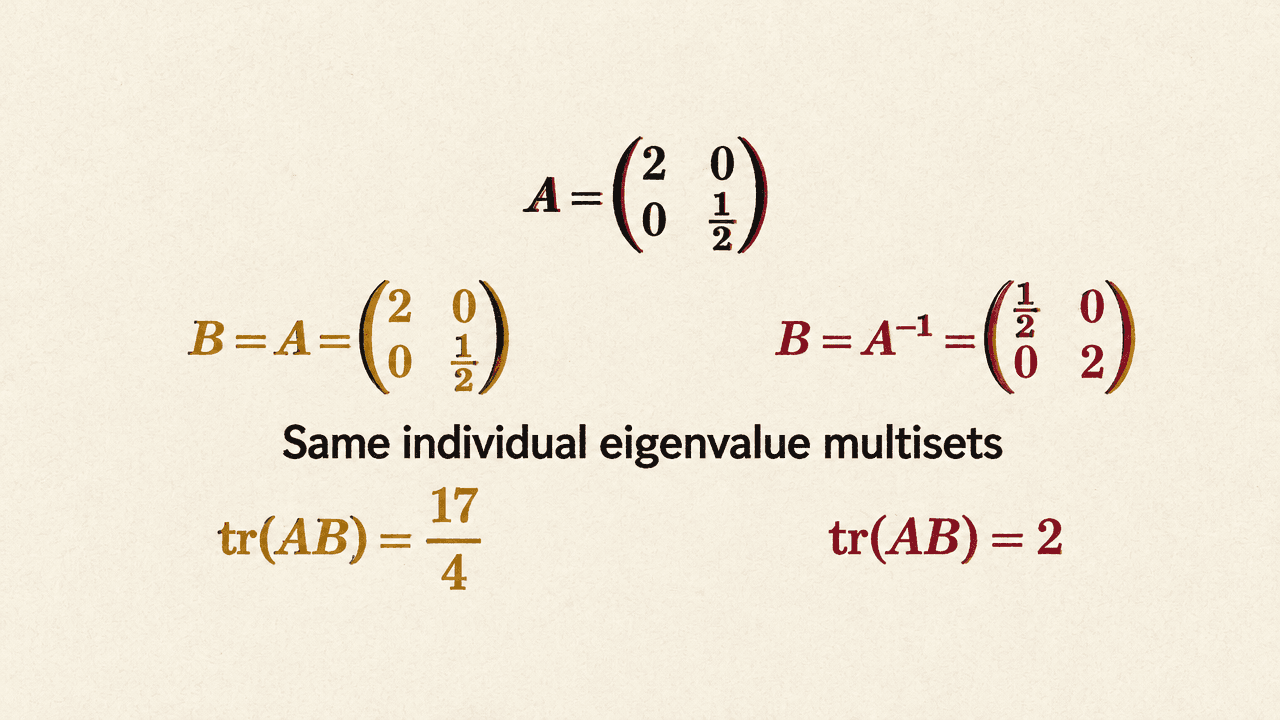
A matrix illustration makes the alignment problem concrete. Let A be diagonal with entries 2 and 1/2, and let B be either A or its inverse. In both cases A and B individually have the same eigenvalues, but the trace of AB is 17/4 in the first case and 2 in the second. The example is not a counterexample to the manuscript; it shows why individual data need not determine how pieces fit together.
The proof therefore compares simultaneous invariants of whole tuples, such as the tuple of parameter values at several Weil-group elements. Those compatible invariants are an input to the construction, not yet the desired global enhancement. The subsequent geometric and representation-theoretic arguments must produce a support point in an open orbit, then use Levi projections, the tuple criterion, and a lift through the finite center to obtain the global pair. The final identification is by one fixed conjugation for the entire parameter, rather than a different conjugation for each test.
The enhancement separates degree while retaining inertia
The setting is a smooth, projective, geometrically connected curve over a finite field with q elements, and a split, connected, semisimple group G. A full finite level is specified by a divisor D; removing its support gives the open curve U. The coefficient field is an algebraic closure of the ℓ-adic numbers, with ℓ different from the characteristic of the finite field.
An excursion character occurring at this level determines a parameter from the fundamental group of U into the Langlands dual group L. Restrict it to the Weil group Γ. Each element w of Γ has an integer degree, recording its motion in the constant-field direction.
At a good closed point x, write dₓ for its degree. The input theorem gives the semisimple Frobenius class as an SL₂ diagonal factor with entries a to the power dₓ and a to the power −dₓ, times a commuting algebraic factor cₓ; here a is a chosen square root of q. The factor cₓ centralizes the whole SL₂ image and is conjugate into a compact subgroup at every complex embedding. The common nilpotent orbit supplies the SL₂ type, but the local factors cₓ still have to be assembled coherently.
The output is a map φ from SL₂ to L and a map τ from Γ into the full centralizer of φ(SL₂), which may be disconnected. Define H(w) by applying φ to the diagonal matrix with entries a to the power deg(w) and a to the power −deg(w). After one fixed conjugation, the parameter satisfies σ(w) = τ(w)H(w) for every w in Γ. The map φ has the prescribed nilpotent orbit; τ is continuous and has reductive Zariski closure. Both maps are defined over a finite extension of the coefficient field.
This factorization retains ramification. Inertia elements have degree zero, so H is the identity on inertia and τ equals σ there.
The homomorphism property of τ depends on centralization. Since degrees add, H(wv) = H(w)H(v). Once the construction ensures that σ(v) commutes with H(w), expanding τ(wv) and rearranging the factors gives τ(wv) = τ(w)τ(v). Without that commutation, the rearrangement would not be valid.
An open orbit turns compatible tests into a global candidate
A nonzero cuspidal eigenvector generates a finite-type support. Its points record an initially abstract homomorphism b from Γ to the adjoint dual group and a Lie algebra element e, with the scaling relation Ad(b(w))e = q to the power deg(w), times e. The relevant simultaneous tuple invariants of b agree with those of the parameter. This agreement alone does not produce an enhancement: the proof uses carefully chosen good places to study the corresponding resonance spaces and must find a support point in an open orbit.
At such a point, Levi projections and the tuple criterion identify the candidate data; a lift through the finite center then produces the required global pair. The rank-one illustration shows what the open-orbit condition can look like. Take q = 4, let t be diagonal with entries 2 and 1/2, and let e have a single 1 in the upper-right entry. Then t e t inverse equals 4e. Under the diagonal centralizer, the nonzero multiples of e form one open orbit, with zero on its boundary. This is only an illustration: the general resonance spaces need not be lines, and the manuscript also treats the case where the resonance space is zero, so that the zero orbit is open.
To force an open-orbit point, the proof argues by contradiction. If no enhancement exists, each selected local test sees only boundary support. Coherent flag tests are constructed whose maps vanish on every derived residue-field fiber of that support. Fiberwise vanishing is not enough by itself to show global vanishing. A Noetherian tensor argument nevertheless gives a finite product of tests that kills the cuspidal class. A simple quotient of the cuspidal Hecke module detects that same class and shows it survives every finite product, a contradiction. A cohomological lower bound independent of the number of places makes the two calculations comparable. The category comparisons and the uniform-bound argument are substantial parts of the proof.
The result imposes a weight condition but stops short of classification
At every good place, the resulting Frobenius eigenvalues have absolute value 1 at every complex embedding in every finite-dimensional algebraic representation of the split rational form of the dual group. This weight conclusion is distinct from the input theorem’s compactness condition on the commuting local factors.
The proof explains the weight conclusion through a logarithmic absolute-value direction written as half the SL₂ cocharacter plus a residual direction. Commutation makes the directions orthogonal. The input fixes the total squared norm to the squared norm of the SL₂ contribution alone, forcing the residual direction to vanish. This argument applies to the Frobenius eigenvalues at every good place, in the stated representations and at every complex embedding.
The conclusion is one global commuting pair enhancing the original parameter, conditional on the stated finite-level input. It does not establish ellipticity, classify Arthur packets, or provide a multiplicity formula.