Infinitely Many Primes Have Squarefree Predecessors With Even Prime-Factor Parity
An OpenAI preprint proves that infinitely many primes p have p−1 squarefree with an even number of distinct prime factors. Its proof uses weighted candidates and analytic estimates to show that enough survive as primes after composites are removed; it does not claim that half of all primes have this property. Perplexity Computer adapted the preprint into an animated video.
The theorem concerns squarefree predecessors, not just even parity
For a prime p, consider the prime factors of p − 1. The manuscript claims that infinitely many primes have predecessors that are squarefree and contain an even number of distinct prime factors. The examples illustrate the distinction: 7 − 1 = 2 · 3 has two distinct prime factors, while 31 − 1 = 2 · 3 · 5 has three, and 211 − 1 = 2 · 3 · 5 · 7 has four. Examples do not establish that such primes continue indefinitely.
Squarefreeness matters because there are two ways to count factors. For 12, the factorization 2 · 2 · 3 has three factors counted with multiplicity but only two distinct prime factors. The Möbius function combines the conditions the theorem needs: μ(n) = 0 if a prime square divides n; otherwise it is +1 when the number of prime factors is even and −1 when it is odd. The theorem is that infinitely many primes p satisfy μ(p − 1) = 1†. The small case p = 2 qualifies because μ(1) = 1, but that single example says nothing about infinitude.
The construction writes a prospective prime as p = 2u + 1, with u odd. If u is squarefree, then 2u is squarefree, and its number of prime factors is one more than that of u. So an odd number of prime factors in u gives an even number in p − 1. For instance, u = 105 = 3 · 5 · 7 produces 2u + 1 = 211.
That change of variables isolates the parity condition but does not solve the problem: 2u + 1 need not be prime. The proof must find enough candidates satisfying the factor conditions and then show that prime candidates survive the removal of composites.
Weights isolate parity but leave primality and squarefreeness to prove
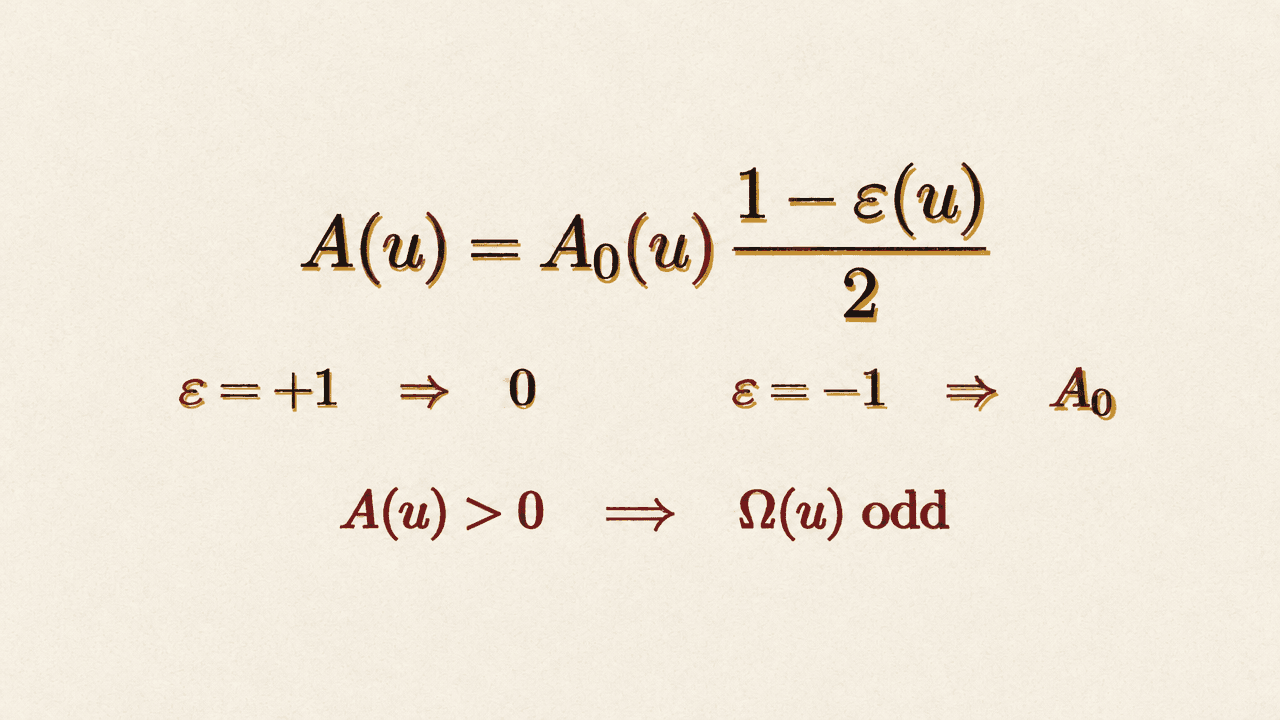
Rather than count all candidate integers equally, the manuscript assigns them non-negative weights. It divides prime factors into ordinary bands and designated groups. The ordinary part is arranged to contribute an even total number of factors, counted with multiplicity. A sign ε records the parity of the factor count in the designated groups: it is +1 for an even count and −1 for an odd one.
Multiplying the initial weight A₀(u) by (1 − ε(u))/2 removes candidates with an even designated-group count and retains those with an odd one. The resulting weight A(u) remains non-negative. A candidate with positive weight therefore has an odd total factor count. But this filter alone proves neither that u is squarefree nor that 2u + 1 is prime. Those are separate obstacles.
One exact algebraic step helps carry the parity information through the argument. For a positive integer D and endpoints w and w′, exponents of each designated prime add under multiplication. Thus ε(Dw) = ε(D)ε(w), and the same identity holds for w′. Multiplying these identities cancels the shared factor: ε(D)² = 1, so ε(Dw)ε(Dw′) = ε(w)ε(w′). The cancellation holds even if the factors overlap; it requires no coprimality or squarefreeness assumption. The manuscript uses this identity inside a larger dilation-graph argument. The identity itself is exact, but it does not establish the additional graph estimates that the broader proof needs.
Prime cancellation and distribution estimates do the harder analytic work
A second bridge replaces a slot occupied by rough integers with one occupied by primes. Here “rough” means having no small prime factors; it does not mean prime. To justify the replacement, the manuscript proves cancellation in sums over primes with an oscillating phase and a character that tracks residue classes.
In the stated ranges, the sum is smaller than any prescribed negative power of log x once the frequency passes a suitable logarithmic threshold, up to x². The result applies to intervals within the specified size range and to characters with moduli bounded by a power of log x; the threshold depends on the requested accuracy and other fixed parameters. The explanation omits the technical proof arguments, which it describes as proceeding through power-sum estimates, a logarithmic phase bound, and a zero-free strip. Its rotating-arrow diagram illustrates finite phases, not the asymptotic bound.
Combined with graph results imported from a companion paper, the new prime estimate yields a Type 2 theorem for weighted sums satisfying mn = 2u + 1. The theorem requires specified factor ranges and bounded coefficients, with rough support and strong discrepancy bounds on one coefficient sequence. Under those hypotheses, it gives a small weighted error; it does not say every such sum is small. The proof can then replace prime and roughness tests inside weighted sums by bounded local-density proxies, controlling the total error rather than asserting pointwise equality. A separate congruence theorem supports the initial sieve.
The sieve leaves primes after accounting for large-factor composites
Let X_A denote the total candidate weight near scale x, and let L = log x. After removing candidates with small factors and unbalanced composites, the manuscript retains weight at least a positive constant times X_A/L. The survivors are primes or composites whose least prime factor is unusually large.
For a remaining composite N = 2u + 1, with u between x and 2x, the least prime factor exceeds x^(1/2−κ), where κ is a small fixed positive number less than 1/50. If N had three prime factors, counting multiplicity, their product would exceed x^(3(1/2−κ)). That exponent is greater than one, so for sufficiently large x the product would exceed the candidate’s upper bound 4x + 1. Thus every surviving composite has exactly two prime factors.
These balanced semiprimes have factors q and r in the interval from x^(1/2−2κ) to x^(1/2+2κ). The manuscript bounds their total weight, including prime squares in the upper bound. It does not treat those squares as actual surviving candidates: since u is odd, 2u + 1 is congruent to 3 modulo 4, whereas a prime square is congruent to 0 or 1 modulo 4.
The final comparison is between the surviving weight and the weight of these composites. The survivors contribute at least (S/2)X_A/L, for a fixed positive constant S; the balanced composites contribute at most (Cκ + o(1))X_A/L, for a constant C. The proof establishes S and C first, then chooses κ small enough that Cκ < S/4. Positive prime weight remains. Removing candidates with non-squarefree predecessors costs only a negligible amount on the same scale, so a prime satisfying the desired condition still survives.
Because this works at arbitrarily large scales, it produces arbitrarily large qualifying primes and hence infinitely many. It does not claim that half of all primes qualify.