Bracket Data Recover Function Fields Up to Frobenius and Scaling
An OpenAI manuscript states that a restricted quotient of a field’s absolute Galois group, together with its commutator bracket, can recover the field’s perfect closure and constant field when the relative transcendence degree is at least two. The Bogomolov–Pop reconstruction theorem allows one global \(\ell\)-adic unit scaling in the group data and, in positive characteristic, identifies field isomorphisms up to powers of Frobenius. The manuscript’s central technical step is a uniform bound on the support of images of a pencil of functions, which lets the authors recover the geometric data needed for reconstruction.
The bracket data recover the field up to two ambiguities
For finitely generated function fields over algebraically closed constants, with relative transcendence degree at least two, the Bogomolov–Pop reconstruction theorem claims that a limited quotient of the absolute Galois group retains enough information to recover the field’s perfect closure and its constants. The result applies to surfaces and includes the prime (\ell=2). It has two qualifications: one global (\ell)-adic unit scaling is ignored on the group side, and in positive characteristic field isomorphisms are identified up to integer powers of Frobenius. The claim is stated in the OpenAI manuscript.†
The input is not supplied with valuations, divisors, or curve quotients. Those geometric structures must be recovered from the group data. For a prime (\ell) different from the field’s characteristic, the construction keeps the maximal pro-(\ell) quotient of the absolute Galois group, then considers its abelian quotient and a class-2 quotient, where commutators are central. The commutator bracket records the remaining failure of elements to commute. The theorem concerns continuous (\mathbb Z_\ell)-linear isomorphisms of the abelian data that respect this bracket.
Kummer theory translates the abelian quotient into multiplicative information about functions. At each level (\ell^e), functions differing by an (\ell^e)-th power are identified; the compatible levels form a completed multiplicative group. If ([f]) denotes the class of a function, multiplication becomes addition of classes: ([fg]=[f]+[g]). Constants disappear because the constants are algebraically closed.
The bracket nevertheless preserves a trace of field addition. Commuting pairs impose relations involving (x) and (1-x), expressed as (f(x)g(1-x)=f(1-x)g(x)). Local valuation theory uses these relations to detect candidate geometric places, including some that may also be nontrivial on the constants. The reconstruction problem is to identify the genuine geometric objects among those candidates without having been given them in advance.
Uniform support is the hinge between symmetries and geometry
The central technical obstacle is not showing that each individual function class has finite support at a finite level. It is proving one bound that works across all levels and all members of a pencil.
Suppose two fields have matching bracket data, inducing a map (\Theta) on completed function classes. Fix a nonconstant function (t) in the first field and vary a constant (a). The classes ([t-a]) form a pencil; their images (h_a) in the second field need not initially look like ordinary functions. On a fixed projective model of that field, support is measured by summing the degrees of divisors where the order of (h_a) is nonzero. At each finite level only finitely many divisors appear, but that alone gives no common bound for the whole pencil.
To obtain one, the argument chooses five distinct fixed members of the pencil and one additional test member. At a sufficiently high finite level, a residual curve preserves the relevant power relations and support counts. The curve can vary with the test, but its genus stays bounded by a constant (G) determined by the fixed projective model. A local correspondence gives a matching curve of the same genus. After removing inseparability, the residual pencil defines a separable map to the projective line, of degree (n).
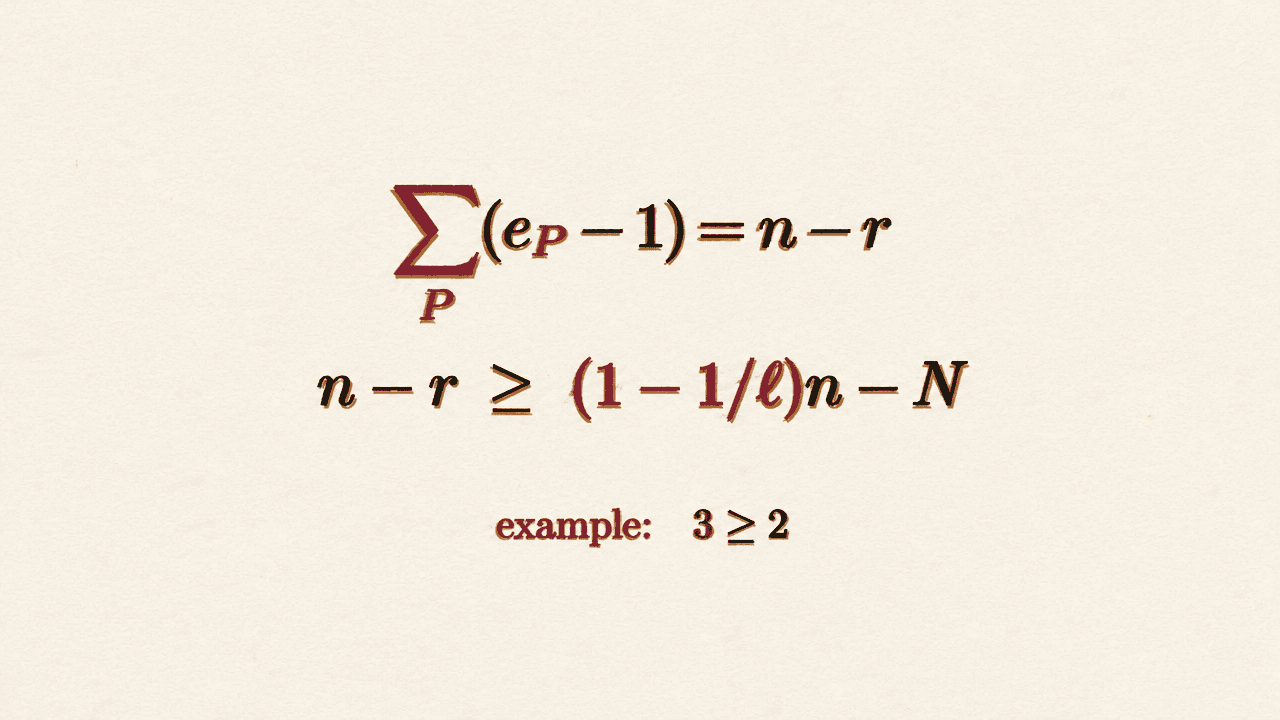
The five fixed members matter because their fibers constrain that degree. In each fiber, multiplicities sum to (n). The argument bounds the number of points with multiplicity not divisible by (\ell); every other point uses at least (\ell) units of the total multiplicity. This gives a lower bound on the fiber’s contribution to ramification. Applying it to five distinct fibers and combining it with Riemann–Hurwitz bounds (n) using the genus bound and counts fixed at the first finite level. The different exponents dominate multiplicity minus one, so the estimate remains valid with wild ramification.
For (\ell=2), five fibers leave a positive coefficient on (n); four would leave zero and would not provide this bound. The resulting degree bound is independent of both the additional pencil member and the finite test level.
Zeros and poles of a pencil member lie in fibers of the map, with at most (n) points in each, so their combined support is bounded by (2n). This first gives a bound at sufficiently high finite levels. The finite-level supports are nested, and every nonzero (\ell)-adic order eventually appears. If the exact support exceeded the bound, some finite collection of divisors would already exceed it; at a high enough level all would be visible together, contradicting the finite-level estimate. Thus the degree bound yields a uniform exact-support bound for every member of the pencil. That uniform bound is the input to the finite-type geometric step that follows.
Recovered curve data complete the reconstruction
The remaining step is geometric. Infinitely many bounded-degree divisors fit into a finite-type parameter family. Their incidence with the original model produces a curve subfield after a finite extension. One parameter curve is fixed before the power tests, rather than selected anew for each test. Normal base change, norms, and an intersection argument then descend the construction.
Applying the construction in both directions matches the completed curve subfields. The recovered data identify divisorial valuations trivial on the constants and recover rational curve quotients. Together with the decomposition graph and compatible rational maps, these data meet the hypotheses of Pop’s global reconstruction theorem.
The stated result is a correspondence between bracket-compatible continuous (\mathbb Z_\ell)-linear isomorphisms of the retained group data and isomorphisms of the fields’ perfect closures carrying one constant field onto the other, after the stated ambiguities. On the group side, a single global (\ell)-adic unit scaling is ignored; the central map scales by its square. In positive characteristic, isomorphisms are identified up to integer powers of Frobenius. In characteristic zero, the perfect closure is the field itself and there is no Frobenius ambiguity.
The manuscript’s accompanying checks have narrower scope than the theorem: these exact partition cases check the illustrated local counting mechanism, not the full theorem. The linked formalization targets uniqueness only, does not formally prove existence, and was not reproduced.