A Uniform Logarithmic Gap Separates Real Dirichlet Zeros From 1
An OpenAI preprint claims that every real zero of an eligible Dirichlet L-function stays a fixed logarithmic distance from 1: for primitive, nonprincipal real characters of conductor \(q\), it asserts \((1-\beta)\log q \ge c\) for an absolute positive constant \(c\). The manuscript’s proof links a hypothetical zero closer to 1 to weighted estimates over primes, then uses their divisibility of an algebraic determinant’s norm to contradict an upper bound on its size; it does not give a numerical value for \(c\).
The theorem gives one logarithmic margin for every eligible zero
The manuscript claims that a real zero of a Dirichlet L-function cannot approach 1 arbitrarily closely relative to its conductor. For every primitive, nonprincipal, real character χ of conductor q ≥ 3, and every real zero β with 0 < β < 1, it asserts that (1 − β) log q ≥ c, where c is one absolute positive constant shared by all eligible characters and zeros.
The claim is not that real zeros do not exist anywhere in (0, 1), and the manuscript supplies no explicit numerical value for c. It is not the Riemann hypothesis. The proof’s central quantity is δ = (1 − β) log q. It links a hypothetical small δ to weighted prime estimates, then uses those estimates to make an algebraic determinant both highly divisible and too small.
A small gap constrains the weighted mass of both prime signs
A real character assigns a multiplicative sign to integers coprime to q: χ(n) is +1 or −1, and is zero when n shares a factor with q. Its L-function begins with the series Σ χ(n)/nˢ for Re(s) > 1, then continues analytically beyond that region.
The proof separates primes by sign, but weighs each prime by log p/p rather than simply counting it. The analytic step combines the logarithmic derivatives of the zeta and L-functions. Their prime-power expansion has nonnegative terms; the zero β contributes the difference
At s = 1 + 1/log X, this difference is at most (1 − β)(log X)². Writing ℓ = log q and δ = (1 − β)ℓ, the manuscript’s estimates bound the weighted mass of plus-sign primes p ≤ X by Cℓ + Cδ(log X)²/ℓ. For minus-sign primes with H < p ≤ X and p not dividing 2q, it gives a lower bound of log X − Cℓ − C_H − Cδ(log X)²/ℓ. Here C is absolute and C_H depends only on H.
Thus a small gap suppresses the plus-prime mass on the scales used in the proof. The minus-prime estimate has its own conductor, cutoff, and gap error terms. These are weighted-mass bounds, not unqualified claims about prime counts. That distinction matters: the later argument uses the minus-sign primes as a supply of distinct divisibilities of the determinant’s norm.
The determinant turns prime signs into a divisibility bound
The proof represents the character using a square-free number d, and sets a = √d and b = √2. When d ≠ 1, 2, the field has basis 1, a, b, ab. From the N⁴ elements θₙ = n₁ + n₂a + n₃b + n₄ab, with each nᵢ between 0 and N − 1, the manuscript forms a matrix whose rows evaluate monomials in these elements and three conjugates.
The interpolation lemma and row selection do different jobs. The lemma supplies enough independent evaluations, uniformly in the field, to make a nonzero determinant Δ possible; its supporting phase argument is omitted in the explanation. The greedy row-selection rule then chooses a determinant from those available rows. The degree scale is U = N^(4/3). The rank conclusion comes from the interpolation result, not from counting columns alone.
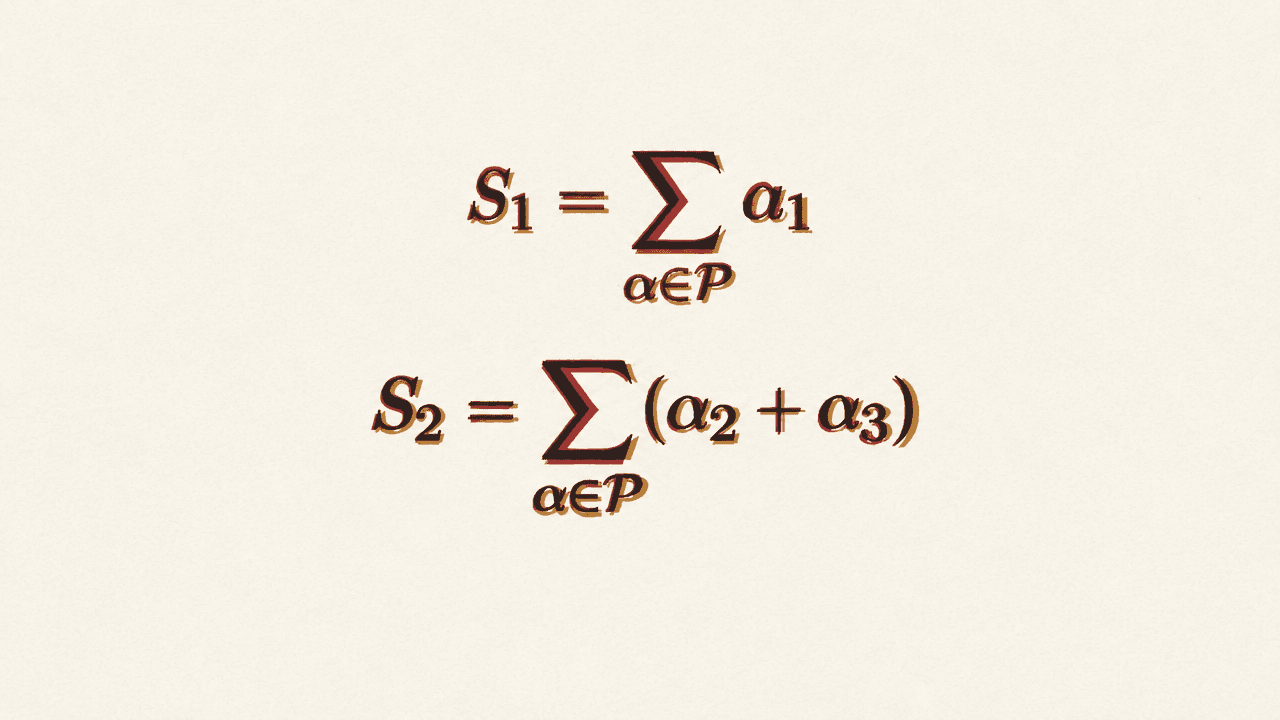
Rows are retained only when they increase the span of those already chosen. Their selection gives the first exponent cost 1 and each of the other two exponent costs H. If S₁ is the sum of first exponents and S₂ the sum of the other exponents, the manuscript’s counting argument gives S₂/S₁ ≤ C₀/(c₀H), for fixed H and sufficiently large N. Choosing H large therefore concentrates degree in the first coordinate.
This concentration is what lets the determinant absorb prime factors without changing. For a prime p > H that does not divide 2q and has χ(p) = −1, taking pth powers modulo p sends elements to one of two conjugates, depending on (2/p). Call the relevant conjugate of x, gₚ(x). If a first exponent is pk + r, with 0 ≤ r < p, the corresponding factor can be replaced by xʳ(xᵖ − gₚ(x))ᵏ. The replacement entries contain pᵏ.
On expansion, the extra terms replace blocks of p first-coordinate factors with conjugate factors. Their weighted cost falls by p − H, which is positive. They therefore lie in the span of earlier retained rows, by the greedy selection rule. The determinant is preserved while powers of p are extracted. The row combinations may use coefficients in the field; divisibility comes from the replacement entries themselves.
The manuscript illustrates the arithmetic with d = 3 and p = 5: a⁵ is congruent to −a modulo 5, and b⁵ to −b. Consequently (a + b)⁵ is congruent to −a − b modulo 5. This is an algebra example, not evidence for a zero near 1.
Multiplying Δ by its four conjugates gives a nonzero integer, its field norm. Each eligible minus-sign prime forces a large power to divide that integer. The weighted minus-prime estimate supplies enough such primes, up to U, to combine these divisibilities into a lower bound whose leading term is S₁ log U. In this way, the analytic estimate becomes arithmetic pressure on the norm.
The same norm has an upper size bound from Hadamard’s inequality: its leading term is (S₁ + S₂) log N, plus conductor-dependent and other error terms. Since log N = ¾ log U, the upper bound’s leading term is smaller than the lower bound’s when S₂/S₁ is sufficiently small. The conductor and error terms still need control; the final parameter choices do that.
The parameter order turns the competing bounds into a contradiction
Assume there is no common positive lower bound for δ. The proof takes a sequence with q tending to infinity and δ tending to zero. Bounded conductors cannot supply such a sequence: there are only finitely many relevant characters, and their L-functions are nonzero at 1. The exceptional field d = 2 is eventually absent as well.
The choices are made in a fixed order. First choose H so that S₂/S₁ ≤ 1/12. Next choose a sufficiently large fixed γ, and set N = ⌈qᵞ⌉. Only then take the sequence limit. The manuscript says the conductor contribution becomes small and the remaining errors vanish. After normalization, the bounds would imply
The right-hand side tends to 7/8, an impossibility. This rules out a sequence of eligible zeros for which (1 − β) log q tends to zero, yielding the claimed uniform positive margin.
The interpolation proof and technical estimates remain in the manuscript; the explanation develops the determinant’s prime-divisibility step in detail.