Codex 5.6 Helped Disprove a Three-Year Algebraic Surfaces Conjecture
Bartosz Naskręcki, a computational mathematician at Adam Mickiewicz University and CCAI Warsaw, says OpenAI’s Codex 5.6 helped his team break open a three-year problem in algebraic surfaces by finding a route they had not tried. The result was not the proof they had been seeking, but a disproof: in his account, the model’s value was in organizing and executing enough technical computation to make a difficult mathematical discovery reachable.
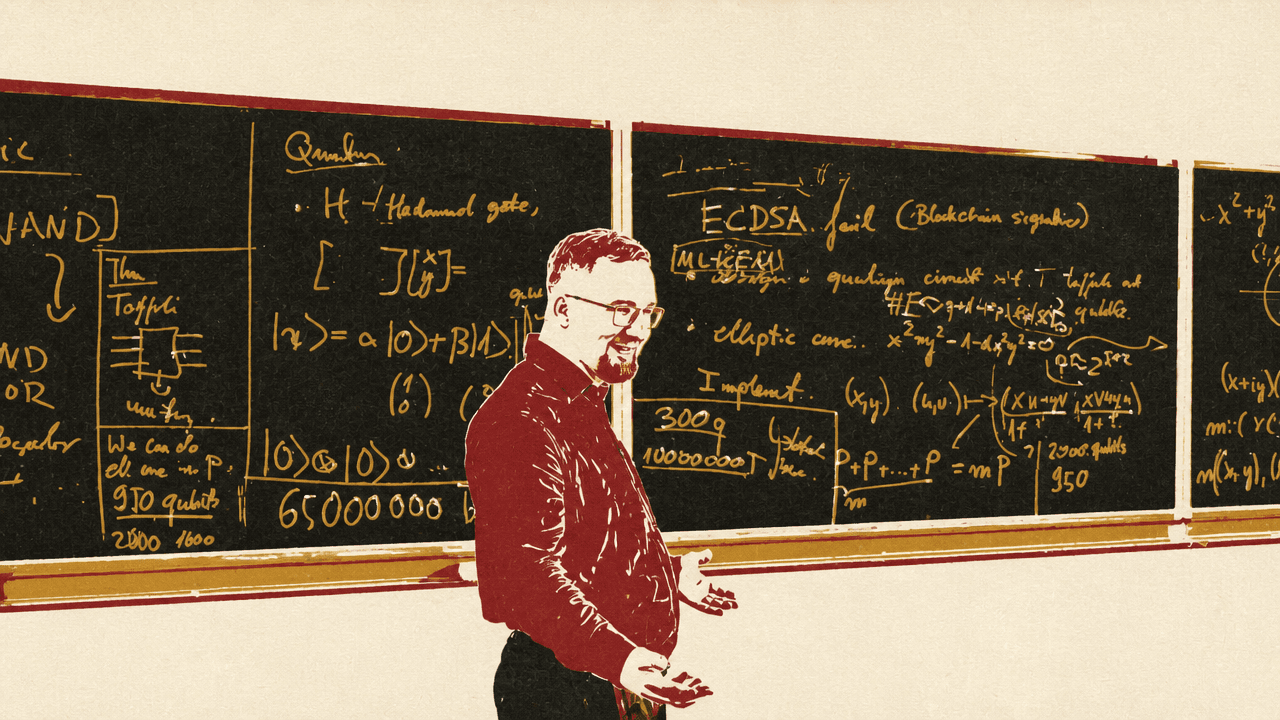
A three-year conjecture failed because Codex found a different route
? bartosz-cki says his team had spent three years on “a remarkably hard question about algebraic surfaces.” They had tried programming experiments, pen-and-paper reasoning, and previous models. None worked well enough.
The change came when he tried what he calls “the new Codex 5.6.” Codex produced “a completely new idea” and helped the team disprove the conjecture they had been trying to prove. The important point is not only that the model sped up a known computation, but that it changed the mathematical direction of the work: the result was not a proof of the hoped-for statement, but the conclusion that the conjecture was false.
Codex was able to come up with a completely new idea, and it helped us disprove the conjecture that we were trying to prove for these three years.
Naskręcki gives one numerical hinge for the contradiction: “14 over 5 is actually bigger than 8 over 3.” From that comparison, “it turns out that the conjecture was basically false.” He does not identify the conjecture by name, but he does identify the outcome: a problem that had occupied the team for three years did not survive the new route Codex helped produce.
His reaction was not framed as disappointment. “I’m so excited of the discovery,” he says. “That’s why we do science, right? Yeah, we want the fun.” The discovery mattered because it resolved the direction of the problem, even if the resolution was negative.
The useful work was organizing computation that would otherwise consume weeks
? bartosz-cki describes his research rhythm in practical terms. When he is stuck, he leaves the problem for a while and goes into the garden, often mowing the lawn while “completely immersed” in his own thoughts. When he returns, he runs Codex for exploration and technical work that would otherwise take weeks.
OpenAI’s on-screen framing calls this “Accelerating mathematics research with GPT-5.6.” Naskręcki’s own description centers on Codex and “Codex 5.6”: he sets up the task, and the system handles exploration and technical execution around the mathematical problem.
The most specific claim about what felt new is how the system behaves when the task becomes computationally large. Codex 5.6 “feels kind of natural,” he says, because after the task is set up, the model can recognize that substantial computation is required and “spawn the sub agents automatically” without him asking for it.
That is more than faster typing or code completion. In the mathematical workflow he describes, Codex recognizes that there is “a lot of computation going” and organizes sub-agents on its own.
You won’t be scared by the sheer amount of computation because you’ll be able to organize it with the model.
For a computational mathematician, that changes the threshold for what is worth attempting. Researchers with “the audacity to try something very big” may be less constrained by the volume of computation if the model can help organize it.
The claim comes from someone already fluent in computation
? bartosz-cki is identified on screen as a computational mathematician at Adam Mickiewicz University and CCAI Warsaw. A shot also shows the exterior sign for Collegium Mathematicum, the Faculty of Mathematics and Computer Science.
He situates the Codex work inside a longer personal relationship with programming. He remembers working on computer code at around age five and “barely” remembers a time when he could not code. “It was like always in my blood,” he says. Childhood photographs on a laptop screen show a young boy typing at an early computer and interacting with scientific equipment.
Those details matter because the claim about Codex comes from someone already comfortable using computation as part of mathematical work. He was not describing a first encounter with programming. He had already been trying “programming stuff” on the algebraic-surfaces question before Codex 5.6 entered the process.
The narrower claim is more useful: the model changed what an experienced computational mathematician could explore and how much technical work he had to carry himself.
The human work remains the hard idea
? bartosz-cki does not describe AI tools as removing the mathematician from the work. They are “meant to empower people.” In his own life, that means more attention for “hard ideas in math,” but also for his family, his kids, and mowing.
Naskręcki expects this ability to organize large amounts of computation to support “a lot of fun and a lot of new discoveries.” He is not claiming that every mathematical problem becomes solvable, or that conjectures will always be proved. In the example given, the breakthrough was the opposite of proof. A conjecture that had guided three years of work was found to be false.
That is still a mathematical discovery. In Naskręcki’s telling, Codex 5.6 mattered because it helped make that discovery reachable.