NVIDIA Alpamayo Presents Autonomous Driving as Explainable Micro-Decisions
NVIDIA presents Alpamayo as a reasoning-based autonomous driving model whose decisions can be rendered as audible, causal judgments rather than hidden vehicle behavior. In the demo, the car responds to ordinary city traffic by explaining why it stops, yields, nudges or keeps distance — because a pedestrian is in the lane, a stop sign controls the intersection, a truck blocks space or another vehicle is merging. The point is not that the car can speak, but that NVIDIA wants Alpamayo understood as continuously evaluating road conditions while the passenger experience remains routine.
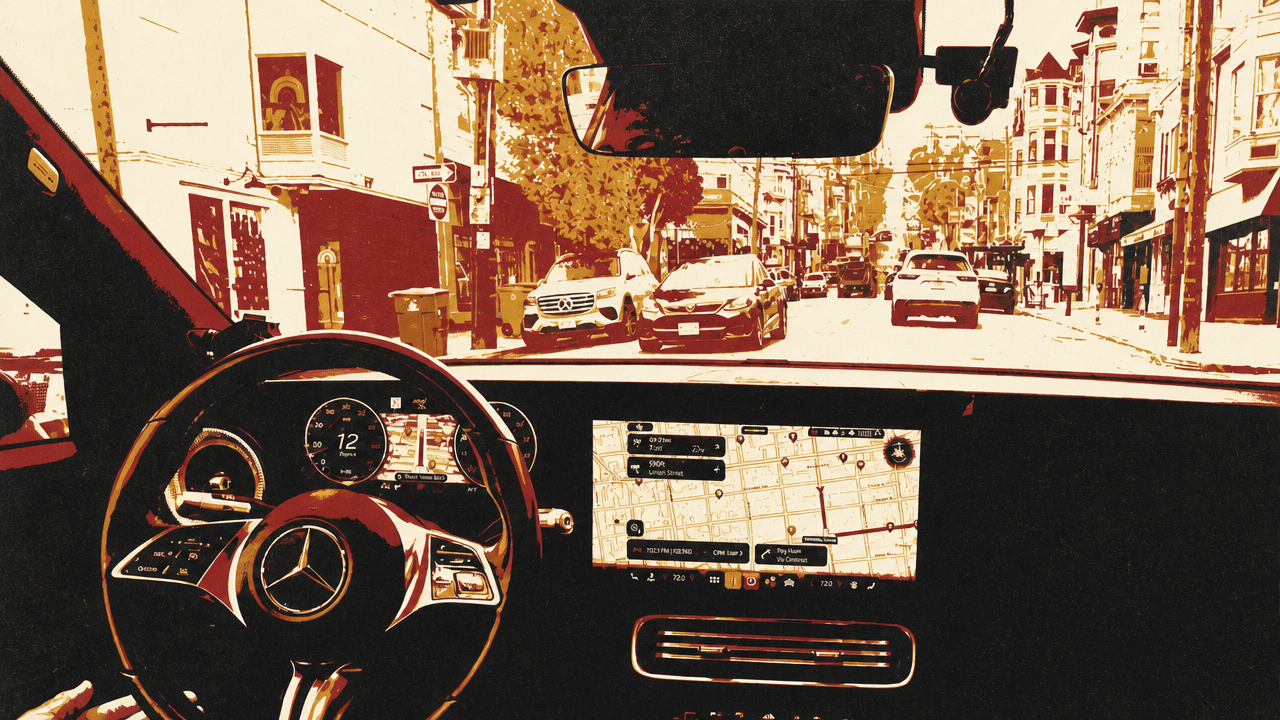
Alpamayo turns driving into causal judgments
Alpamayo is presented as an autonomous driving model whose behavior can be expressed as a stream of reasons: what the vehicle is responding to, what it intends to do next, and why it is changing position or speed. The opening prompt is explicit: “What if you could hear what your car is thinking?” The answer is not a general narration of the route. It is a running account of driving judgments.
The human request is simple: “Hey Mercedes, let’s go to my favorite sandwich shop.” The vehicle responds with ordinary assistant language — “Routing to your destination” — before the normally hidden driving policy becomes audible. On-screen text calls this “NVIDIA Alpamayo thinking out loud,” while point-of-view city driving footage shows a bright green augmented-reality overlay marking surrounding vehicles, pedestrians, and the road ahead. The road scene and the narration work together: relevant agents are highlighted, and the car states its choices as responses to them.
The substantive move in the demonstration is not that the car can speak. It is that Alpamayo’s driving behavior is rendered as a sequence of situation-specific reasons. The vehicle does not merely say “slowing,” “stopping,” or “changing lanes.” It ties each action to a condition in the world: a stationary lead vehicle, a stop sign, a pedestrian in the lane, a cut-in vehicle, cross traffic, or a truck blocking one side of the lane.
“Lane is clear, pulling out to start drive” establishes the pattern. Alpamayo is presented as continuously checking whether the lane is clear, what is blocking it, who has priority, and what distance should be maintained. The main spoken reasoning sequence contains 19 distinct driving judgments if the initial pull-out, “slow down to stop,” each stop, each yield, each nudge, and each repeated “keep distance” statement are counted as separate decisions.
Stop, yield, nudge, keep distance
The spoken stream is built from a small set of repeated driving commitments. Alpamayo stops, yields, nudges, and keeps distance. Each verb carries a specific kind of road judgment.
“Stop” is used when the vehicle must obey control or preserve space. Alpamayo slows down to stop at a stop sign controlling the intersection. Later, it stops again at a stop sign because the intersection is controlled, stops to yield to a pedestrian in the lane, stops to yield to cross traffic, and stops to keep distance to the lead vehicle.
“Yield” is reserved for other road users who are entering or occupying the path. Alpamayo yields to a pedestrian because the person is in the lane. It yields to a cut-in vehicle from the left. It yields to cross traffic because a vehicle is crossing ahead. The language is causal and constrained: the decision follows from the other actor’s position or movement, not from a generic caution signal.
“Nudge” describes small lateral adjustments around blocked space. Alpamayo nudges left because a stationary lead vehicle is blocking the lane, then nudges left to clear a stopped vehicle on the right. It nudges left again because a stopped van blocks the right side of the lane. Around trucks, the adjustments alternate: nudge left when the truck blocks the right side, nudge right when the truck blocks the left side, then nudge left again when the right side is blocked.
“Keep distance” covers following and merging situations. Alpamayo keeps distance to a cut-in vehicle because it is merging into the lane. It keeps distance to the vehicle directly ahead in the lane, repeats that judgment, and later keeps distance to the lead vehicle. The repetition is part of the point: distance management is not a single maneuver but a continuing condition.
| Decision verb | Road condition named in the narration | Driving response |
|---|---|---|
| Stop | Stop sign, pedestrian in lane, cross traffic, lead vehicle | Bring the vehicle to a stop or preserve space |
| Yield | Pedestrian, cut-in vehicle, crossing vehicle | Defer to another road user occupying or entering the path |
| Nudge | Stationary vehicle, stopped van, truck blocking part of the lane | Make a small lateral adjustment around blocked space |
| Keep distance | Merging vehicle, vehicle directly ahead, lead vehicle | Maintain separation from traffic ahead or entering the lane |
Ordinary city traffic supplies the test cases
The road situations are ordinary but demanding. Alpamayo encounters stop signs, pedestrians, cross traffic, merging vehicles, stopped vans, lead vehicles, and trucks partially blocking the lane. None of these moments is treated as dramatic. The value of the demonstration comes from their accumulation: the car must repeatedly decide whether to proceed, stop, yield, shift laterally, or maintain following distance.
The language emphasizes local constraints rather than broad route planning. “Due to,” “since,” and “because” repeatedly pair an action with its justification. Alpamayo slows because an intersection is controlled by a stop sign. It stops because a pedestrian is in the lane. It yields because cross traffic is crossing ahead. It nudges because a stopped object or truck blocks part of the lane. It keeps distance because another vehicle is merging or directly ahead.
That phrasing presents Alpamayo less as a system that simply routes to a destination than as one that repeatedly resolves constrained road situations. The destination is almost incidental. The operational substance is the series of micro-decisions required to get there while accounting for pedestrians, vehicles, stop signs, cross traffic, and blocked lane space.
The repeated “nudge left” and “nudge right” decisions are a useful detail. City driving is treated as a sequence of small lateral negotiations rather than clean, dramatic lane changes. The vocabulary is cautious and bounded: “nudge,” not “swerve”; “keep distance,” not “proceed”; “yield,” not “claim priority.”
The passenger hears little; the reasoning layer stays busy
The ride has two layers of interaction. To the passenger, the trip is simple: request a destination, receive routing confirmation, arrive with “Your destination is on the right.” Between those ordinary interface moments, Alpamayo’s audible reasoning is dense.
The final on-screen line captures the distinction: “NVIDIA Alpamayo is always thinking. Even if you never hear a thing.” The spoken monologue is an explanatory device for the demonstration — a way to make the model’s continuing evaluation audible while the passenger experience remains quiet and routine.
The version of “thinking” presented here is practical and behavioral. It consists of identifying relevant actors and constraints, choosing a next maneuver, and giving a causal reason for that maneuver. The visual overlay supports the same idea by marking surrounding vehicles, pedestrians, and the road ahead while the voice explains stopping, yielding, nudging, and distance-keeping.
NVIDIA’s supplied description calls Alpamayo a reasoning-based autonomous driving model that “continuously evaluates the road, plans next steps, and adapts to changing city traffic.” The demo stays at that product-facing level. It does not expand into model architecture, training method, sensor stack, benchmarks, or a safety case. Its focus is narrower: an autonomous vehicle whose decisions are represented as audible, causal driving judgments.