AI Agents Link Virtual Experiments to Lab Tests, Factory Plans to Floor Conditions
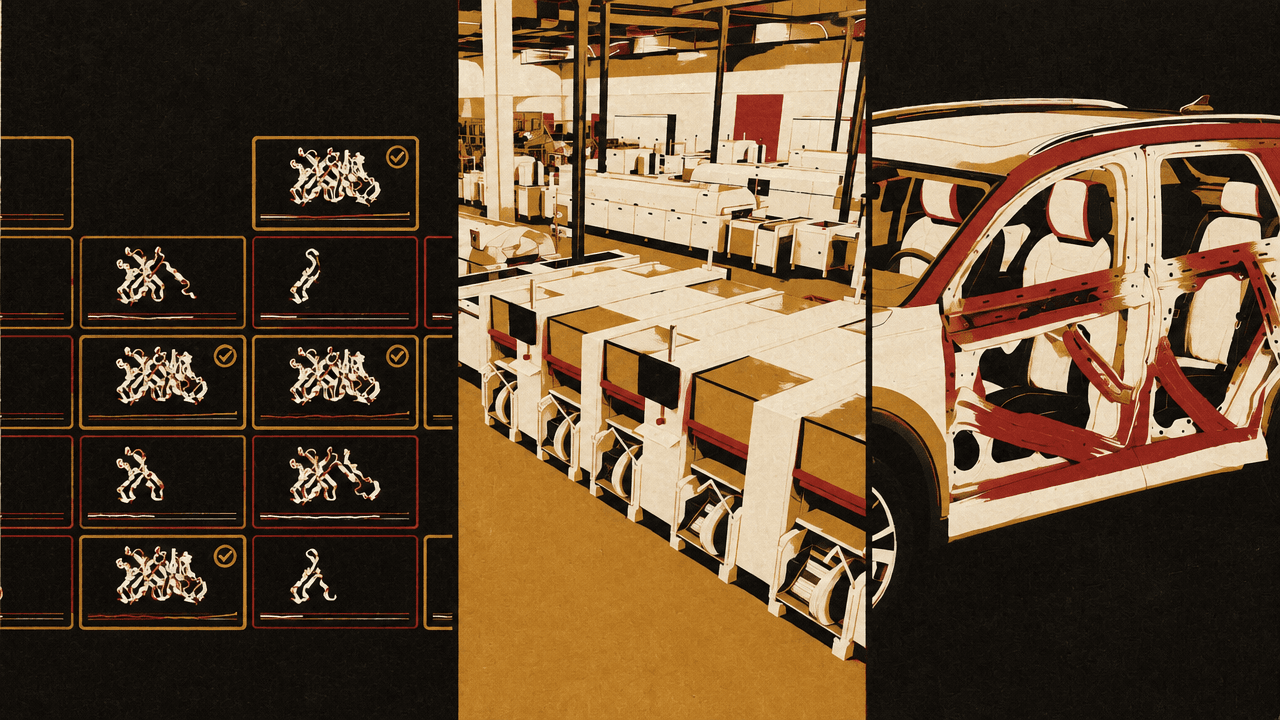
NVIDIA’s GTC Berlin presentation argues that industrial AI agents need more than a model: they must connect to company knowledge and domain-specific tools, with controls over what they can access and execute. It illustrates that architecture through Lila Sciences’ experiments for therapy design, Siemens’ production planning and Dassault Systèmes’ vehicle-design workflow. Lila feeds physical test results into another round of designs and experiments; in Dassault Systèmes’ example, simulation results prompt refinement before an engineer selects the final design.
An agent needs more than a model
A capable scientist still needs a laboratory; an engineer still needs simulators and solvers. The same principle shapes the agent architecture NVIDIA presents: a model is one component in a system built to carry out work.
The five building blocks are a model that perceives, reasons and plans; a harness that coordinates work; a knowledge foundation drawing on a company’s structured and unstructured data; tools that let the agent simulate, experiment and act; and NVIDIA OpenShell, which controls what agents can access and execute. A company can start with a frontier closed model or customize an open one. NVIDIA presents its Agent Toolkit as a way to bring these elements together around company knowledge and expertise.
The examples put those components to work in distinct settings: proposing experiments, planning factory operations and refining a vehicle design. In each, the agent is connected to domain-specific tools and systems. The source’s architecture diagram names the model, knowledge and tools alongside NVIDIA OpenShell’s gateway, supervisor, policy prover and harness.
Lila’s agent connects virtual experiments to physical testing
Lila Sciences’ goal is to design a therapy for B-cell lymphoma. Its Lila Iris agent, built on NVIDIA NeMoTron, turns that goal into an experimental plan.
In the computational “dry lab,” Lila agents use the NVIDIA BioNeMo Agent Toolkit to call models for protein design and RNA optimization, running millions of virtual experiments.
The most promising candidates move to Lila’s AI Science Factory, where autonomous robots and instruments, developed with NVIDIA Omniverse and Cosmos, make and test them. The results return to Iris and shape the next designs and experiments. The sequence links computational exploration to physical testing and feeds those test results into another round of work.
Siemens checks production plans against factory conditions
At Siemens’ electronic factory in Erlangen, the goal is to bring new products into production. Process preparation X-agents use NVIDIA Cosmos to generate virtual prototypes and synthetic data, then train and validate inspection models before production starts.
A separate set of agents addresses production planning. Intelligence Center X-agents use orders, supplies and line setups to recommend plans. The interface shown on screen presents an agent being asked to update production plans after a new order arrives. Digital Twin Composer uses NVIDIA Omniverse libraries to validate the plans with physics simulation and real-time factory data before changes reach the factory floor.
The source describes two related but distinct tasks: preparing inspection models before production, and recommending production plans using operational inputs. In the latter workflow, simulation and factory data are used to validate plans before changes reach the floor.
Vehicle simulation sends a design problem back for revision
Dassault Systèmes’ example adapts a Volkswagen Golf door design for the Tiguan. Aura and Leo use NVIDIA NeMoTron to reason over engineering requirements. A harness coordinates specialized sub-agents and preserves context across planning, design and simulation.
Aura uses ENOVIA to plan the work around the vehicle’s dimensions, weight limits and other engineering requirements. Leo Design Agent selects a compatible Golf door design and uses CATIA to reshape it for the Tiguan. Leo Simulation Agent then uses SIMULIA, accelerated by NVIDIA CUDA-X libraries, to test the variants.
The simulation reveals a vibration problem. Its results return to the design agent for refinement, after which an engineer reviews the refined designs and selects the final one. The on-screen simulation visualizes a side-impact crash test, and another view shows door variants with vibration modes and frequencies. The workflow places simulation between design and the engineer’s final selection.
The same components support different workflows
The three applications use the same broad building blocks, but the work differs by domain. Lila’s experimental results inform subsequent designs and experiments. Siemens’ plans are checked using physics simulation and real-time factory data. In vehicle engineering, simulation results prompt design refinement before an engineer selects the final design.
NVIDIA’s closing formulation is open models, CUDA-X-accelerated tools and the OpenShell secure runtime, brought together through the Agent Toolkit. Across the examples, agents coordinate specialized models, knowledge and tools; the specific tasks and the point at which a person reviews or selects an outcome vary with the workflow.