NVIDIA Frames Physical AI Startups as the Next Industrial Stack
NVIDIA’s GTC Taipei 2026 startup showcase argues that the next industrial AI cycle will be built around “physical and sovereign AI”: systems that combine accelerated compute, domain models, simulation, robotics, healthcare, quantum workflows, and network infrastructure. Through Inception companies including Tricuss, FindingsTech, Nexuni, RLWRLD, Quantum Brilliance, and SynaXG, NVIDIA presents its hardware and software stack as the means to move AI from prototypes into deployed industrial systems.
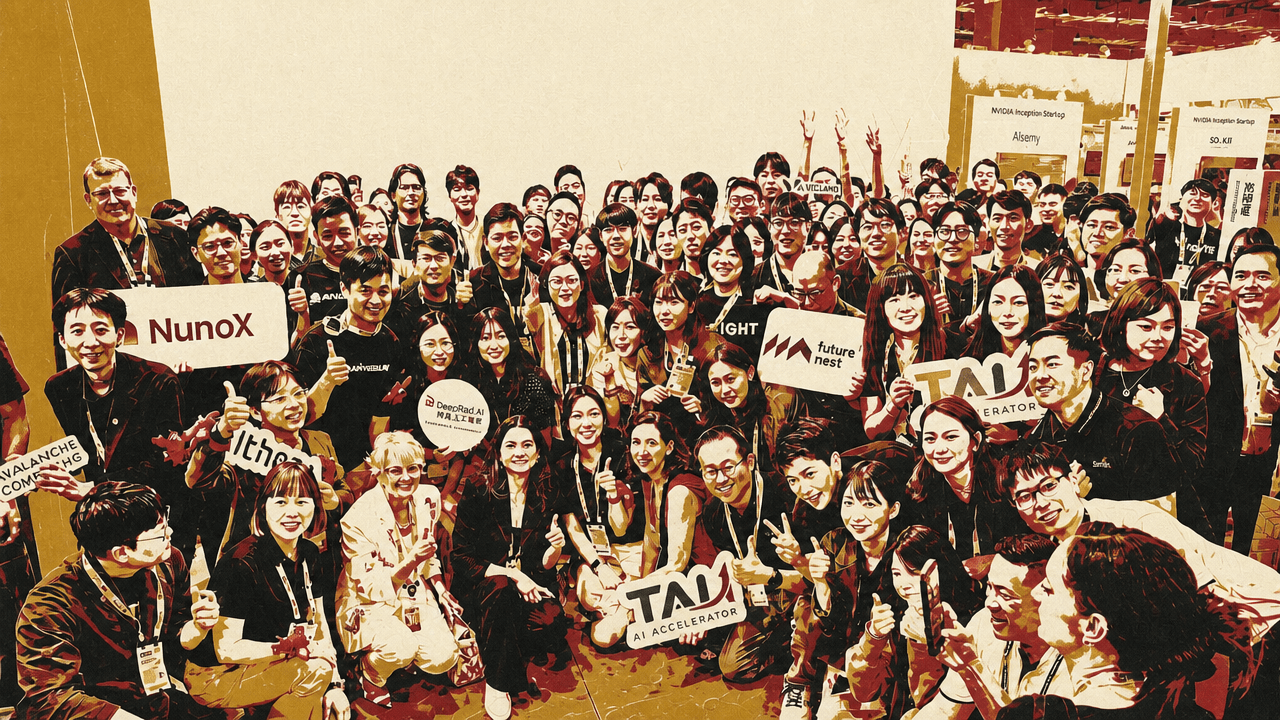
NVIDIA’s startup thesis is full-stack acceleration applied to physical infrastructure
NVIDIA frames the next industrial cycle around “physical and sovereign AI”: systems that connect digital intelligence to real-world infrastructure, national or enterprise-scale compute, communications, robotics, healthcare, R&D, and quantum workloads. The startups highlighted at GTC Taipei 2026 are presented less as isolated application companies than as examples of a common pattern: use NVIDIA’s software and hardware stack to shorten the path from model, simulation, or prototype to deployed industrial system.
The claim is that this compression is already visible across multiple technical domains. In R&D simulation, Tricuss is shown using PhysicsNeMo and physics AI models. In healthcare, FindingsTech uses MONAI and a proprietary 3D model for liver analysis. In robotics, Nexuni and RLWRLD build on Isaac GR00T, Jetson, and Isaac Lab. In quantum computing, Quantum Brilliance uses CUDA-Q, cuTensorNet, and Grace Hopper. In network infrastructure, SynaXG uses NVIDIA AI Aerial to combine 5G and AI workloads on one platform.
The unifying argument is not that all of these markets are the same. It is that the relevant bottleneck in each market is now the ability to connect accelerated compute, domain-specific models, simulation, and deployment infrastructure into a production system. NVIDIA presents its Inception program as the ecosystem wrapper around that stack, offering startups technical resources, cloud credits, and venture-capital exposure.
Tricuss turns R&D simulation into an autonomous research workflow
Tricuss is positioned around the end-to-end R&D lifecycle. Its Co-Research AI Agent integrates NVIDIA PhysicsNeMo and physics AI models to support experiment design, simulation runs, and research insight generation. The software interface shown during the presentation describes the system as “Your AI Researcher,” likening it to “a senior researcher with deep knowledge of Physics and Statistics.” It also shows an auto-generated research report, parameter tables, and a 3D heatsink visualization.
The material claim is speed and experimental reduction. NVIDIA says Tricuss combines physical simulations that run 1,000 times faster with statistical algorithms, reducing experiments by 70% and compressing weeks of R&D into minutes.
The emphasis is not simply faster simulation. The showcased workflow ties simulation speed to an autonomous loop: design the experiment, run the simulation, analyze the output, and produce a research report. In NVIDIA’s framing, that is the mechanism by which R&D cycle time collapses.
FindingsTech applies MONAI to volumetric liver-fat analysis
FindingsTech is presented as a healthcare AI company focused on fatty liver quantification in Taiwan. Its Hepatowell AI platform is powered by NVIDIA MONAI and a proprietary 3D deep learning model. NVIDIA says the system achieves a DICE score over 90%, supporting high-precision volumetric liver fat fraction analysis, or VLFF, even when motion artifacts are present.
The visual shown alongside the claim is a rotating pink 3D liver model on a black background with the text: “Real-Time 3D Liver Render” and “Instantly generate and explore a 3D liver model from segmentation data.” The point is that FindingsTech is not described only as a detection tool; it is described as a volumetric analysis and rendering workflow built from segmentation data.
In this case, NVIDIA’s “precision science” framing narrows to a clinical measurement problem: extracting a reliable liver-fat fraction from 3D medical imaging data, including imperfect data affected by patient motion.
The robotics examples separate adaptation from task-specific automation
Nexuni and RLWRLD are both presented under physical AI, but the claims are distinct.
Nexuni uses the NVIDIA Isaac GR00T foundation model and NVIDIA Jetson platform to build physical AI applications for complex environments “where traditional automation fails.” NVIDIA says the aim is to enable robots to reason and adapt, with labor shortages as the practical driver. The cited deployments are concrete: AI quadrupeds reduced manpower needs by 65% in Singapore’s integrated facilities management sector, while autonomous welding robots in Taiwan increased production efficiency by 50%.
| Startup | NVIDIA technology named | Use case | Reported impact |
|---|---|---|---|
| Nexuni | Isaac GR00T and Jetson | AI quadrupeds in Singapore integrated facilities management | 65% reduction in manpower needs |
| Nexuni | Isaac GR00T and Jetson | Autonomous welding robots in Taiwan | 50% increase in production efficiency |
| RLWRLD | Isaac Lab | Generalized dexterous manipulation for assembly and sorting | Fine motor tasks without reprogramming for every task |
RLWRLD is described as tackling “one of the hardest problems in robotics”: generalized dexterous manipulation. Its Real Dex foundation model, co-developed with NVIDIA Isaac Lab, is said to let robotic systems perform fine motor tasks such as assembly and sorting across industries without being reprogrammed for every task.
The contrast matters. Nexuni is presented through high-stakes deployment metrics in facilities management and welding. RLWRLD is presented through the harder generalization problem: getting robotic systems to perform fine motor operations across task categories without a bespoke programming cycle each time.
Quantum Brilliance is using NVIDIA’s quantum stack to scale simulation and hardware integration
Quantum Brilliance is presented as a diamond-based quantum-chip company building within NVIDIA’s quantum software ecosystem. NVIDIA says the company uses CUDA-Q and cuTensorNet, with the goal of accelerating the integration of quantum processors into accelerated supercomputers.
The workflow shown on screen connects quantum algorithm writing, optimization and transpilation, and circuit execution through QRISTAL and CUDA-Q simulators, with virtual QPU backends including cuQuantum and cuTensorNet. The visual also lists tensor-network emulation, matrix product state, matrix product density operator purification, and NVIDIA cuQuantum components such as cuStateVec and cuTensorNet.
A second chart compares runtime in seconds against number of qubits for a benchmark circuit, identified on-screen as Quantum Fourier Transform. The chart labels the showcased approach “Quantum Brilliance + NVIDIA cuQuantum” and says it is “10x Faster” than the “industry best in class” for noisy emulation.
NVIDIA also says that, powered by Grace Hopper, Quantum Brilliance achieved a 3x increase in simulation capacity, reaching simulations of up to 140 qubits. The stated purpose of that capacity is to better understand how its hardware and applications will run.
Here, the pitch is not that quantum processors have already replaced classical supercomputing. It is that the development and integration of quantum hardware depend on large-scale accelerated simulation, and NVIDIA’s stack is presented as the bridge between quantum software workflows, emulation, and eventual hardware integration.
SynaXG treats AI-RAN as required infrastructure for physical AI
SynaXG is the connectivity example. NVIDIA says the company is transforming enterprise network infrastructure with AI Radio Access Network technology that can run 5G and AI workloads concurrently on the same platform.
Using NVIDIA AI Aerial, SynaXG’s software-defined AI-RAN platform is described as delivering carrier-grade 5G connectivity with deterministic low latency while also supporting AI at the edge. NVIDIA calls this critical for physical AI because intelligent networks depend on consistent, real-time connectivity.
The underlying claim is that robotics, edge AI, and other physical systems do not depend only on local inference or onboard compute. They also require network infrastructure predictable enough to support real-time operation. In NVIDIA’s framing, AI-native 5G and 6G connectivity are part of the same industrial AI stack as simulation, medical imaging, robotics foundation models, and quantum emulation.