NVIDIA Links Road Tests, Simulation, and Vehicle Hardware in One Safety Loop
NVIDIA presents Halos SAFE as a framework for evaluating autonomous-vehicle safety by linking road tests, simulation, fleet data and vehicle hardware in a repeatable testing loop. Its central claim is that measured driving scenarios can be reconstructed with Omniverse NuRec, varied across conditions with Cosmos, and reused to test software changes and vehicle responses against safety targets. NVIDIA says the approach is intended to support evaluations from driver assistance through L4 robotaxis and provide evidence for certification across markets.
Safety claims depend on repeatable evidence
NVIDIA presents Halos SAFE as a framework for evaluating autonomous-vehicle safety by connecting road tests, simulation, fleet data and vehicle hardware in a continuous loop. The premise is that safety must be demonstrated with evidence, not asserted. The framework is intended to support test suites for New Car Assessment Programs (NCAP) across regions, as well as evaluations spanning L2 driver assistance through L4 robotaxis.
The materials name US NCAP, Euro NCAP, C-NCAP, JNCAP and KNCAP, and show categories from L2 driver assistance and L2++ advanced driver assistance to L3 conditional automation and L4 robotaxis. Waymo, Volvo Cars and VW Commercial Vehicles appear alongside that category list; the display does not clearly assign each maker to a particular level.
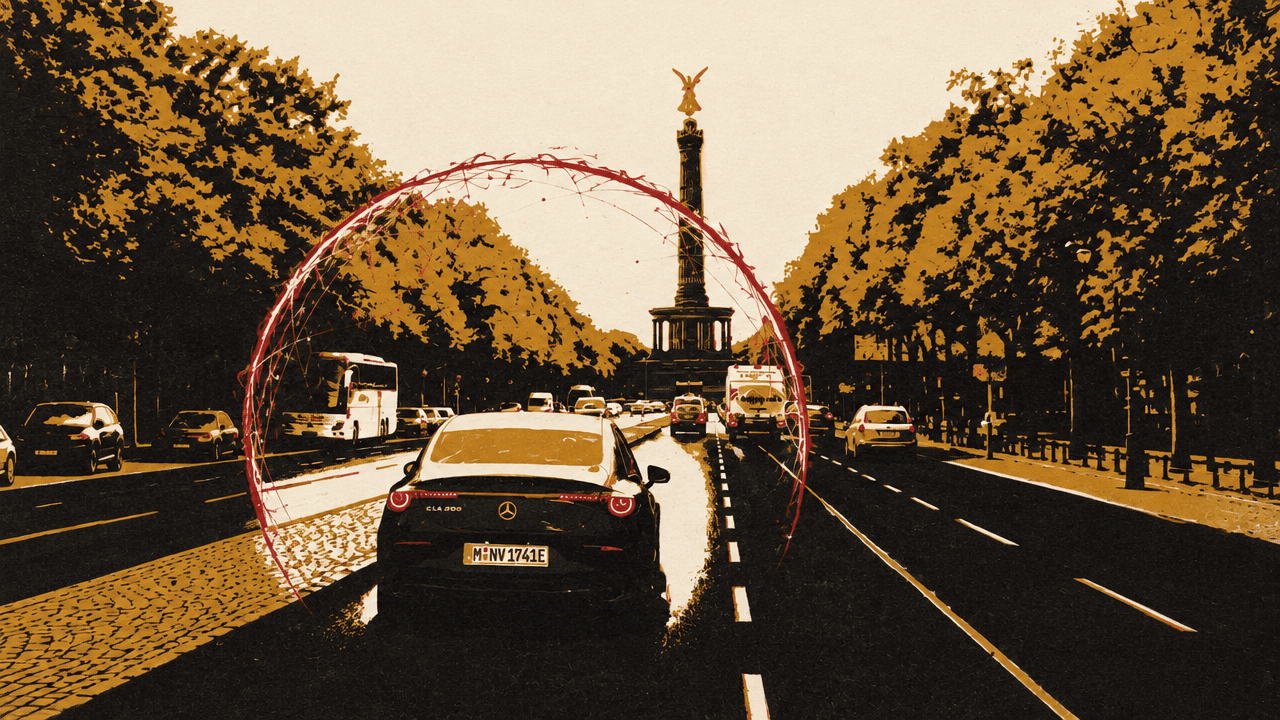
NVIDIA opens with the Mercedes-Benz CLA, powered by NVIDIA Hyperion and Halos, which it says was Euro NCAP’s best performer of 2025, with the highest overall safety score that year. That example frames the larger claim: a safety evaluation needs to connect measured performance in real driving with tests that can be repeated and extended.
A measured drive becomes a reusable simulation
The loop begins on a test track. NVIDIA says it captures a sample of driving scenarios and measures what happened; those measurements become the ground truth for evaluating a simulation. Omniverse NuRec reconstructs the scene, allowing the same test to be run virtually and the vehicle’s simulated response to be compared with the track measurements.
The displayed Vienna obstacle-perception analysis pairs front and right camera views with a top-down view. Its labels identify pedestrians beside St. Stephen’s Cathedral and distinguish perception, ground truth and sensor information; it also marks a detection as “not safety critical.” These are the measures and classifications presented for that example.
Once simulation results match real-world scenarios, NVIDIA says those scenarios can be reused to test new software releases. A measured drive can therefore serve as a consistent test case as the software changes, rather than requiring every evaluation to begin with a new road test.
Virtual hazards test the real vehicle and its hardware
Simulation also feeds back into physical testing. NVIDIA describes a hardware-in-the-loop test using the DRIVE AGX Thor platform, intended to check whether improvements seen in simulation carry through to the hardware. In this setup, the real car receives simulated sensor inputs in real time. It can encounter virtual obstacles and edge cases that are not physically present, respond to them, and be tested against dangerous situations without staging those hazards on the road.
A split-screen demonstration pairs the view from a driven car with a simulated exterior scene in which a virtual vehicle crosses its path. The real vehicle receives the simulated hazard through its sensor inputs, allowing its response to be tested outside a fully virtual model.
NVIDIA says each result is measured against a safety target, so evaluators can identify what passed, what failed and why. The crash-avoidance dashboard labels include a scenario viewer, measurement data, ego behavior, physical parameters, and score and KPIs. Those results feed back into development, and the next software version is tested again. The process is iterative: evaluate, use the findings to improve the system, then repeat the evaluation.
Scenario variations extend the range of tests
A reconstructed scenario captures one set of conditions. To vary those conditions, NVIDIA says Cosmos generates thousands of offline variations in lighting, weather, road surfaces and traffic. A grid of video feeds shows the same driving scenario rendered across different environmental conditions.
The recorded test provides the measured reference; generated variations let developers test responses across changed conditions without treating those variations as additional real-world measurements. NVIDIA’s stated aim is continuous safety validation and evidence for certification across markets, with each new software version tested before deployment.