NVIDIA Positions 1,000 CUDA-X Libraries as Physical AI Infrastructure
NVIDIA’s GTC Taipei and COMPUTEX 2026 montage presents CUDA-X as the software stack that extends CUDA from an accelerated-computing architecture into what the company calls the algorithmic foundation for physical AI. NVIDIA argues that more than 1,000 CUDA-X libraries now support simulation and engineering work across domains including molecular science, robotics, factory automation, autonomous systems and Earth-scale digital twins, with the visual evidence explicitly framed as computer graphics and simulation rather than generative AI.
CUDA-X is presented as the algorithmic substrate for physical AI
NVIDIA presents CUDA-X as the software layer that turns CUDA from a single accelerated-computing architecture into an algorithmic foundation for physical AI. The framing begins with CUDA itself: “20 years ago, we built CUDA, a single architecture for accelerated computing.” NVIDIA’s next claim is that the architecture has expanded into a full stack of libraries used across science and engineering.
The named libraries define the range of the stack. cuLitho is tied to computational lithography, cuOpt to decision optimization, cuDSS to direct sparse solvers, AI-Q to deep research across structured and unstructured documents, Aerial to AI-RAN, Warp to differentiable physics, and Parabricks to genomics. NVIDIA calls CUDA-X libraries “tools for agents,” connecting accelerated computing to systems that reason about, simulate, and act in physical environments.
A thousand CUDA-X libraries help developers make breakthroughs in every field of science and engineering.
A prominent on-screen disclaimer sets an important boundary for the visual evidence: “Everything you're about to see is computer graphics and simulation—not generative AI.” The distinction is central to NVIDIA’s case. The work being presented is not prompt-generated imagery. It is rendered and simulated behavior across materials, fluids, biological structures, vehicles, robots, factories, cities, and Earth-scale environments.
| Domain | Examples shown | Associated attributions |
|---|---|---|
| Rendering and physics | Ornate sculpture, dining scene, terrain depth rendering, collisions, cloth, tubes, fluids, bouncy balls | Omniverse RTX; RTX Neural Rendering; RTX Mega Geometry; Newton; Warp; RTX |
| Science and medicine | Molecular and crystalline structures, molecular chains, cell interactions, protein structures | Synopsys; Applied Materials; Alchemi; LabGenius Therapeutics; AnHorn Medicines |
| Engineering design | Wave-energy systems, vehicle aerodynamics, data-center airflow and cooling, aircraft airflow | Eco Wave Power; Mercedes-Benz; Siemens; Honda; Synopsys; McLaren; Rescale; Cadence; Foxconn; The ePlane Company; Boom Supersonic |
| Robotics and industrial work | Hands, arms, humanoids, warehouse robots, construction robots, welding, server-room maintenance, factory automation | Sharpa; Shadow Robot; PTC Inc.; DextrAH; Fauna Robotics; Isaac Lab; Unitree; Solomon; Techman Robot; Lightwheel; FANUC; Wistron; Quanta |
| Digital twins and autonomy | Factories, warehouses, driving perception, city intersections, drones, bridges, Taipei wind flow, Earth-scale environment | TSMC; Foxconn; KION Group; Accenture; Parallel Domain; Drive AV; Ansys Perceive EM; Aerial Omniverse Digital Twin; Linker Vision; Cesium ion; Google; Earth-2 |
Rendering and physics make simulated environments legible
NVIDIA treats visual realism and physical behavior as adjacent requirements for physical AI. Omniverse RTX is associated with a close 3D render of an ornate bronze horse sculpture. RTX Neural Rendering appears with a photorealistic dining-table scene. RTX Mega Geometry shows a green mountain valley with a red house, then transitions into a false-color, depth-map-style rendering.
Physics becomes the stronger thread as the examples move from appearance to behavior. Newton is credited on simulations of a wall of yellow blocks breaking apart and a green figure being squeezed between two grey gears. Warp appears across cloth, tube, sheet, and ocean-wave simulations: fabric draping over a cylinder, colorful tubes bending around vertical pegs, a red sheet unrolling down a ramp, and turbulent water. An RTX-attributed work, “Stan by André Šimoník,” shows hundreds of colorful bouncy balls tumbling through a narrow cobblestone street.
The common visual language is contact, deformation, collisions, fluids, and motion. In NVIDIA’s framing, physical AI depends on digital environments where objects have geometry, surfaces, constraints, and physically meaningful behavior.
Science and engineering broaden the claim beyond robotics
NVIDIA’s “every field of science and engineering” claim extends from molecular and biological systems into industrial design. Synopsys and Applied Materials are associated with a microscopic molecular or crystalline structure with glowing purple and blue nodes. Alchemi appears through dense, interlocking molecular chains. LabGenius Therapeutics shows a large purple cell interacting with smaller cellular structures, while AnHorn Medicines shows two complex protein structures merging.
Energy and vehicle design extend the same simulation language into engineered systems. Eco Wave Power is represented by wave-energy converters mounted on a seawall, with visible parameters including “49 Bar Hydraulic Pre-Charge” and “2.3 Meter Wave Height.” Mercedes-Benz and Siemens are tied to aerodynamic flow lines over a dark sedan. Honda and Synopsys show airflow over a blue SUV with internal engine components visible. McLaren and Rescale appear through a mixed-reality airflow simulation around a yellow sports car.
Aviation and data-center design are treated as related simulation problems. The ePlane Company is associated with a blue and white eVTOL aircraft hovering in an urban environment with simulated airflow. Synopsys shows a supersonic jet over mountains with aerodynamic flow visible over its wings. Boom Supersonic’s Overture appears with labels including “Mach 1.7 Cruising Altitude” and “Mach 1.0.” Cadence shows a 3D model of a data-center hallway with server racks, cooling infrastructure, and floor zones; Cadence and Foxconn are credited on airflow paths circulating around server racks.
Across these examples, the same accelerated-computing foundation is applied to molecules, cells, waves, aerodynamics, thermal behavior, airflow, and compute facilities.
Robotics is organized around capabilities, not a single machine
The robotics examples make physical AI concrete by moving from dexterity to locomotion, warehouse work, construction, maintenance, and factory operations. Dexterous manipulation appears through robotic hands independently handling a red ball, a yellow star, and a blue cylinder; a black mechanical hand holding a multicolored cube; a white robotic arm picking cylindrical items from a yellow bin; and two robotic arms inserting a USB drive into a port and placing a small white square into a slot.
Whole-body and mobile systems expand the problem. A light green bipedal robot walks through a door. Isaac Lab shows simplified figures performing kicks and martial-arts movements. Unitree shows a humanoid robot stretching and climbing stairs. Solomon is associated with a humanoid working in a warehouse and handling a small box. DataMesh shows a robotic arm mounted on an autonomous mobile robot interacting with machinery. Noble Machines shows bipedal robots carrying crates through a building under construction.
Industrial scenes add harsher and more varied settings. Techman Robot shows a dual-arm system picking small items and placing them into a cardboard box. Lightwheel shows a robot in a server room plugging network cables into a rack. Mirle shows robotic torsos on autonomous mobile platforms moving through a factory. idealworks shows an autonomous mobile robot carrying a multi-tiered shelf down a warehouse aisle. AeROBOT appears both directing a cement truck with a glowing baton and operating a welding tool on a large curved metal structure. Persona AI shows robotic machines welding steel beams inside a large industrial construction site while human workers walk nearby.
NVIDIA is not centering one robot form factor. The robotics claim is organized around capabilities: manipulation, locomotion, routing, inspection, maintenance, warehouse handling, construction, welding, and human-adjacent industrial work.
Digital twins scale the same logic from factories to cities and Earth
Facility-scale examples turn simulation into digital twins. General Atomics, DIII-D National Fusion Facility, and the US Department of Energy are credited on a 3D model of a complex circular fusion reactor facility. TSMC is associated with a simulated 3D factory layout shown alongside top-down 2D floor plans. Foxconn appears through a greyscale 3D factory with servers and electronics moving along conveyor belts. SK Telecom is associated with a grid-like telecommunications and server infrastructure layout. GIGABYTE appears through black server racks in a data center.
Factory automation sits inside the same digital-twin frame. FANUC shows a yellow industrial robotic arm sliding along a floor track in a clean room. MetAI shows an automated overhead conveyor carrying parts through a bright factory. Wistron shows a robotic assembly station moving circuit boards between stations. Pegatron shows an autonomous cart loading a pallet from an automated station. Quanta shows a long assembly line with robotic arms and human workers in clean suits. Delta Electronics shows a humanoid robot standing beside automated production machinery. KION Group and Accenture are credited on a warehouse simulation with pallets, racks, moving robots, and drawn pathways.
Autonomous systems add perception and city context. Parallel Domain shows a four-way driving simulation: standard view, depth map, semantic segmentation, and object bounding boxes. Drive AV shows an overhead digital twin of a city intersection with vehicles and crosswalks. Ansys Perceive EM adds a sweeping simulated sensor-range overlay tracking cars. Aerial Omniverse Digital Twin shows red drones moving through a 3D city model along yellow flight paths. Linker Vision is associated with a 3D architectural rendering of a large cable-stayed bridge.
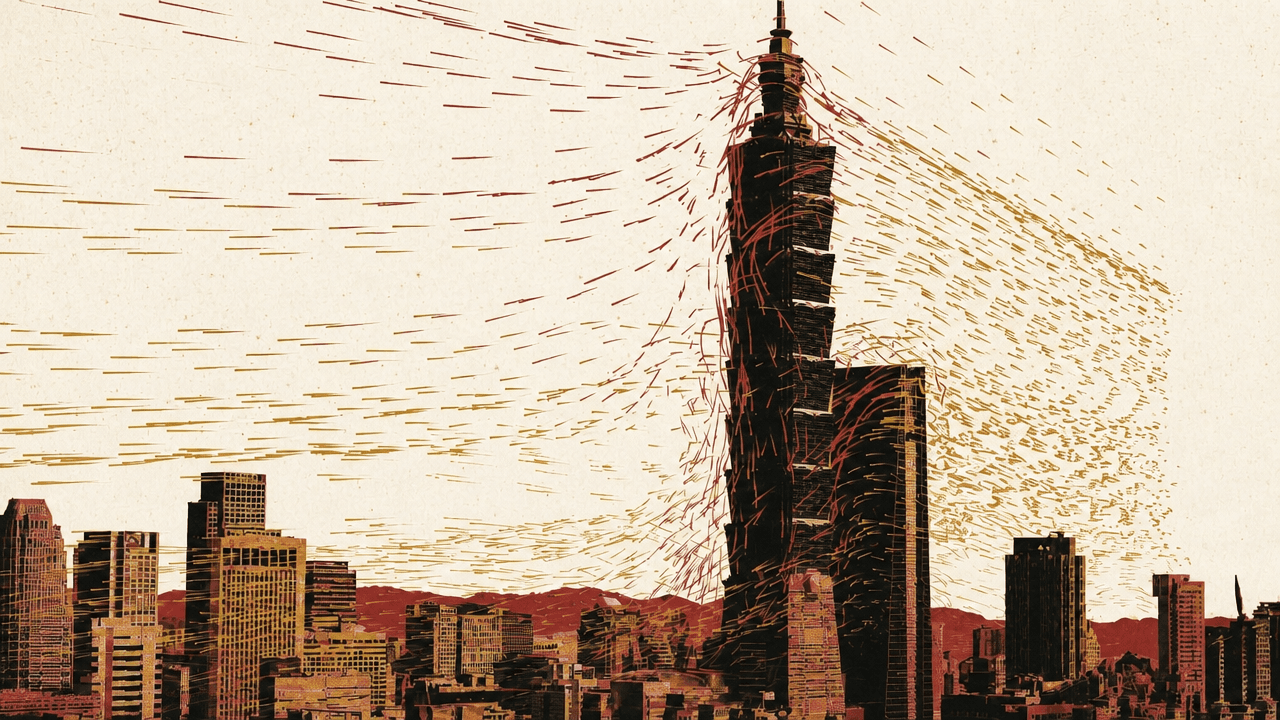
The endpoint is geographic scale. Cesium ion and Google are credited on simulated wind-flow lines around Taipei 101 and surrounding city blocks. The visible attribution names “Scientific Data: PKUM Model” and terrain data sources including Google, Airbus, Data SIO, NOAA, the U.S. Navy, NGA, GEBCO, Landsat/Copernicus, IBCAO, the U.S. Geological Survey, and PGC/NASA. Earth-2 then moves from Taiwan to a full view of the planet in space.
NVIDIA’s through-line is that one accelerated-computing foundation can support many categories of simulated physical systems: molecules, cells, vehicles, data centers, robots, factories, roads, drones, urban flows, and planetary environments.