DSX MaxLPS Claims 45% More GPUs Inside a 1 GW Power Budget
NVIDIA is positioning DSX as a control stack for gigawatt-scale AI factories where the binding constraint is usable power rather than installed hardware. In its press release and technical blog, the company argues that DSX Sim, MaxLPS, Flex and OS let operators design, validate and run facilities as integrated power, cooling, compute and grid systems, increasing GPU capacity inside fixed power budgets. The central claim is that AI infrastructure economics will depend on maximizing reliable tokens per watt, not simply adding more racks.
Usable power, not installed hardware, sets the ceiling
NVIDIA presents the AI factory as a power-and-compute system whose business output depends on how much revenue-producing compute can be operated inside a fixed power envelope. Its blunt formulation is that “compute is revenues.” From that premise, every layer — chip, rack, network, power, cooling, and grid — has to be designed together rather than optimized as separate subsystems.
Every layer — chip, rack, network, power, cooling, grid — must be designed together from end to end.
The most concrete illustration is the comparison NVIDIA shows for DSX MaxLPS. At a 1 GW power budget, the displayed dashboard says an AI factory with DSX MaxLPS can support 399,096 GPUs and $267 billion in annual revenue, compared with 274,968 GPUs and $201 billion without MaxLPS. The same visual shows a smaller but directionally identical gap at 96 MW and 250 MW.
| Power budget | With DSX MaxLPS | Without DSX MaxLPS | Annual revenue with DSX MaxLPS | Annual revenue without DSX MaxLPS |
|---|---|---|---|---|
| 96 MW | 38,304 GPUs | 26,322 GPUs | $26B | $19B |
| 250 MW | 99,720 GPUs | 68,688 GPUs | $67B | $50B |
| 1 GW | 399,096 GPUs | 274,968 GPUs | $267B | $201B |
NVIDIA says today’s AI factories over-provision power by up to 40%, and that MaxLPS lets operators safely deploy more GPUs inside the same power budget. It describes the mechanism in operational terms: dynamic power allocation steers power from rack to rack, recovers “stranded watts,” and sends power where work is happening. In-rack power smoothing is shown as a way to flatten peak current spikes and power surges.
The supporting visual names “Intelligent Power Smoothing” and claims up to 25% lower peak grid demand and 6X more rack energy storage. Taken together, NVIDIA’s claim is not simply that DSX improves efficiency in the abstract. It is that software-controlled power behavior changes how much compute capacity can be safely installed and used under the same power constraint.
DSX is framed as the reference design for controlling that system
DSX is described as NVIDIA’s blueprint: a reference design for building and operating AI factories “at maximum efficiency and profitability.” The platform diagram places DSX OS, DSX Sim, DSX MaxLPS, and DSX Flex above an infrastructure stack that includes power optimization, resiliency, compliance, observability, security, platform software, infrastructure software, libraries and frameworks, and 45°C liquid cooling.
That architecture matters because NVIDIA frames the AI factory as one integrated operating problem. Power behavior affects GPU density. Cooling affects how much energy remains available for compute. Grid signals affect when and how the facility should draw power. Operations software affects whether installed infrastructure can be provisioned, monitored, remediated, and made available as trusted multi-tenant capacity.
NVIDIA’s language is explicitly end to end. The AI factory is not presented as a data center with GPUs added. It is presented as a coordinated industrial system whose layers have to be designed and operated together because the output being optimized is tokens per watt and compute revenue per power budget.
Design risk is pushed into simulation before racks arrive
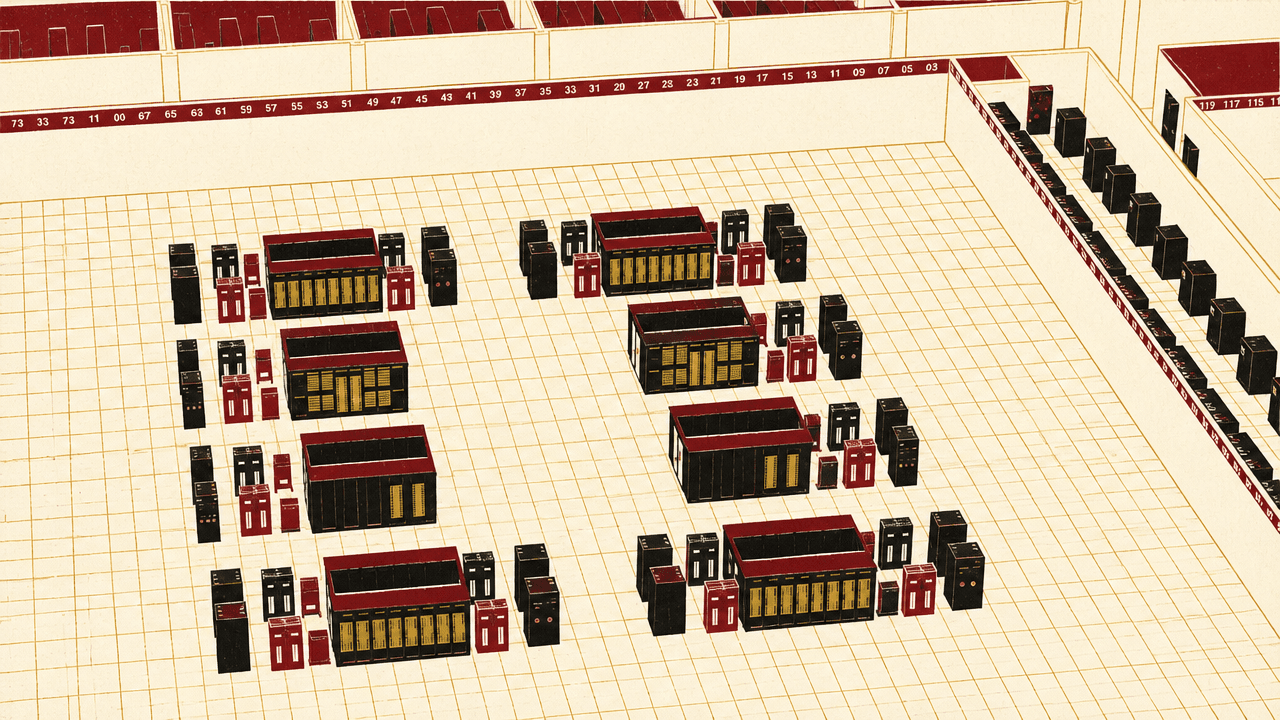
The preconstruction problem is assigned to DSX Sim. NVIDIA says partners use the DSX Sim Omniverse blueprint to design and validate an NVIDIA Vera Rubin AI factory “before a single rack lands.” The associated interface shows 3D rack layouts, thermal simulations, and network design work, with visible references to Cadence, Siemens, Ansys, Keysight, and NVIDIA DSX APIs.
DSX Sim is positioned as the environment where operators plan the layout, simulate power and cooling, design the network, validate integrations, and test changes in a digital twin. NVIDIA does not describe DSX Sim as a narrow planning tool; it assigns it the job of validating the interactions among layout, power, cooling, networking, integrations, and future changes before hardware lands.
Operations are treated as a multi-tenant reliability problem
Once the factory powers on, NVIDIA says DSX OS “takes over” to provision, operate, monitor, and remediate the infrastructure. The result is described as “trusted, multi-tenant, resilient, AI-ready capacity.”
The visual emphasis shifts from design tooling to live operating metrics. Separate tenant identifiers show GPU utilization, GPU memory, and CPU usage, followed by green padlock icons on racks. The visible tenant dashboard shows different utilization profiles: one tenant at 96% GPU utilization and 81% GPU memory, another at 25% GPU utilization and 21% GPU memory, and another at 93% GPU utilization and 75% GPU memory.
DSX OS is tied to four operating functions: provisioning, operation, monitoring, and remediation. The tenant view and lock imagery add the trust and tenancy layer. NVIDIA’s claim is that installed systems become AI-ready capacity when they can be allocated, observed, secured, and kept resilient across tenants.
Cooling is folded into the same power-allocation problem
Cooling is presented as another way to shift more of the factory’s power toward compute. NVIDIA describes “breakthrough hot liquid cooling at 45 degrees Celsius” as using less water and energy. The accompanying visual shows hot liquid cooling with liquid input at 45°C and liquid output at 55°C, with status marked normal.
The stated consequence is direct: less water and energy for cooling means “more power going to revenue-generating compute.” That keeps the cooling claim tied to the same constraint as MaxLPS: how much useful compute can run inside the available power budget.
NVIDIA also says teams of AI agents work with DSX MaxLPS throughout the factory, continuously coordinating cooling and power to meet workload demand. A time-series chart compares “AI Control” with “Traditional Control” for CDU supply temperature and IT load. The chart is not presented with detailed axis values; it illustrates NVIDIA’s claimed coordination of cooling behavior, power behavior, and workload demand rather than establishing a measured performance result.
Grid responsiveness extends the control loop outside the building
NVIDIA describes DSX AI factories as “flexible energy assets” that operate cooperatively with the grid. DSX Flex is said to read real-time grid signals and dynamically adjust factory power when the grid needs relief. A visual attributed to “emeraldoi” shows grid demand fluctuating through values including 54%, 57%, 88%, 94%, 93%, 74%, 70%, and 90%.
DSX Flex positions the AI factory as a controllable load that can respond to external grid conditions, not only as a facility that optimizes its own racks and cooling loops. Inside the factory, MaxLPS and power smoothing are used to shift and flatten demand. DSX Flex is presented as the component that adjusts factory power in response to real-time grid signals.
NVIDIA closes with the scale context: 100 gigawatts of AI factories will come online before the end of the decade. Against that backdrop, the company says DSX AI factories run at the highest efficiency, produce the lowest-cost tokens, and make the grid stronger. The core claim is that at gigawatt scale, AI infrastructure has to be designed as both a compute factory and a power-responsive system.