NVIDIA’s OpenShell Enforces Agent Access Outside the Model
NVIDIA’s OpenShell reference architecture argues that model alignment and instructions are not enough to secure autonomous agents: the systems around them must enforce limits on access. OpenShell applies operator-defined policies at the runtime boundary, mediating agents’ system, file and network access; an optional layer called Sentry monitors activity outside the host and can cut an agent’s connection to its model. NVIDIA presents the two controls as complementary safeguards for agents that use tools and data.
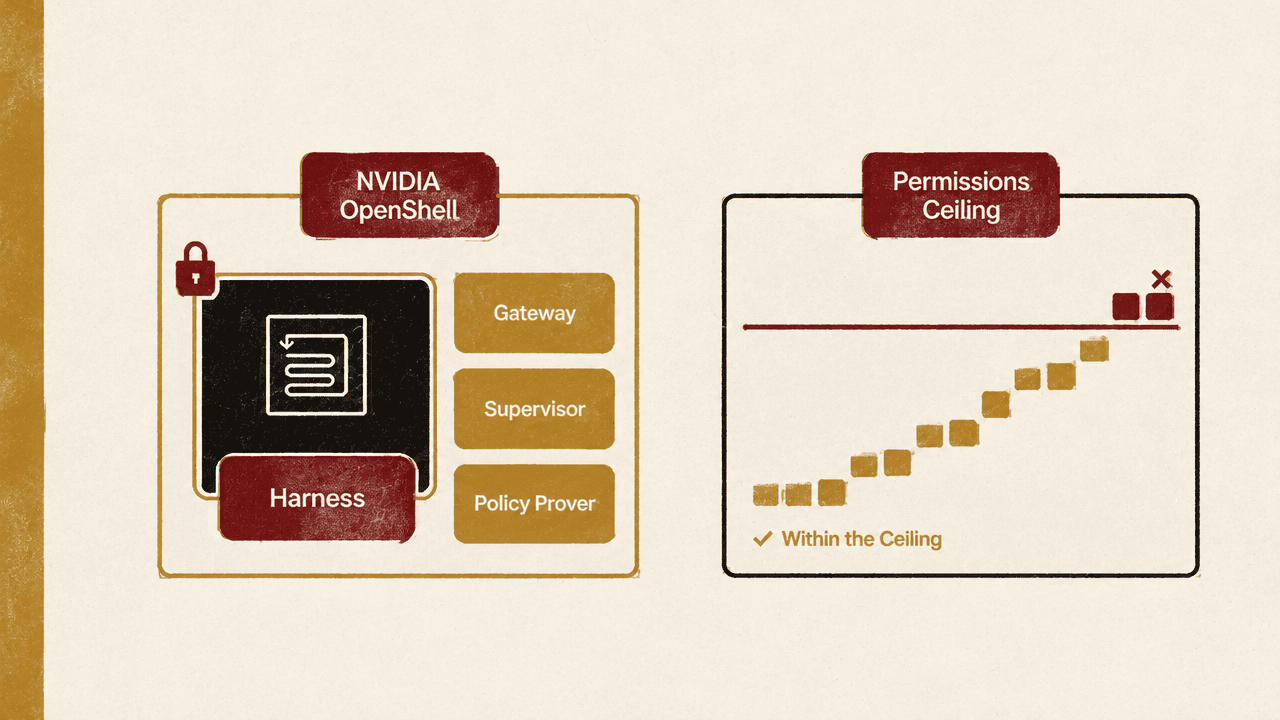
Agent access needs an enforcement boundary
Useful agents need to reason, plan, use tools, reach data, and work across tasks. NVIDIA’s starting point is that agents with those capabilities should not be governed only by requests such as “Please don’t delete anything,” “Please don’t push to main,” or “Please don’t touch my SSH keys.” Those instructions express intent; they do not enforce a limit on what the agent can do.
NVIDIA OpenShell and Sentry are presented as infrastructure controls for that problem. OpenShell applies policy around an agent’s runtime and access. Sentry adds an optional monitoring and enforcement layer outside the host. Their roles differ: OpenShell governs activity at the sandbox boundary; Sentry can monitor agent activity from a hardware-isolated trust domain and interrupt the connection to the model.
OpenShell turns an access policy into runtime controls
An operator writes a policy specifying what an agent may touch. OpenShell enforces it at the level of system calls, file access, and network connections. The examples include denying ptrace, making /usr read-only, and allowing a connection to api.github.com.
The architecture assigns distinct jobs to three OpenShell components. The gateway is the control plane; the supervisor makes decisions about requests; and the policy prover checks proposed policies against the operator’s permissions ceiling. NVIDIA says formal verification checks each policy change against that ceiling, so the agent does not gain more access than intended.
| Component | Role described by NVIDIA |
|---|---|
| Gateway | Control plane |
| Supervisor | Makes decisions on requests |
| Policy prover | Checks proposed policies against the permissions ceiling |
| Harness and sandbox | Contain the agent |
NVIDIA compares the approach to browser security: early web pages could pose risks to a user’s computer, while browsers enforced limits on what pages could do. In the analogy, OpenShell supplies a comparable boundary for agents. The key distinction is that policy is enforced by the surrounding infrastructure, rather than relying only on instructions or guardrails inside the model.
The supervisor mediates network access and credentials
Each agent runs in its own isolated sandbox and has no direct route to the network. Outbound requests pass through the supervisor, which checks them against policy. If a request is not permitted, it is denied.
The example policy distinguishes between actions, not just destinations: it allows GET api.github.com and denies POST /issues. This makes the supervisor the point where an agent’s requested action is compared with the permissions set by the operator.
Credentials are kept outside the sandbox with the supervisor. A key is added only when a request is headed to an approved endpoint. NVIDIA’s stated rationale is that a compromised agent cannot leak a key it never had. In this design, the agent can form a request, but it does not independently control network access or hold the credentials needed to make every request.
Sentry can interrupt the model connection from outside the host
OpenShell combines Linux kernel isolation with runtime policy enforcement. Sentry is an optional additional layer outside the host, running on a BlueField-4 DPU in a hardware-isolated trust domain. NVIDIA says it monitors agent activity and enforces security policies there.
Because reasoning traffic passes through Sentry, NVIDIA says it can respond when an agent is planning an unintended action: update policy, deny further inference, and cut the connection to the model. The stated result is quarantine in milliseconds.
Sentry also keeps tamper-evident records of communications, policy decisions, and runtime evidence for operators to verify during detection, investigation, and response. Its function is therefore distinct from OpenShell’s sandbox enforcement: OpenShell mediates the agent’s access at runtime, while Sentry supplies an additional observation and intervention point outside the host.
The demonstration pairs a short setup with a broad deployment claim
OpenShell is described as open-source under Apache 2.0 and intended to run wherever agents run, from edge to cloud. The command-line demonstration installs the CLI, creates a sandbox named demo, loads policy, brings up the gateway, and launches OpenCode. It shows a setup path, not a detailed account of how an operator should write or maintain policies.
The governing principle is that an agent’s usefulness depends on the access it is given. OpenShell puts that access under operator-defined policy; Sentry can add monitoring and a way to sever the model connection. The two layers address different points in the system rather than asking the model alone to police its own behavior.