Siemens Uses Synthetic Product Variants to Train Inspection Models Before Production
Siemens says it is using NVIDIA AI tools to move two manufacturing tasks earlier and faster: preparing inspection models for new product variants and revising production plans when orders change. At its Erlangen electronics factory, the Process Preparation X workflow uses NVIDIA Cosmos to generate virtual prototypes and synthetic data for training and validating inspection models before production; Siemens reports a 40% reduction in time to market. Separately, agents built with the NVIDIA Factory Operations Blueprint recommend production plans in minutes, which a digital twin can validate against factory conditions.
Synthetic variants let inspection preparation start before production
At the Siemens electronics factory in Erlangen, each new product variant has traditionally required a physical prototype before an inspection model could be trained. That dependency puts quality-control preparation behind product changes: the model cannot be trained on the new variant until a physical example exists.
The workflow shown for Process Preparation X moves that preparation earlier. When a change arrives, its agents use NVIDIA Cosmos to generate a virtual prototype and synthetic datasets. Those generated examples provide material for training inspection models and validating them before production starts. The source reports that this approach cuts time to market by 40%.
The visual sequence makes the synthetic-data step concrete. A Process Preparation X screen shows a virtual circuit-board layout, followed by a grid of generated layout variations. The variations are not presented as a record of production runs; they are synthetic examples created for model training and validation. The point is to prepare for product variation without first making a physical prototype of every new version.
The source also shows how the workflow handles a component change. In a Process Preparation X interface, a prompt asks to update a model using a new component manual, and the displayed change concerns the component’s color. The accompanying explanation says that when components change unexpectedly, an agent can adapt inspection models through in-context learning in minutes. This is a separate use of the system from generating a virtual prototype and dataset for a new product variant: the example is an adjustment prompted by an unexpected component change.
These steps address the inspection side of manufacturing. They concern how a model is prepared to inspect a product when its design or components change; they do not, by themselves, determine how the factory should schedule production.
Production plans are recommended, then checked in a factory twin
A new order creates a different problem: the production plan may need to change to account for orders, supplies, and line setups. In the example, a dashboard for Siemens Intelligence Center X shows an operator asking an agent to update production plans after a new order arrives. Agents built with the NVIDIA Factory Operations Blueprint recommend plans in minutes. The source gives potential cost savings of 20%, not a guaranteed result.
A workflow diagram labels a Production Planner Agent and shows it connected with planning skills and models. Another architecture diagram places agents alongside a supervisor, tools, knowledge, and models. Together, the diagrams depict planning as an agent workflow supported by connected resources, rather than as a single prompt producing a plan in isolation. The source does not specify the contents of each tool or model, but the displayed labels show the components the workflow brings together.
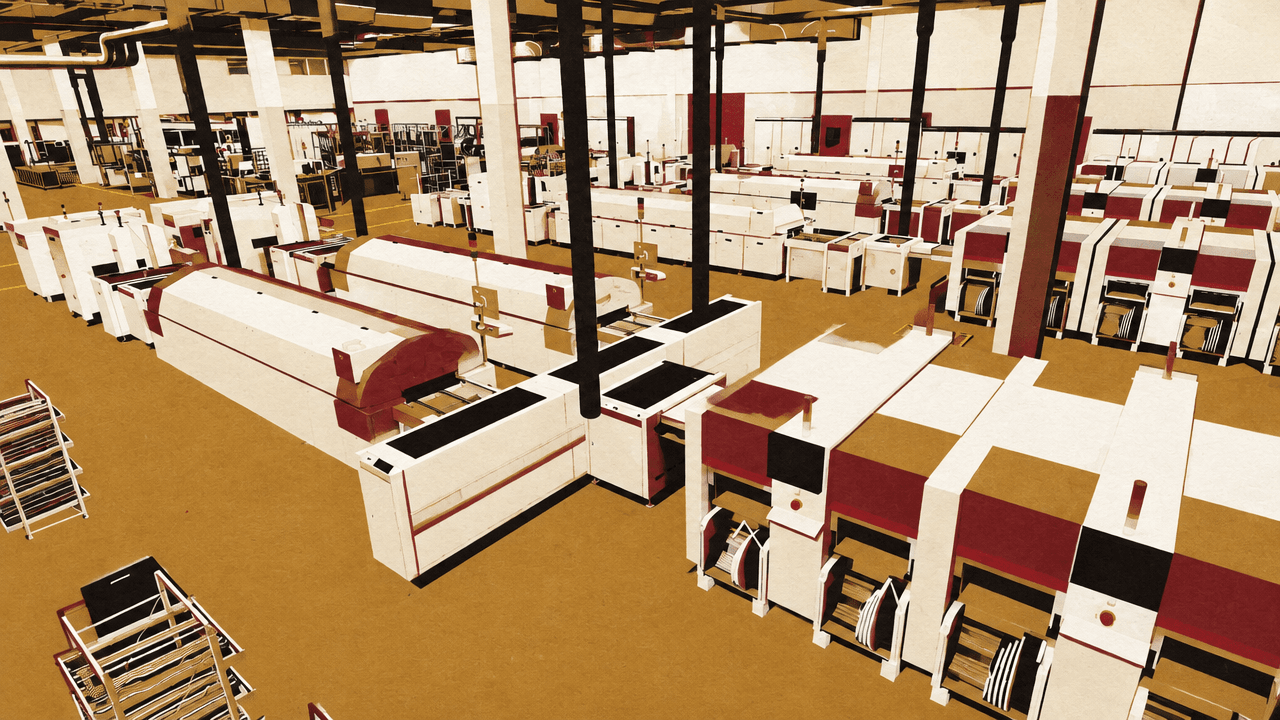
A recommendation still needs to be validated against the factory. Digital Twin Composer, using NVIDIA Omniverse libraries, combines physics-based simulation with real-time data to validate plans. The source shows a three-dimensional factory digital twin transitioning to footage of the physical factory. The transition links the simulated environment to the operation it represents; the spoken explanation identifies simulation and real-time data as the basis for checking a plan.
The two workflows therefore address different kinds of change. Synthetic prototypes and datasets prepare inspection models for product variation before production begins. Planning agents respond to new orders by recommending production plans, while the digital twin provides a way to validate those plans. The source presents both as parts of adaptive manufacturing, but distinguishes model preparation from factory-level planning and validation.