Low-Cost Robot Arms Let Non-Specialists Train Physical AI
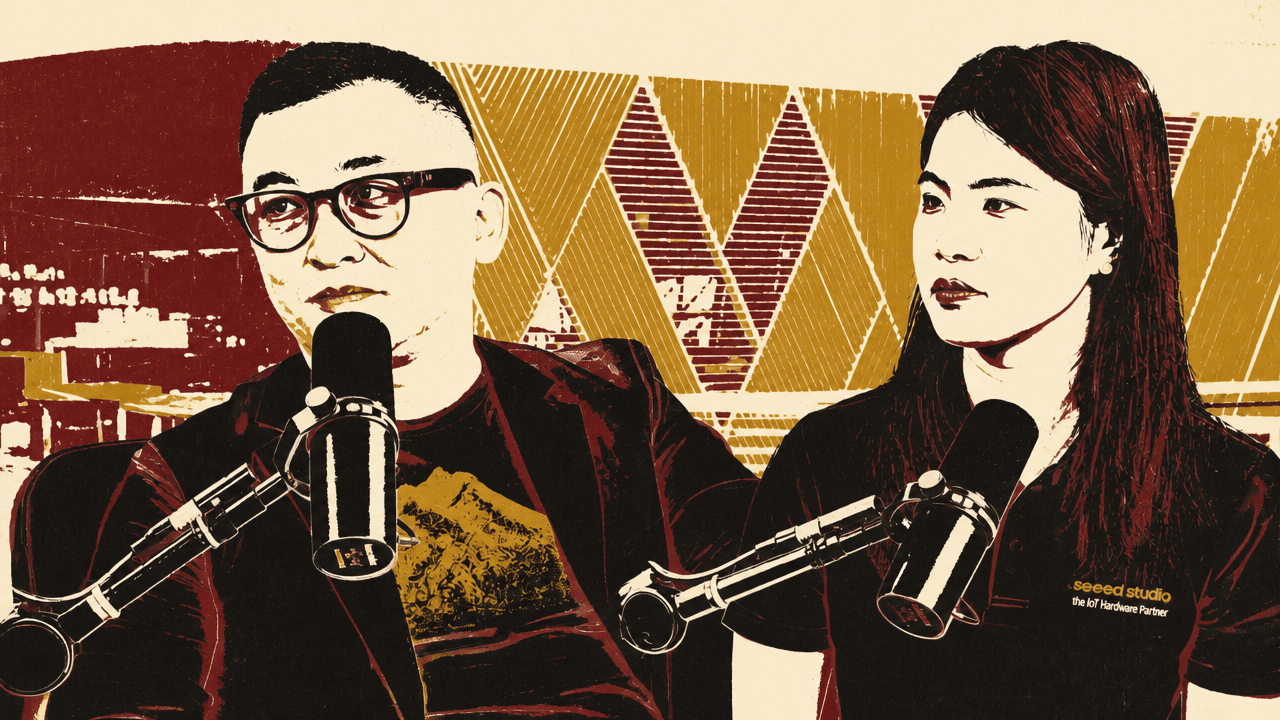
On NVIDIA’s AI Podcast, Seeed Studio CEO Eric Pan and head of robotics Elaine Wu make the case that open-source, Jetson-powered robot arms can move embodied AI beyond specialist industrial settings. Their argument is that low-cost hardware, frameworks such as OpenClaw and LeRobot, and Isaac Sim digital twins let makers, students and small businesses teach and constrain robots around specific tasks, rather than waiting for a closed general-purpose humanoid.
Open robotics is being framed as an adoption mechanism, not just a licensing choice
Eric Pan describes Seeed Studio’s robotics work as an extension of a longer open-hardware trajectory: the company began supporting global open source hardware communities in 2008, first through modules, then through devices, and more recently through open robotics built around NVIDIA Jetson systems. The company’s current lineup includes arms and small desktop “embodiments,” alongside Jetson carrier boards and devices developed through its NVIDIA partnership.
For Pan, the importance of open source in robotics is not only that “technology is evolving fast because people can contribute with their own talents.” It is that robotics has not converged on a single winning form. He compares the field to biology: many creatures compete and evolve, and useful forms emerge by domain. That matters because he does not expect one robot to do everything, at least not now. He expects specialized robots, backed by open models and shaped by particular use cases.
That argument leads to a practical claim about trust. Pan says robots and edge AI systems will enter homes, factories, and retail stores only if users feel they can control and modify them. Open systems, in his view, reduce the feeling of being locked away from the machines operating inside a business or personal environment. Instead of a salesperson pushing a closed system, he sees makers and developers experimenting, integrating, and discovering what the technology can do in their own settings.
Elaine Wu makes the same point from the developer side. Open, she says, means accessible: lower barriers, modular hardware, customization, affordability, tutorials, development kits, and an ecosystem that lets people get hands-on with physical AI and embodied AI without starting from a closed industrial robotics stack.
Seeed’s users, as Pan describes them, are hard to categorize because many begin as makers and later become employees, founders, researchers, or innovation-lab operators inside larger companies. He says the company has millions of customers, with students and researchers making up much of the population by number, while much of the revenue and productivity comes from small and medium-sized businesses. His metaphor is “micro-veins” running into every industry: people who learn the technology in open communities and then carry it into their domain.
The strategic bet is that open robotics does not merely make existing robots cheaper. It changes who is allowed to discover robot use cases. Pan contrasts this with expensive traditional robotics in medical and automotive settings and with closed-source humanoid efforts. Seeed’s stated aim is narrower and broader at once: not to build the universal robot, but to “give the possibility to everyone to create their own physical AI.”
The $200 arm changes the entry point for embodied AI
Seeed’s best-selling robotics product, according to Pan, is the SOR arm, an open source arm developed with Hugging Face and priced at about $200. He presents that price as a break from the older pattern in which professional roboticists spent long periods programming, debugging, and maintaining expensive machines. In that older model, robots were concentrated in domains such as medical and automotive work. In the newer model, a low-cost arm can be treated almost as disposable hardware — accessible enough for children, makers, students, and small businesses to experiment with.
Pan is careful not to reduce the product to a toy, even while acknowledging that some professionals might see it that way. Seeed ran hackathons where people used the arm for tasks such as cooking and barbecues. Those examples matter less as polished applications than as evidence of a different discovery process: inexpensive hardware lets people test ideas that would not justify a conventional robot purchase.
His framing is particularly focused on small businesses. “How about every business we can have some robots to help us?” he asks. The implication is not that a $200 arm replaces industrial automation. It is that it creates a foundation for more mature applications by giving more people a way to learn, prototype, and adapt robotics to local problems.
Wu adds that Seeed distributes products through its website and global distribution channels, but she places equal emphasis on the company’s developer activity: hackathons and workshops in different cities and countries, meant to make the hardware easier to find and easier to start using.
The more consequential shift is how Pan says these arms are trained. Previously, he says, users needed months of training to understand spatial planning and robot movement. Now, after setup, a user can train the robot “like you train a dog”: physically guide the arm through an operation several times, send the resulting data to the cloud for training, and deploy the trained behavior on Jetson. The deployed system can use a diffusion model with cameras to determine how to execute the task. If it does not perform correctly, it can be retrained.
Previously you need to spend months of trainings to understand the spatial like planning on the robots, how it moves. But now what you do with the robots is after the setting up, you train it. Like you train a dog.
Pan’s example of who should train such a robot is not a robotics engineer. It is a skilled person — a chef, a blacksmith, someone with domain knowledge — teaching the machine by demonstration. That distinction is central to his view of physical AI. The robot is not a generic labor replacement dropped into a business from outside. It is an “apprentice” that inherits a user’s process and augments that person’s operation.
He explicitly rejects the idea that the robot should be understood as giving away or replacing the business. It is “my robot,” in his phrasing, acquired to enhance operations. The business model and mechanism change when the person with the skill can train the machine directly.
OpenClaw turns instruction into robot control
Wu describes OpenClaw on Jetson as a move away from hard-coding every layer of a robotic application. In the older pattern, she says, a developer had to program perception, control, and nearly every other part of the robot. Seeed has installed OpenClaw locally on a Jetson board and connected it to a local model API, using Qwen 1.5 32B in the example she gives. A user can type commands into OpenClaw’s chat box — move the robot arm up, move it down, pick up the claw — and the arm executes the task.
Her point is not that text commands are a novelty interface. It is that the development process changes: controlling the arm begins to look less like coding and more like instructing. Wu also describes a maintenance use case for Jetson users. Updating repositories or debugging issues can be time-consuming, she says, and OpenClaw inside Jetson can help update and debug necessary components more quickly.
Wu situates that work inside Seeed’s NVIDIA partnership. She says Seeed began working with NVIDIA six or seven years ago, starting with Jetson Nano, and later became an NVIDIA Elite Partner by making Jetson carrier boards and devices. She credits NVIDIA with deep technical support for getting hardware and products ready for market, and points to Jetson AI Lab, NVIDIA’s forum, Isaac Sim, GR00T, and NVIDIA’s SDKs and models as parts of the stack Seeed is working to put into devices, solutions, and tutorials.
Pan pushes the OpenClaw claim further. The arm is not merely controlled by OpenClaw; in his phrasing, “the robot arm is becoming a claw itself.” Seeed connected the SOR arm to OpenClaw about two weeks before the discussion and gave it a deliberately broad prompt: find your libraries, read the instructions, and build yourself into the physical world. Pan says OpenClaw pulled together libraries and planned what it meant for the arm to move 20 centimeters upward, including the dimensional reasoning required for that physical command.
In Pan’s framing, this gives an agent a physical body. OpenClaw does not only help a user understand or organize the world; attached to a robotic arm, it can move physical things. The command path can be a message, a WhatsApp instruction, or a microphone array. Pan calls that “liberating” OpenClaw, while also acknowledging the unsettling feeling that comes with speaking to a system and watching it begin to move.
When asked whether the arm understands that it has physical embodiment, Pan answers in terms of role definition rather than consciousness. “You can write in the soul,” he says: define the role, definitions, and skills. Seeed does not ask the robot to try arbitrary gestures. It gives the system the actions it is allowed to perform, the peripherals and objects on the table, and a role such as “chef.” From there, the system can follow operating procedures.
That is also where Pan raises the idea of a society of physical agents. If OpenClaw becomes a personal agent in software, then installed into robots it can sit farther away from the user while remaining addressable. Multiple robots could talk to one another and collaborate. Pan gives an example structure: a home assistant manages devices, an AI camera observes whether tasks are being done correctly and provides feedback, an AGV feeds materials to a robot arm, and the arm repeats a taught operation ten times.
But he pairs that vision with control boundaries. Robots need privileges and authorities. The “soul” of the system is not imagined as unconstrained autonomy; it is a set of roles, skills, permissions, peripherals, and procedures that define what the embodied agent is allowed to do.
Safety starts with robot rules, access controls, and a stop button
The safety discussion is provisional because the work is new. Asked whether there are guidelines specific to robotics when working with AI and agentic systems, Pan says Seeed has only just started using the cloud for this kind of work and is still testing the limits. The terrain, he says, is changing too quickly to pretend the boundary is fixed.
The starting point, in Pan’s description, is to treat the system as a robot first and apply the basic robot guidelines Seeed should already follow. If the robot connects to an IT system, he says it should have controls “as if it’s a human being.” Seeed applies that basic layer first, then explores the boundaries.
He also emphasizes a blunt physical safeguard: a panic button or simply shutting the system off. In his description, the embodied nature of the system can make shutdown easier than in purely digital environments: unplug it, stop it, restart.
Simulation is the bridge between digital creations and physical deployment
Pan describes OpenClaw as an interface between the digital and physical worlds, but he assigns a different role to NVIDIA Isaac Sim: working through the details of how physical parts move and how robots interact with their environments. Simulation and digital twins, in his view, let more people participate before they own robots or deploy them in the field.
The demonstration on the table used Seeed’s newer ReBot arm, a green and grey articulated arm labeled “seeed studio,” moving beside a laptop. The laptop displayed a 3D simulation that mirrored the physical arm’s structure and movements. A closer view showed the digital twin of the arm inside NVIDIA Isaac Sim, with the simulated arm tracking the physical arm’s position and actuator movement.
Wu says the ReBot arm was showing trajectory planning — smooth and stable motion — and that, compared with the SOR arm 101, it is more robust. She also says Seeed mirrored the physical arm “real-to-sim” into NVIDIA Isaac Sim, so the positions and actuator movements can be seen in simulation. She adds that ReBot is an open source project already at 1.3k GitHub stars.
ReBot, Pan says, stands for redefining robots. He assigns it three features. First, it is open source: some parts are 3D printed, and Seeed plans to release the files so people can modify the design for their own scenarios, such as turning it into a microphone holder that can respond to a user. Second, it is meant to be applied rather than only educational; people should see it and think they can use it for real work. Third, it is intended for agentic use.
The price point is also part of the argument. Pan describes ReBot as starting at $1,000, while Wu clarifies it will be less than $1,000. Pan says Seeed pairs it with Jetson Nano for local functions, with everything running on it for those local functions, while cloud systems or larger platforms such as Thor can be used for more complex planning. In that setup, smaller edge AI executes standard operating procedures while more capable systems handle heavier management or planning work.
Pan’s broader simulation thesis is that there is not yet one robot for everyone, but more people can participate online through simulation. More affordable robots can then help close the sim-to-real gap because more people are validating, improving controls, and making behavior smoother and more practical. In that workflow, developers train vision-language-action systems in simulation and deploy them in the field, where users can interact with them “as if they are talking to a creature.”
Wu connects this to Hugging Face’s LeRobot framework. She says LeRobot brings datasets, models, and policy into one framework for training robots end to end, instead of requiring developers to code each part of the robot separately. That opens embodied AI to researchers, AI engineers, and hardware engineers across backgrounds. Seeed’s role is to provide compatible hardware: the SO arm and ReBot arm work with LeRobot so developers can get started more quickly.
She also points to Seeed’s manufacturing and customization services. As an example, she says Seeed worked with Hugging Face on Reachy Mini and moved from design to development and manufacturing in five months, starting with 3,000 units shipped to customers.
Seeed is decomposing the humanoid into parts
Pan’s roadmap rejects the idea that Seeed should build a single general-purpose humanoid. He says the company is working in the “reversed way” from humanoids: disassembling the humanoid into components such as heads, torsos, arms, and wheels, then letting users combine those parts according to need.
That modular strategy matches the rest of the open-source thesis. If the field is not at an endgame, and if use cases will emerge from communities with specific physical demands, then the right product is not one machine that claims to do everything. It is a set of open, ROS-compatible parts — Wu names arms, chassis, hands, and desktop robots — that developers and businesses can assemble into practical systems.
Pan says Seeed’s own robot designs should be understood as reference designs. Because the company is open source, it does not expect everyone simply to use the robot exactly as released. Customers and startups come back wanting to change a design for their own creation or wrap it around a specific practice. Pan says a key part of Seeed’s business is helping those users scale: start from the reference design, develop the application, then work with Seeed to adapt it into a different physical product.
The time horizon he gives is near-term. He expects a “big fleet” of open physical AI creations to emerge over the next one to three years, driven by people who have a problem to solve and can now reach a faster, easier hardware path.
His closing distinction is between waiting for someone else’s humanoid and building the robot one actually needs. A general humanoid may be too expensive, too slow to arrive, or not trusted. A community with similar scenarios can instead form around a cluster of needs, assemble parts, and create a business around physical AI.
We don’t wait for someone to build a humanoid for us. Maybe we don’t trust it. Maybe we cannot wait. Maybe it’s too expensive. But now everyone can build a robot for themselves.