NVIDIA Positions RTX Spark as a 128 GB Local AI Workstation


NVIDIA’s Computex preview positioned RTX Spark as a compact Windows platform for local AI, creative production and RTX gaming, built around a new superchip pairing a Blackwell RTX GPU with a Grace CPU. Jacob Freeman and other NVIDIA presenters argued that its 128 GB of unified memory and RTX acceleration allow slim laptops and small desktops to run larger local agents, handle heavy creative scenes and support modern ray-traced games with DLSS 4.5.
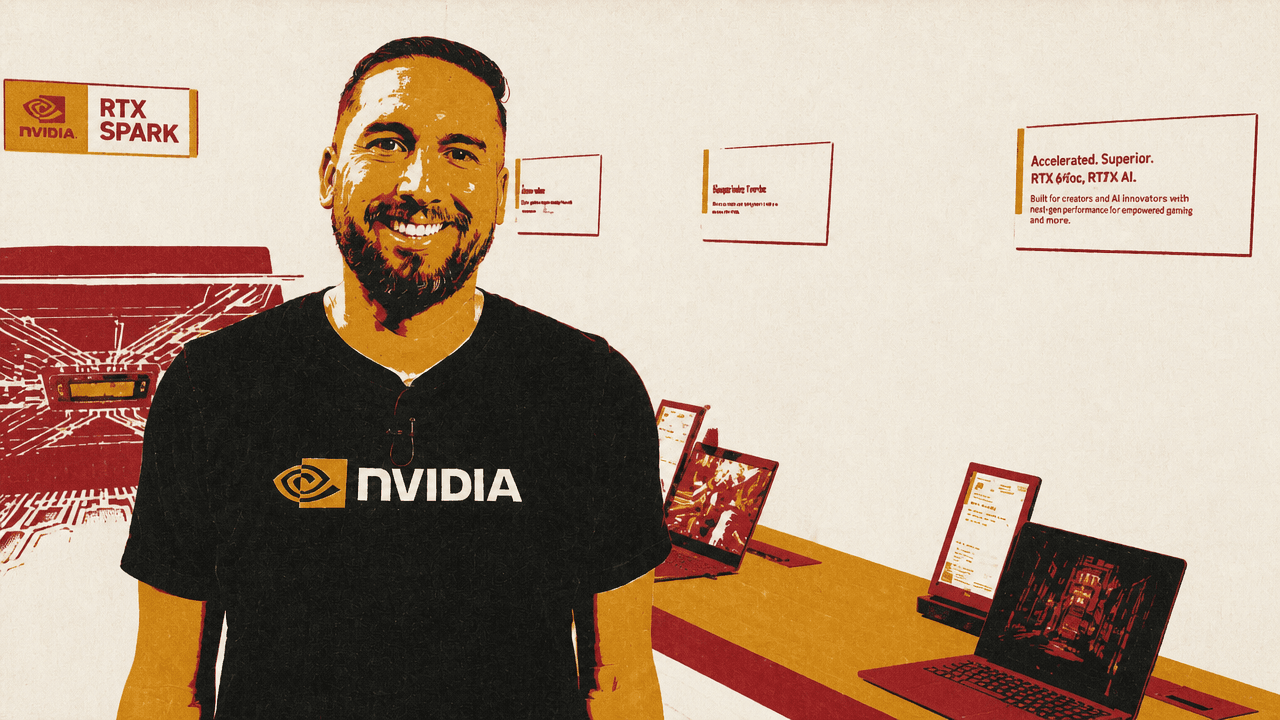
RTX Spark is being positioned as a local AI workstation, not just a gaming laptop
Jacob Freeman described NVIDIA RTX Spark as a new “superchip” for Windows PCs, meant to combine three workloads that have usually been discussed separately: personal AI agents, advanced creative work, and high-performance gaming. The systems shown were slim Windows laptops and compact desktops, with the chip pairing an NVIDIA Blackwell RTX GPU with an NVIDIA Grace CPU.
The specifications NVIDIA put on screen were central to the pitch: 6,144 CUDA cores, 1 petaFLOP of FP4 AI performance, a 20-core Grace CPU, and up to 128 GB of LPDDR5X unified memory. The chip was described as custom-built with MediaTek and connected through NVLink C2C, with 600 GB/s GPU-to-CPU bandwidth, which the visual framed as five times PCIe Gen 5.
The point of the memory figure was not only speed or capacity in the abstract. Joel Pennington tied it directly to running larger local models. In his explanation, RTX Spark’s 128 GB of unified memory allows personal agents to run “big models,” while the built-in RTX GPU is what makes those models run quickly. He also said NVIDIA is working with Microsoft so that “everything’s local,” with the stated benefit that user data stays private and secure.
The agent demo used OpenDevin to operate ComfyUI
Joel Pennington demonstrated the local-agent claim through an image-generation workflow. The screen showed an image-editing workspace with a terminal-style chat interface for an AI agent named OpenDevin on the left, and concept art of a griffon with reference images of eagles and snowy owls in the main workspace. Pennington’s task was to turn a simple line-art sketch into a more finished material look using reference photos, then place the character into a snowy scene.


The important part of this example was not only that ComfyUI could generate an image. Pennington said he did not want to operate ComfyUI directly; he would ask OpenDevin to do it for him rather than work inside ComfyUI’s complexity himself. His prompt was plain-language: “create a new image from my sketch and snowy background.”
From there, Pennington described OpenDevin as controlling ComfyUI on his behalf. It was “handling the prompts” and “handling all of the hyper parameters.” In this workflow, the agent was presented as an operator of the creative software used in the demo, not merely a chatbot that offers suggestions.
After the generated image appeared, Pennington extended the same workflow to video. He used the image as a start frame and added another text prompt: “make the camera move back looking at the griffon.” The resulting clip showed a photorealistic griffon in a snowy mountain landscape while the camera slowly pulled back. Pennington characterized the result as “quickly adding a little bit of life” to the concept art.
The narrower claim was that, in this RTX Spark example, a local AI agent could sit between a creator and a complex node-based or parameter-heavy tool. The evidence offered was the two prompts Pennington typed and his description of OpenDevin controlling ComfyUI while handling prompts and hyperparameters.
For creators, the memory claim becomes 12K video and 90 GB scenes
Gerardo Delgado moved from agent workflows to conventional content creation workloads. He said RTX laptops can edit up to 12K 4:2:2 video and render “gigantic scenes” up to 90 GB, attributing both capabilities to the 128 GB of memory available in the laptops.


Delgado also said NVIDIA is working with top creative applications so they work well “on day one,” and that some are adding new features. The concrete example was Blender. In the demo, Delgado contrasted Blender’s existing OptiX denoiser with a newer DLSS 4.5 Ray Reconstruction workflow.
The side-by-side visual showed a rendered stone-house scene in Blender. The left side, labeled “Ray Reconstruction Off,” appeared less resolved and noisier. The right side, labeled “Ray Reconstruction On,” appeared sharper. Delgado’s claim was not simply that the right side looked cleaner; it was that the clearer preview changes the creator’s ability to make decisions while moving through the scene. On the left, he said, the image was “not fully resolving.” On the right, creators could see “how the final content would look like.”
The value being claimed is interactive judgment. If the viewport more closely resembles final output while the artist navigates the scene, the acceleration affects layout, lighting, and composition decisions during the working process, not only the final render.
Gaming remains part of the pitch, with DLSS 4.5 and broad API support
Jacob Freeman returned to gaming as the third pillar of the RTX Spark preview. NVIDIA showed multiple games running on RTX Spark, naming Alan Wake 2, War Thunder, and Pragmata. Freeman specifically described Pragmata running at 1600p resolution with ray tracing and DLSS 4.5.
The Pragmata footage, attributed on screen to CAPCOM, showed gameplay in a futuristic city environment with neon signage. Freeman said the game was “playing so smooth,” and credited the new transformer model in DLSS 4.5 with helping bring out environmental detail. The gaming demonstration was framed around the visible experience and feature support rather than benchmark tables.
NVIDIA also showed Fortnite and said RTX Spark supports games running on DirectX, OpenGL, or Vulkan, including multiplayer titles with anti-cheat such as Fortnite. The significance NVIDIA attached to this part of the preview was breadth of support: the platform was presented as a Windows gaming system for named RTX titles, multiple graphics APIs, and at least one multiplayer game with anti-cheat.
Freeman closed by saying RTX Spark laptops and compact desktops will start shipping in the fall. The preview’s positioning was clear: a compact Windows machine with unified memory for local AI models, GPU acceleration for creative and generative workflows, and RTX features for modern games.