AI Factories Shift From Peak Power Design to Dynamic Capacity
NVIDIA argues that AI-factory capacity is constrained by the facility as a whole—grid connection, power delivery and cooling—not GPUs alone. Its DSX AI Factory Platform combines grid-responsive demand management, DSX MaxLPS power controls, 800 VDC distribution and 45°C liquid cooling to direct more of a fixed power budget to compute. NVIDIA says MaxLPS can enable up to 40% more compute within the same power budget.
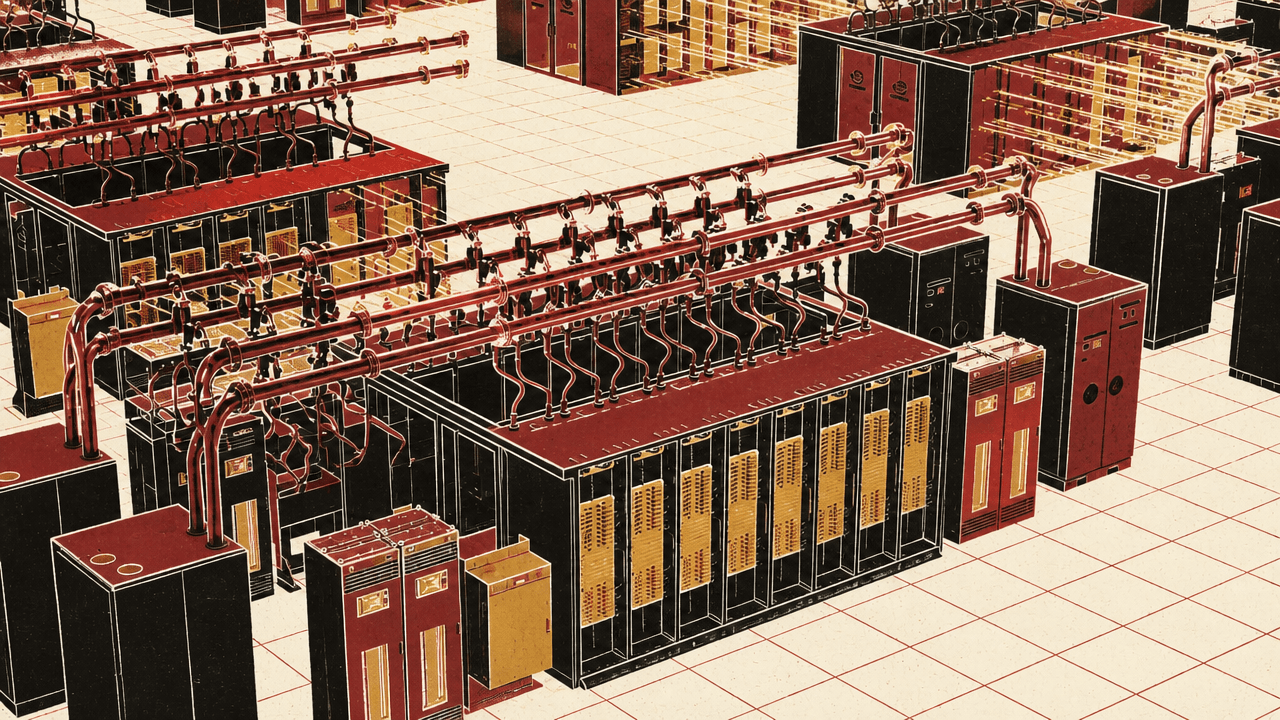
AI capacity is constrained by the whole facility, not just the chips
NVIDIA frames an AI factory as a different kind of data center: not a collection of independently managed servers and utilities, but an integrated system spanning the grid connection, power delivery, and cooling. The objective is to turn each available megawatt into more AI compute.
That framing makes power a production constraint rather than a background utility. NVIDIA’s claim is that adding electrical capacity is not the only route to more output; facilities also need to use the capacity they already have more deliberately. A peak-based approach to infrastructure design, it says, can strand capacity that could otherwise serve AI workloads.
The NVIDIA DSX AI Factory Platform is presented as the layer connecting design, simulation, deployment, and operations. The platform diagram places DSX Sim, DSX MaxLPS, DSX Flex, power optimization, power systems, and 45°C liquid cooling within the same architecture.
The premise is operational as much as architectural: teams should be able to scale AI capacity faster while running it more efficiently because the facility’s power, cooling, workloads, and grid conditions are treated as parts of one system.
Efficiency requires responding to the grid
NVIDIA identifies grid flexibility, dynamic power management, and high-temperature liquid cooling as the three pillars of AI-factory energy efficiency. The important distinction, in its account, is between a facility that merely draws more electricity and one that can adapt its demand as grid conditions change.
NVIDIA DSX Exchange and DSX Flex are intended to connect signals from workloads, infrastructure, and the grid. DSX Flex is presented as adjusting facility power demand in response to those signals, while still supporting AI workloads. A depicted grid-demand gauge reads 54%, illustrating the changing conditions the system is meant to address.
Rather than designing the facility solely around its highest expected draw, NVIDIA proposes dynamically managing demand and directing available power toward compute. Its stated concern is that peak-based design can leave capacity unused.
Every megawatt counts, and peak-based design can leave valuable capacity unused.
Power management is pitched as additional compute within a fixed budget
DSX MaxLPS is NVIDIA’s power-management mechanism for GPUs, racks, and workloads. NVIDIA says it dynamically manages power across all three layers and can enable up to 40% more compute within the same power budget.
A dashboard shown in the source contrasts scenarios with and without DSX MaxLPS. In the illustrated comparison, the system with MaxLPS is assigned 38,304 total GPUs and $26 billion in annual revenue, versus 26,322 GPUs and $19 billion without it. The display also presents power-budget labels ranging from 80 MW through 2 GW, though it does not specify which budget corresponds to the displayed GPU and revenue figures.
| Scenario | Total GPUs | Annual revenue |
|---|---|---|
| With DSX MaxLPS | 38,304 | $26B |
| Without DSX MaxLPS | 26,322 | $19B |
The system’s control objective is therefore not just to cap draw. It is to allocate constrained power across the infrastructure in a way that supports more computing capacity and workload output. An accompanying control chart contrasts “AI Control” with “Traditional Control” across IT load and supply temperature, positioning coordinated power-and-thermal management as an alternative to operating those variables separately.
Higher-voltage delivery and hotter liquid cooling address the physical system
NVIDIA also presents 800 VDC power delivery as a way to optimize power delivery as AI factories scale. The company’s position is that improved electrical distribution is necessary, but insufficient on its own: extracting more compute from a megawatt still leaves the problem of removing the resulting heat.
Its proposed cooling approach uses closed-loop liquid supplied at 45°C. A cooling monitor shown in the source lists a 45°C liquid input and a 54°C liquid output under normal status. NVIDIA says 45°C liquid cooling keeps high-density AI compute operating efficiently while lowering cooling overhead.
The combination matters because the components are interdependent. More densely deployed compute raises both the value of available power and the demands placed on thermal systems. NVIDIA’s blueprint joins grid-aware demand adjustment, power management, 800 VDC delivery, and 45°C liquid cooling rather than treating any one of them as the complete solution.
The film labels data-center imagery with the names Foxconn, Delta, Digital Realty, Nscale, and Nebius. NVIDIA describes the broader effort as an ecosystem blueprint for AI factories that are more efficient across grid interaction, power delivery, and cooling.