NVIDIA RTX Spark Recasts Windows PCs as Local AI Agent Machines
NVIDIA chief executive Jensen Huang used his GTC Taipei keynote to present RTX Spark as the basis for a new class of Windows PCs built around personal AI agents. His argument was that the PC needs an abstraction layer comparable to the one that made the original Windows ecosystem work: existing applications, CUDA workloads and games still run, but large language models and agent runtimes become part of the operating environment.
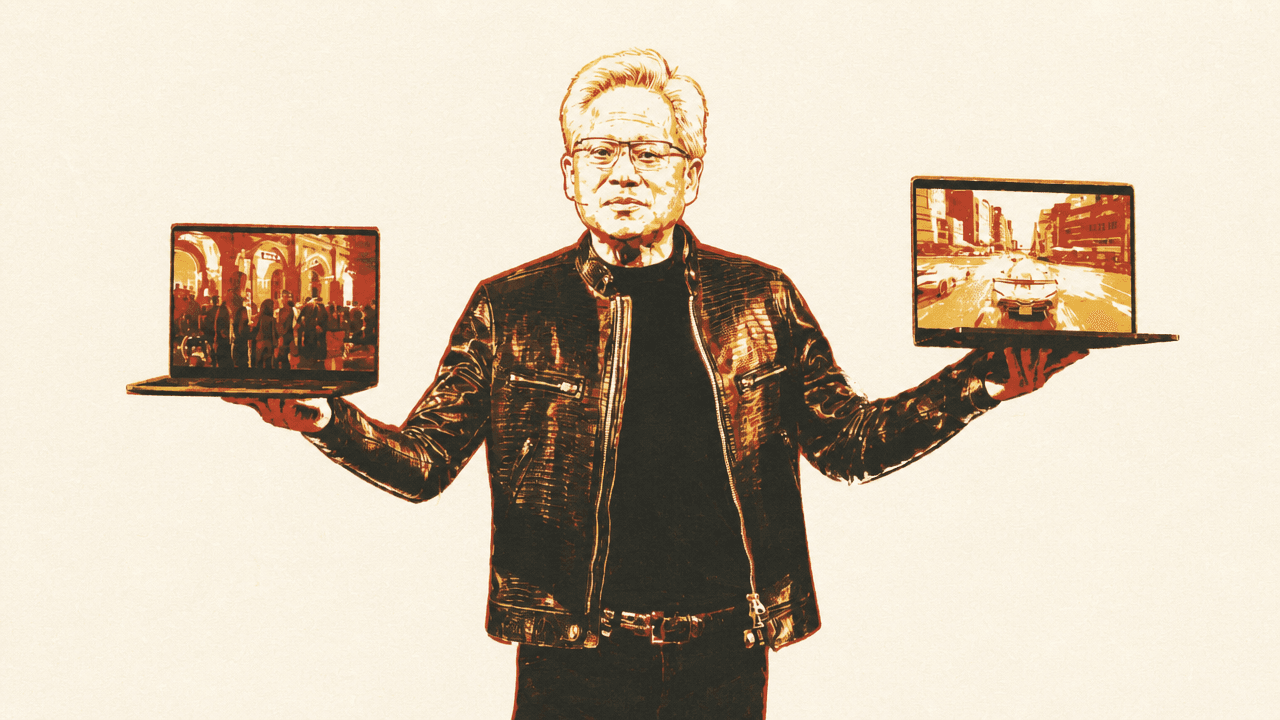
The PC gets a new abstraction layer: local AI agents
Jensen Huang framed NVIDIA RTX Spark as the start of a new PC architecture built for personal AI agents. His reference point was the original Windows PC: a platform that became universal, in his telling, because it was “properly abstracted,” with system BIOSes, open chipsets, an operating system with runtime-installable drivers, and multimedia APIs that opened up the PC.

Huang’s argument was that a comparable platform shift is now needed. The old PC architecture made applications practical across a broad hardware and software ecosystem. The new one, as NVIDIA presented it, adds large language models to the operating system and treats the application layer as an agentic runtime.
The slide NVIDIA showed for this architecture placed a user prompt above an “OpenShell” box with four agent functions: context, observe, reason, and act. Beneath that sat a “Local LLM” layer, with model names including DeepSeek, Gemma, SLM, ChatGLM, Mini, MiniMax, Nemotron, and Qwen, on top of Windows. Huang described the new operating system as “the old operating system, plus large language models,” calling LLMs “the modern version of DirectX” and “the intelligence extension of the PC.”
The new operating system is, of course, the old operating system, plus large language models.
That analogy did much of the work. Huang’s claim is that LLMs can become a comparable extension point for the PC: a layer that understands prompts, vision, generated video, generated sound, and user intent. The software unit above it is no longer only a manually launched application; Huang described the modern application as an agent that can understand a person, read files, do research, and act on the user’s behalf.
Huang said Microsoft and NVIDIA had spent three years working on this reinvention, and that he would discuss the work further with Satya Nadella. The claim was not that agents only belong in cloud infrastructure. He described the agent compute pattern as spanning AI clouds, enterprises, and PCs. RTX Spark is NVIDIA’s attempt to make the personal computer one of the places where those agents run.
RTX Spark is positioned as a Windows-compatible PC platform
The RTX Spark announcement centered on a chip and a laptop platform, but Huang repeatedly emphasized compatibility and continuity. He described the product as a Windows machine that can run existing Windows software, NVIDIA’s software stack, CUDA workloads, games, creative applications, and new agents.
The launch video and slides described RTX Spark as built around a Blackwell RTX GPU with 6,144 CUDA cores and 1 petaflop of FP4 AI performance, paired with a 20-core Grace CPU custom built with MediaTek. The same material listed unified memory with NVLink C2C, 128 GB of LPDDR5X memory, “600 GB/s GPU to CPU I 5X PCIe Gen 5,” a TSMC 3 nm process, and 70 billion transistors. It also placed RTX Spark in a laptop context with phrases including “Peak Efficiency Max-Q Laptops,” “Tandem OLED G-SYNC Panel,” “14mm Thin,” and “All-Day Battery Life.”
| Component or capability | RTX Spark detail shown |
|---|---|
| GPU | NVIDIA Blackwell RTX GPU; 6,144 CUDA cores |
| AI performance | 1 petaflop FP4 AI performance |
| CPU | 20-core Grace CPU; custom built with MediaTek |
| Memory | 128 GB LPDDR5X / 128 GB unified memory |
| Interconnect | Unified memory with NVLink C2C; 600 GB/s GPU to CPU I 5X PCIe Gen 5 |
| Process and scale | TSMC 3 nm process; 70B transistors |
| Laptop claims | Peak Efficiency Max-Q laptops; Tandem OLED G-SYNC panel; 14mm thin; all-day battery life |
| Agent target | 120B parameter agents with 1M context |
| Software stack shown | CUDA; TensorRT; NVPp4; RTX ray tracing; DLSS; Reflex; G-SYNC |
Huang identified the chip as N1X, built with MediaTek, and called it “the most amazing chip the world has ever built.” His explanation for that claim was not only silicon performance. It was that “100% of NVIDIA’s software stack runs here.” He listed digital biology, seismic processing, astrophysics, physics, biology, genomics, AI, computer graphics, and CUDA applications as workloads the platform could run.
The compatibility claim was even broader: Huang said Microsoft and NVIDIA had “meticulously optimized everything” so the computer “literally runs everything the world has ever created, plus it now runs agents.” That was presented as the platform’s defining feature: a Windows PC that keeps the existing software base while adding agent execution.
This computer literally runs everything the world has ever created, plus it now runs agents.
The launch video also positioned RTX Spark for familiar RTX use cases: rendering 90 GB 3D scenes, editing 12K video with 4:2:2, 100 FPS 1440p gaming, ray tracing, and DLSS. Huang began the physical product reveal by showing games, including Forza and a new 007 game, before introducing “NVIDIA’s RTX Spark laptops.”
RTX Spark was presented as a personal computer that retains gaming, creation, CUDA acceleration, and Windows compatibility while adding local agent execution.
The agent demo made the PC a coordinator of tools, models, and creative software
The most concrete demonstration showed an AI-assisted architectural workflow. A prompt asked for “a modern four-bedroom, three-bathroom, three-story residence perched atop of a sloping site, with dramatic cantilevered upper levels extending over shaded verandas and oriented to celebrate sweeping westward ocean vistas.” The demo connected a site image, references, and text brief to tools including Rhino, Blender, and ComfyUI through an OpenShell agent.
The visual architecture of the demo repeated the agent loop shown earlier: context, observe, reason, act. A Claude Sonnet model appeared as part of the workflow. The agent was shown generating a 3D model in Rhino and then producing a photorealistic rendering in Blender.
Huang asked the audience to imagine that “everything here is going to run on your PC.” He did not limit that to one model placement. He said the computer could run a local Nemotron 3 Ultra or Nemotron 3 Super model, or use Claude Code, Codex, another cloud model, or a model on the network. NVIDIA positioned the agentic PC as a machine that can combine local models, cloud models, network models, desktop applications, and files.
That is why the OpenShell layer mattered in the demonstration. NVIDIA showed an agent using context, observing application state, reasoning over a task, and acting through multiple creative tools on the machine. The claim was larger than model response quality: it was that a PC can become a place where agents operate across applications.
NVIDIA reinforced that with a slide titled “Accelerate Every AI. Every App. Every Game,” filled with logos from creative software, development tools, AI models, game engines, cloud providers, and local model tools. The visible names included Adobe, Anaconda, Blender, Claude, Codex, ComfyUI, Cursor, DaVinci Resolve, Docker, Epic Games, Google Cloud, Hugging Face, Jupyter, LangChain, Luma AI, Meta, Mistral AI, Notion, OBS, Ollama, Perplexity, PyTorch, Runway, Rhino, Roblox, Unity, Unreal Engine, Visual Studio, and others.
Huang summarized developer reaction by saying they were “so excited” about “PC in the world of agents.” The software claim was ecosystem-wide: RTX Spark would accelerate AI, applications, and games, while giving agents a runtime that can interact with those applications.
Adobe’s role showed how applications become agent-friendly
Adobe was the named application partner with the clearest product claim. NVIDIA showed a Premiere Pro interface editing a race-car video alongside the text: “Announcing New Adobe Premiere and Photoshop for RTX Spark,” “Up to 2X Faster,” and “Creative Agent-Ready.”
Huang said Adobe had re-engineered the core architecture of Photoshop and Premiere for RTX Spark. He described the new versions as twice as fast and “agent-friendly.” The mechanism he named was an MCP server, which would allow Adobe applications to interact with agents on the laptop.
That statement made Adobe more than a performance partner in the announcement. In Huang’s framing, the application itself has to expose some form of agent interaction. The point is not only that Photoshop and Premiere run faster on the GPU. It is that creative software can interact with agents through an MCP server.
Adobe’s tools, Huang noted, are used by tens of millions of people. The broader product launch slide showed laptop OEMs including ProArt, MSI, Dell, Samsung, Lenovo, HP, ASUS, GIGABYTE, and Acer, with availability listed as fall. Huang said “basically everybody” would support RTX Spark and build “smart and powerful and beautiful laptops.”
The Adobe example showed what NVIDIA emphasized for the broader PC ecosystem: not just drivers and acceleration, but applications designed so agents can work with them.
The product family extends beyond laptops into always-on personal AI machines
Huang then widened the announcement from RTX Spark laptops to what NVIDIA called “Three Revolutionary Windows Machines.” The slide showed a desktop tower, a laptop, and a small desktop box under the line: “One Architecture. Agent-Ready.”
He said Microsoft and NVIDIA were reinventing “all of PC,” covering desktop, laptop, and workstations. He described the machines as 100% Windows compatible, 100% CUDA, and 100% NVIDIA AI Tensor Core. Anything shown running on NVIDIA platforms elsewhere, he said, runs on these machines.
The desktop form factor carried a different argument from the laptop. Huang described an RTX Spark desktop as a personal agent machine that could run “24/7,” with “no meter anxiety.” In his description, the value of the local machine was that a user could “download your agent,” run it continuously, and connect it to the house, laptop, display, cameras, dryer, water cooler, water heater, and security system.
He gave the example of an agent that could help book travel. More broadly, he described the desktop as a personal AI that gets smarter over time as model generations improve: Nemotron 3 Ultra, then Nemotron 4, Nemotron 5, Nemotron 6, and so on.
The workstation pitch was aimed at developers. Huang introduced “a DGX Station for Windows” with 768 GB of memory, enough, he said, to run a trillion-parameter model. He also gave the system’s performance as 28 petaflops and memory bandwidth as 8 TB/s. The workstation sits by a developer’s desk, in his description, for building large language models and agents before deploying them to the cloud.
The line Huang described spans a laptop for everyday personal computing and mobility, a desktop for continuously running personal agents, and a workstation for local development of large models and agent systems.
The analogy is the smartphone: the category name stays, but the use changes
Jensen Huang’s larger prediction was that “PC” will become a legacy name for a substantially different object. He compared it to the phone. Fifteen or twenty years ago, he said, people had “an idea called a phone.” Today, the thing still called a phone is used mostly for everything except phone calls. The word stayed; the device’s role changed.
He argued that the same transition is coming for the PC. The current idea of a PC is “a tool where you launch applications, click and type.” Ten years from now, he said, that concept will be “completely different.”
His more speculative version was domestic: someday, a house may have an AI supercomputer in the same way many houses have home theaters, stereos, dishwashers, game consoles, and large TVs. That machine would run assistants and agents that do tasks continuously. Huang said these systems may come to feel more like R2-D2 or C-3PO than like a PC.
The analogy clarifies the product strategy NVIDIA presented. Agents were not treated as another app category. They were presented as a reason to rework the PC line around local compute, unified memory, GPU acceleration, Windows compatibility, and an agent runtime that can interact with desktop software and, in Huang’s speculative home example, connected devices.
There is no question this reinvention of the computer is as big of a deal as the reinvention of the phone into what we now know as the smartphone.
Huang presented the announcement as the beginning rather than a one-off launch. The roadmap slide was titled “A New Line. A New Beginning.”
Spark is planned as a recurring architecture, not a single generation
The roadmap shown at the end mapped the new PC line across Blackwell, Rubin, and Feynman generations from 2025 through 2030. Huang said this would be “a brand new product family” for NVIDIA, with every generation of architecture including a desktop, a laptop, and a workstation.
The visible roadmap began with Blackwell-era products and references including Blackwell Ultra RTX GPU, Grace Blackwell Spark, RTX Spark, DGX Station for Windows, LPDDR5X, and MediaTek. It then moved into Rubin, listing Rubin RTX GPU, HBM4, New Rubin Spark, CX9, a new CPU, LPDDR6, CX10, and a new DGX Station. The final portion listed Feynman, Feynman HBM Next, Nova, Nova Feynman Spark, CX10, and a new DGX Station. The slide placed the overall roadmap across a 2025-to-2030 timeline, but did not make every item’s timing precise.
| Architecture shown | Elements visible on the roadmap |
|---|---|
| Blackwell | Blackwell Ultra RTX GPU; Grace Blackwell Spark; RTX Spark; DGX Station for Windows; LPDDR5X; MediaTek |
| Rubin | Rubin RTX GPU; HBM4; New Rubin Spark; CX9; new CPU; LPDDR6; CX10; new DGX Station |
| Feynman | Feynman HBM Next; Nova; Nova Feynman Spark; CX10; new DGX Station |
Huang closed the announcement by saying that “100% of the world’s PC industry” had joined NVIDIA to reinvent the PC. The specific claim at the end was not that a single RTX Spark laptop would define the next decade. It was that NVIDIA now intends to ship a recurring PC product family across architectural generations, with each generation covering desktop, laptop, and workstation machines built for agents.