Scientific Discovery Is Being Rebuilt Around Models, Agents, and Lab Automation
NVIDIA argues that scientific discovery is being reorganized around a new bottleneck: instruments and simulations now generate more biological data than researchers can interpret manually. Its case for the “agentic AI era” is that accelerated computing, open biological models, AI agents, and lab automation are becoming a single discovery stack, compressing simulation timelines and shifting more of the work of reading, design, analysis, and execution onto computational systems while scientists define the questions.
The bottleneck shifts from instruments to interpretation
NVIDIA frames the shift in scientific discovery as a change in speed: for centuries, science moved “at the speed of humans and time,” but accelerated computing and global research work have “changed the math.” The claim is not simply that laboratories have better tools. It is that computation has compressed parts of the scientific workflow so sharply that the limiting factor has moved.
The concrete example is broad but pointed: simulations that once took months of compute can now collapse into a day. The accompanying visuals place that claim in molecular science: a 3D scatter plot of molecular properties labeled LogP, MolWt, and QED; chemical formulas paired with 3D molecular structures and QED scores; and protein simulations from Basecamp Research and Chai Discovery showing proteins interacting with DNA and folding. Accelerated computing is positioned as a way to make biological systems more directly observable in simulation, “allowing us to watch molecules move and disease unfold.”
That acceleration is applied to “every instrument of science,” not only to molecular simulation. NVIDIA names sequencers, cytometers, microscopes, and X-ray systems, while showing sequencing hardware from Oxford Nanopore Technologies, cytology equipment from Thermo Fisher Scientific, 3D cellular imagery attributed to the University of California, Berkeley, and a progression of brain imaging from a grayscale 1971 scan to a detailed Philips CT image from 2016 and a 2025 Atlas Meditech 3D brain model.
The point is that better instruments reveal more signals, structures, and biological detail than researchers can manually absorb at the rate produced. Richer measurement creates a second-order problem: science is generating data faster than humans can read and understand it.
Open biological models are cast as the response to excess data
NVIDIA’s answer to the interpretation bottleneck is to “build the intelligence” that can work with the expanding biological data stream. The models are described as “open models that understand molecules and biology,” placed in a chain that runs from measurement to interpretation to design.
The examples extend beyond NVIDIA’s own product line. A grid of molecular-model systems names Google DeepMind’s AlphaFold3, Biohub’s ESM3, Boltz PBC’s Boltz-2, and OpenFold Consortium’s OpenFold3. In NVIDIA’s framing, these biological models are part of the toolset being made available to researchers and companies working on molecular and biological problems. NVIDIA describes them as built “for every researcher, every company, and every breakthrough waiting to happen.”
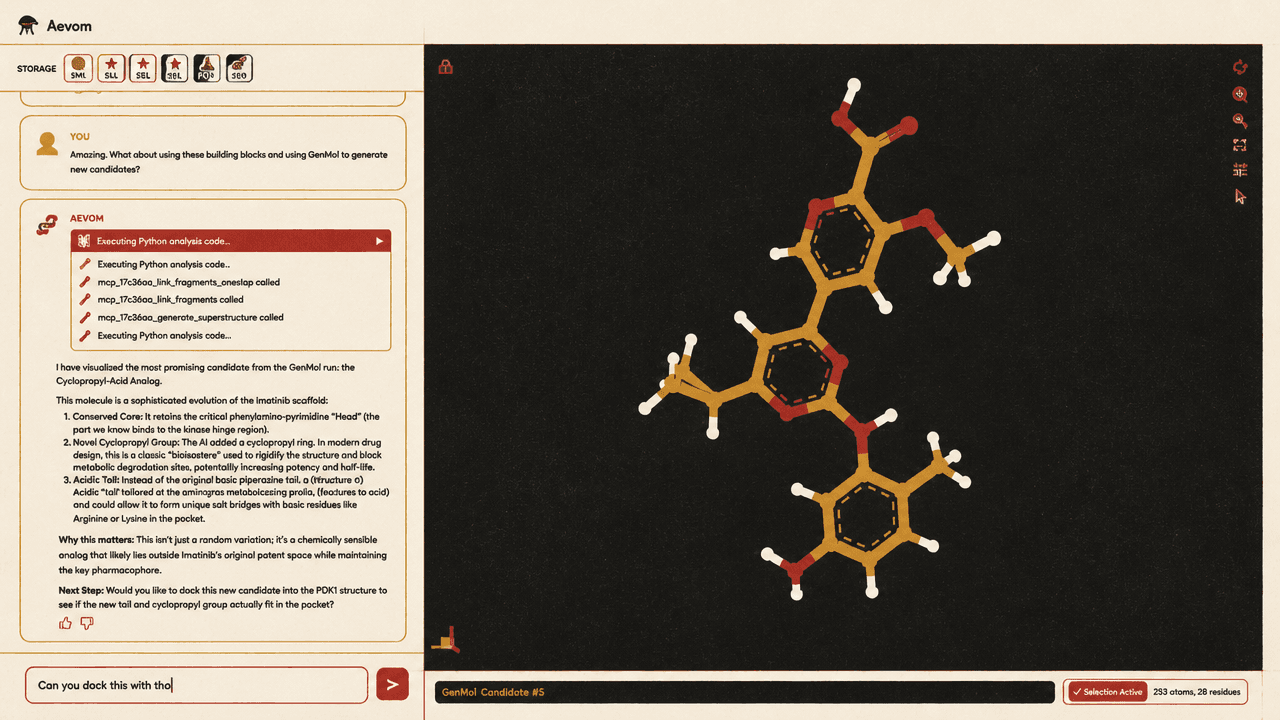
The surrounding software examples widen the role assigned to AI. A network graph from Edison Scientific and FutureHouse links data nodes and document panels. An Aevom interface shows code execution steps alongside a 3D molecular structure. An NYB.ai workspace maps relationships among scientific research documents. Benchling AI appears with a scatter plot for candidate performance. The workflow implied by these examples is not limited to predicting protein structures or generating molecules; it also includes navigating papers, executing code, comparing candidates, and reasoning across research materials.
That distinction matters because the transition NVIDIA is describing is not only about model capability in isolation. Instruments produce more biological data. Accelerated computing reduces the time required for simulation and analysis. Biological models help interpret and design within molecules, structures, and scientific knowledge. The agent layer is introduced after those pieces are in place, as a way to use the tools shown across research software and design environments.
Agents are the layer that runs discovery tasks
NVIDIA’s strongest shift in language comes with agents: “A world of agents takes these tools and runs.” The phrase marks a move from AI as a model a researcher consults toward AI as software that can operate inside the kinds of research interfaces shown on screen.
The displayed tasks are concrete. One interface shows protein sequences next to a 3D protein model with the instruction, “Design 10 protein binders for PD-L1 - Binder 1.” A Benchling AI chat interface analyzes sequence modifications for reduced viscosity. A Dassault Systèmes 3DEXPERIENCE molecular simulation interface shows a 3D structure with numerical simulation parameters. NVIDIA places agentic AI in the practical middle of discovery work: binder design, sequence-property analysis, and interaction with simulation tools.
Discovery no longer waits on us.
That line concentrates the thesis. NVIDIA’s framing does not dwell on institutional process or oversight; it keeps human curiosity central while assigning more of the work to computation. The final formulation gives the work two speeds: “Science now moves at the speed of human curiosity and works at the speed of computation.”
The closing visuals extend the operating model from software into physical lab systems. Medra is shown with robotic arms operating laboratory equipment. Lila Sciences appears as an automated track moving sample plates through a lab. Multiply Labs shows a humanoid robot transporting a rack of samples. Thermo Fisher Scientific appears again with a scientist analyzing data on a monitor. The system NVIDIA sketches is one in which computational models support interpretation and design, agents work inside digital research environments, automated instruments and robots handle parts of laboratory execution, and researchers continue to supply the questions.
The stack joins measurement, models, agents, and automation
NVIDIA’s ecosystem claim is built by assembling the pieces of a discovery stack. Wet-lab and pharmaceutical settings appear through Recursion, Genentech, and IQVIA. Measurement and imaging are represented by sequencing, cytometry, microscopy, and brain-scan visuals, including Oxford Nanopore Technologies, Thermo Fisher Scientific, Roche, UC Berkeley, Philips CT, and Atlas Meditech. These are the systems that generate the signals and structures NVIDIA says biology is now revealing at scale.
The next layer is computational interpretation. Biological foundation-model examples appear through AlphaFold3, ESM3, Boltz-2, and OpenFold3. Research software and agent interfaces appear through FutureHouse, Aevom, NYB.ai, Benchling, and Dassault Systèmes. In the visuals, these tools connect documents, execute code, display molecular structures, compare candidate performance, analyze sequence changes, and run or inspect simulations. Their role in NVIDIA’s account is to make the expanding data stream usable for discovery rather than leaving it as unread volume.
The final layer is execution. Medra, Lila Sciences, and Multiply Labs represent laboratory automation: robotic arms operating equipment, sample plates moving through an automated track, and a humanoid robot transporting lab samples. By placing those systems after the agent and simulation examples, NVIDIA links computational reasoning to the physical movement of experiments through laboratory infrastructure.
The stack supports NVIDIA’s central claim about speed. Instruments and imaging systems create more biological data. Accelerated computing compresses some simulation timelines from months to a day. Biological models provide a computational way to work with molecules, structures, and scientific knowledge. Agents use design, analysis, document, code, and simulation tools. Automation carries parts of the process into the lab. “Agentic AI era,” in this framing, means science still begins with human curiosity, but more of the reading, simulation, design, analysis, and experimental movement is carried by computational systems.