AI Agents Build Robot Training Worlds From CAD Models and Real-World Motion
NVIDIA presents Agent Astra as a way to automate parts of robot development, turning a prompt, CAD assets and real-world motion data into a simulation for training and testing skills. In the demonstration, Astra builds the world, replays motion and tunes its physics; Isaac Lab and Newton handle training, while Isaac Lab-Arena evaluates skills locally on DGX Station. NVIDIA positions Agile ONE SN, built on Isaac GR00T and powered by Jetson Thor, as a reference robot for bringing trained skills into the physical world.
A prompt and real-world data become a training world
Building a robot requires more than defining a task: developers also need a simulation world in which to train and test it. Agent Astra is presented as a way to automate parts of that setup. Developers describe the assets, environment, and task in a prompt and provide data; Astra uses NVIDIA open libraries and models as tools.
The demonstration prompt asks Astra to take CAD models, convert a real robot demonstration into simulation, then train and evaluate GR00T across benchmarks on DGX Station. The interface shows Astra resolving asset references. A system diagram places an Agent Sandbox between an LLM and Knowledge and Tools, and names World Generation, Reinforcement Learning, and Evaluation as parts of the workflow. Labels in the diagram include Isaac Lab, Newton, Isaac Lab-Arena, Isaac ROS, GR00T, SimReady, and a CAD-conversion tool.
Astra builds the training world from the supplied assets and task description. It then replays real-world motion and tunes the simulation’s physics to prepare that world for training. A split-screen comparison shows a real robot inserting a cable alongside the simulated version. The demonstration therefore links the robot’s physical motion to a simulation intended for training: start with CAD models and a real demonstration, create a corresponding world, and adjust its physics.
Training and evaluation continue on the same workstation
Once the simulation is ready, Astra trains and refines robot skills using Isaac Lab and Newton, then evaluates them at scale with Isaac Lab-Arena. A screen shows multiple simulation feeds running at once alongside a log describing the evaluation.
The sequence connects world-building with the next stages of robot development. Isaac Lab and Newton are used for training and refinement; Isaac Lab-Arena is used for evaluation. The tools run locally on DGX Station, which the narration says enables faster iteration. In the demonstration, building the world, training and evaluating the skill are presented as steps in one local workflow.
The cable-insertion task is described as one skill among many. Other scenes show a medical device in Isaac Sim and robots in settings including a home, a hospital, a store, a factory, and a sidewalk. The examples range from a humanoid holding a laundry basket to a small delivery robot navigating outdoors. They give a view of the different settings and tasks the training approach is intended to address.
Agile ONE SN is a starting point for deployment
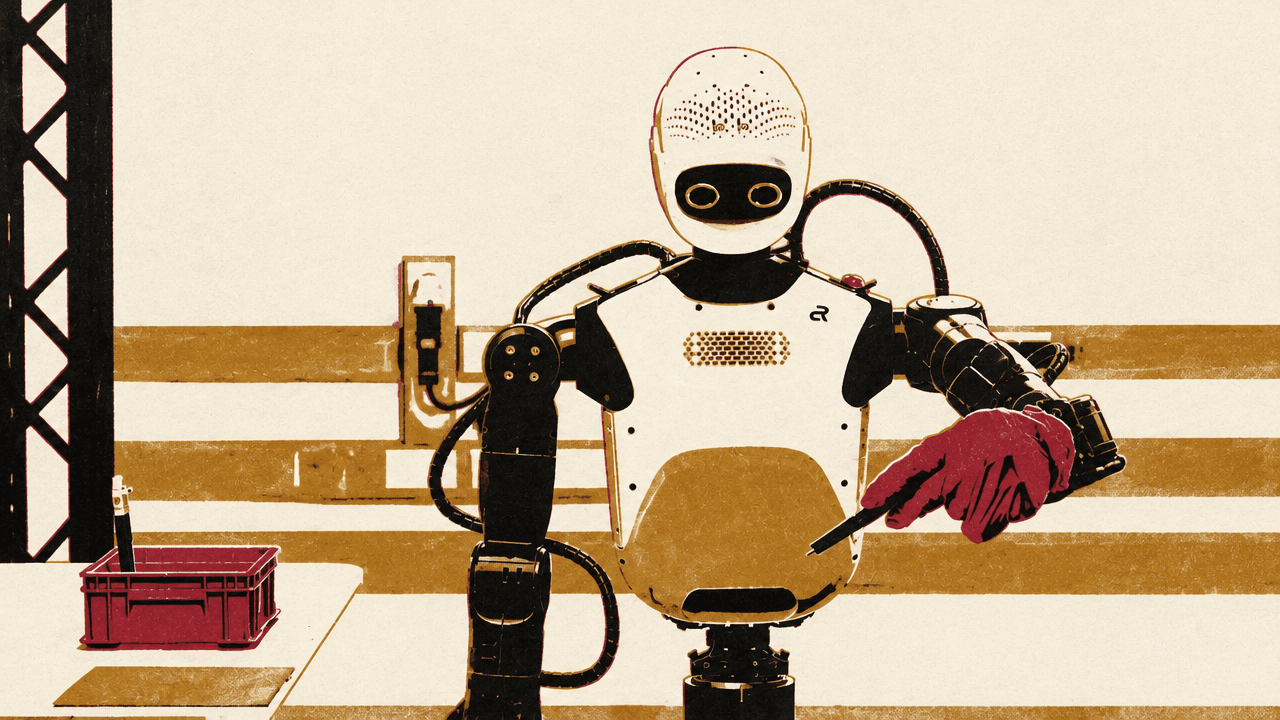
The final step is to move learned skills from simulation to the real world. Agile ONE SN is introduced as a full-stack reference robot built on NVIDIA Isaac GR00T and powered by Jetson Thor. Its stated role is to give developers a starting point for training and deploying new skills. In the lab scene, the robot is identified as running the NVIDIA Isaac GR00T World Action Model and is shown preparing to pick up an object from a table.
That reference robot provides a physical endpoint for the workflow described earlier: build and prepare a simulation, train and evaluate skills, then bring them into the real world. The demonstration does not describe the details of transferring a particular cable-insertion skill to Agile ONE SN; it presents the robot as a platform developers can use to train and deploy new skills.
NVIDIA’s broader claim is that work that once took a team of specialists can be done by any developer with Astra and NVIDIA Isaac tools for agents. The workflow gives that claim concrete shape: describe the task and supply assets and demonstration data; build a simulation world; replay motion and tune physics; train and evaluate a skill; then use a reference robot as a starting point for physical deployment.