Nuclear’s Bottleneck Is Hardware Execution, Not Reactor Design


Valar Atomics founder Isaiah Taylor argues that nuclear power will become cheap and abundant not through a more elaborate reactor design, but through rapid hardware iteration and factory-style production. He says the company is using DOE testing authority to operate experimental reactors, generate the data that simulations cannot provide, and learn how to build simpler, passively safe systems at scale. Taylor’s wager is that vertical integration and equity-funded early deployments can turn nuclear from a bespoke construction business into repeatable industrial equipment.
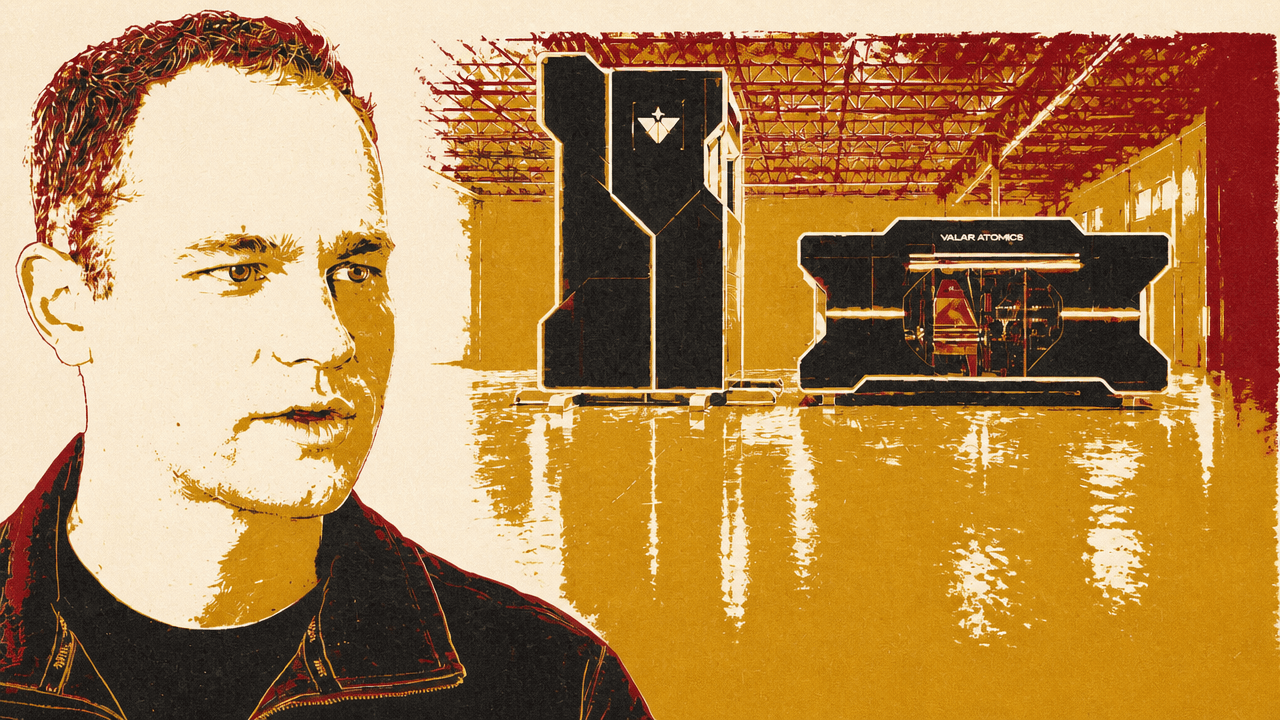
The bet is not on a better paper reactor but on a faster factory
Isaiah Taylor says Valar Atomics is trying to give nuclear fission its “Ford moment” or “Tesla moment”: move reactor production away from bespoke civil construction and toward manufactured equipment that can be built repeatedly, cheaply, and at planetary scale. The company’s stated objective is not merely to bring another small modular reactor design to market, but to make energy ten times cheaper.


Taylor divides the sector into two camps. One treats nuclear as a design problem: optimize the reactor, seek higher efficiency, devise a sophisticated system, and assemble the specialized materials and supply chains necessary to build it. The other treats it as a hardware-execution problem: build reactors, turn them on, operate them, learn from their behavior, and repeat the process until production scales from one unit to ten, then a hundred, then thousands.
Valar belongs firmly in the latter camp. Taylor compares the desired product to a Toyota Camry rather than a Lamborghini. A more complicated reactor may offer better performance on some measure, he says, but it will not necessarily produce cheaper energy than a simple design manufactured in very large numbers. For Valar, the relevant economic question is not whether uranium is expensive—Taylor says fuel is cheap—but whether plants can be produced quickly and cheaply.
We don't want to make Lamborghinis. We want to make a very simple, very cheap, very safe reactor that we can make literally tens of thousands of.
The company calls its operational measure of progress “tick rate”: the interval between meaningful changes in reactor state, specifically between bringing new systems to criticality. Taylor says Valar went from incorporation to its first atom split in two years and four months. Its second criticality, at Ward 250, followed about seven months after Project Nova. The eventual ambition is a new reactor coming online every few minutes.
A short tick rate is not just a measure of engineering velocity in Taylor’s account. It is how the company expects to lower cost. More hardware cycles yield operating data, expose failure modes, sharpen manufacturing methods, and create the capacity to build plants at scale. A sector organized mainly around models and simulations, he argues, cannot get to that industrial learning loop.
That is a claim about company organization as much as reactor architecture. Taylor says Valar hires for people who have built difficult physical systems, including people from outside nuclear, and screens traditional nuclear candidates for whether they want to write papers or build and operate plants. The company’s advantage, in his view, comes from treating every practical constraint around the reactor—shielding, controls, sites, fuel, construction, and supply chains—as part of the product.
DOE testing authority is Valar’s route to operating data
Taylor’s historical account begins with Three Mile Island, which he treats as the event that broke public confidence in U.S. nuclear construction. He says nobody died, nobody was injured, and there was no radiation dose to the public, but the incident became an optics and public-relations failure. Traditional light-water reactors require continued cooling after shutdown because decay heat remains after the chain reaction stops; a loss of cooling can lead to a core meltdown.
His more consequential point is what happened after construction slowed. The United States, he argues, lost much of its capacity to deliver large civil-infrastructure projects—bridges, dams, highways, and major power plants—while becoming much stronger at advanced manufacturing. Restarting nuclear through the old construction model would therefore be poorly matched to the country’s current industrial strengths. The alternative, in his view, is to manufacture more of the plant.
That approach creates a regulatory chicken-and-egg problem. Developers need operating data to satisfy regulators, Taylor says, but obtaining permission to operate an experimental reactor can require the evidence that only an operating reactor produces. The industry’s response, in his telling, has been detailed modeling and simulation: “paper reactors” that predict how a theoretical design should behave.
Taylor argues that Congress created a separate route for testing. The Nuclear Regulatory Commission handles commercial deployment, while the Department of Energy inherited a testing mandate from the Energy Research and Development Administration, or ERDA, which itself emerged from the former Atomic Energy Commission. His point is not that the NRC is unnecessary. Its role, he says, is overseeing mature systems at commercial scale. The mistake is trying to conduct early experimental iteration entirely through that same pathway.
According to Taylor, Valar used Department of Energy authority under Executive Order 14301, which called for three advanced reactors to go critical on American soil by July 4. That route allowed Ward 250 to operate as a test reactor. At the Utah facility, Taylor said the reactor was producing 100 kilowatts and splitting roughly 10^ atoms per second.
Ward 250, Taylor says, is Valar’s first reactor to make power. He describes it as the first advanced reactor to make power by a startup, the first advanced reactor built outside a national laboratory, and the fifth new nuclear device to make power in the United States since 2000. An on-site criticality notice displayed in the source reads: “WARD 250 IS CRITICAL,” dated June 18, 2026, in Emery County, Utah.
The significance, as Taylor sees it, is practical rather than symbolic. A running reactor supplies empirical data. The DOE route is meant to let the company test and learn from hardware before it seeks to deploy a mature commercial system at scale.
That leaves an important boundary in the strategy. The testing route solves the question of how Valar can operate and learn from an experimental system. It does not itself answer how a tested design will proceed through commercial deployment. Taylor’s argument is that the company should first accumulate the data, operating experience, and manufacturing capability that commercial deployment requires rather than attempt to establish all of them through a first project.
The safety case is that failure should not depend on perfect operation
Sarah Guo presses Taylor on an apparent tension at the center of the approach. Hardware iteration requires turning machines on. Nuclear regulation and public caution exist precisely because failures can be consequential. Taylor’s answer is that scale requires not only reducing the probability of failure, but reducing its consequences so substantially that safety does not rest solely on flawless operation.


In a traditional light-water plant, he says, shutdown does not end the safety challenge. Recently split atoms continue to decay, producing heat equal to roughly 5% to 6% of the reactor’s prior continuous power. If cooling stops, heat can build up. At Three Mile Island and Fukushima, Taylor says, loss of cooling was central to the meltdown scenario.
Ward 250 uses a TRISO-fueled, graphite-moderated, helium-cooled architecture. Taylor describes its central safety feature as the ability to dissipate decay heat without active cooling. During a planned scram, control rods introduce boron carbide into the core. Because boron absorbs neutrons, the chain reaction cannot sustain criticality.
The control-system display shown at Ward 250 frames the planned test as a “LOSS OF COOLING SYSTEM SAFETY DEMONSTRATION.” Its interface includes rod controls, temperature and power graphs, and labeled shutdown-bank controls. That display matters because the test Taylor describes is deliberately more severe than a normal shutdown sequence: Valar planned to scram the reactor, cut the plant’s electrical supply, turn off the circulator and reactor cavity cooling-system pump, and observe the result.
In prior non-nuclear testing at Hawthorne, Taylor says, Valar used electrical resistors to heat the plant to nuclear operating temperatures and pressures, then shut off active systems. Water jackets around the core entered passive circulation: water boiled, steam rose and condensed, and the geometry of the system removed heat over time without moving parts, electrical power, or operator intervention.
When you're doing that many times, you really just want it to never ever melt down for any reason.
This reflects Taylor’s framing of risk. He says traditional nuclear safety emphasizes making adverse events exceedingly unlikely. Valar still uses trained operators and site security, he says, but places more weight on reducing the consequence if something unexpected happens. Its stated safety basis begins with an extreme assumption: every relevant component has failed. The question is then whether workers or the public receive a radiation dose. Taylor says Valar’s answer is no.
The reactor protection system is designed to act without human input. It contains three independent sections that determine whether the plant is safe; if two judge it unsafe, the system shuts the reactor down. Taylor describes this as the reactor’s “brain,” distinct from the operator controls used to run the plant.
Reliability still has ordinary engineering causes. Taylor points to helium circulators and heat exchangers as components with historical operating challenges. A Valar team member adds that graphite can absorb moisture, including in desert conditions. Over time, moisture can migrate out of graphite blocks; if it is not removed through helium purification, carbon steel can corrode, producing particles that can obstruct equipment or create electrical faults. The team cites Fort St. Vrain as a lesson in the need to manage that moisture.
Taylor nonetheless sees helium and graphite as favorable fundamentals. Helium is chemically inert, unlike water and steam systems that must carefully manage moisture to protect turbomachinery. It is not dense and requires more pumping power, he acknowledges, but he argues that its chemical simplicity supports a simpler plant.
The tension is not resolved merely by calling the design passively safe. Valar’s intended path still depends on building many systems, maintaining them, and proving their behavior in operation. Taylor’s claim is narrower and more specific: a design whose basic physics remove decay heat without active intervention gives rapid replication a more credible safety foundation than one that relies primarily on redundant active systems and correct operation.
The Citadel makes the manufacturing thesis physical
Ward 250’s concrete biological shield is Taylor’s example of what Valar means by manufacturing a reactor rather than constructing one as a custom civil project.
The shield consists of 78 inches of concrete between the reactor and the observation area. Rather than pour a bespoke structure on site, Valar manufactures precast blocks in its Salt Lake City “Citadel Factory.” Taylor says the production line can make 3,000 identical blocks a year. The blocks are delivered by truck and placed with a crane.
The difficulty with modular shielding is not simply casting concrete blocks. Taylor explains that adjacent blocks do not form a perfectly continuous mass at a microscopic level. Gamma radiation and neutrons can travel through straight gaps. A shielding diagram shown at the facility contrasts a straight line through an ordinary joint with interlocking zigzag edges. The diagram labels the problem as gamma radiation and neutrons, and shows a four-millimeter tolerance between blocks.
The interlocking seams create what Taylor calls a tortuous path: there is no straight line from the reactor interior to the exterior through the shield. The blocks are also stacked without grout, bolts, or screws. The facility includes a seismic frame after a disagreement over the Utah building-code requirement, but Taylor says the blocks themselves require no mechanical fastening. He says that changed the shield-construction timeline from roughly three months to about 42 hours.
The material itself required a separate development effort. The concrete needed enough density to shield gamma radiation, enough strength to be self-stacking, and no rebar. Rebar, Taylor says, could become activated by neutrons and create nuclear waste. The aggregate also needed an atomic composition that would not itself become waste after irradiation.
Valar assigned a mechanical engineer and a nuclear physicist to develop the concrete. Taylor says they traveled around the country collecting rock samples, dissolved samples in acid, and used spectroscopy to identify their compositions. He says the engineers were 23 and 21 years old, respectively.
The point is not simply that Valar developed a concrete mix. In Taylor’s account, shielding material, factory throughput, construction logistics, and reactor deployment are all part of the same scaling problem. A reactor design cannot be modular in the economic sense if the components around it still require slow, bespoke site work.
Vertical integration is the response to costs and lead times Valar cannot accept
Taylor calls the willingness to verticalize Valar’s “secret weapon.” The company does not want to make every input itself, he says. If an inexpensive, reliable reactor kit existed, Valar would buy it and focus on deploying plants. But many components are supply-constrained or priced in ways he considers detached from their actual complexity. The operating rule is to internalize whatever becomes a bottleneck.
The control skid offers his most pointed example. Three analog-to-digital electronics boxes used to transfer detector signals to the control room cost $450,000 each, Taylor says. Valar accepted that expense because purchasing them was faster than delaying the project.
A separate reactor protection system was quoted at $5 million with a two-and-a-half-year delivery time, according to Taylor. Valar tried to accelerate the supplier, then chose to build the system itself. He says five engineers produced a working reactor protection system in six weeks for about $400,000.
| Approach | Stated cost | Stated delivery time |
|---|---|---|
| Supplier bid for reactor protection system | $5 million | 2.5 years |
| Valar in-house system | $400,000 | 6 weeks |
Taylor says the original vendor subsequently portrayed Valar as unsafe within the industry. He interprets the conflict as evidence of a supply base that, in his view, has not had to build at scale and can therefore sustain extraordinary margins and timelines.
His broader claim is that nuclear cost is not solely a property of reactor physics. In Taylor’s analysis, constrained suppliers, long lead times, construction practices, and a sector accustomed to sparse, expensive projects all shape cost. Valar’s answer is to attack bottlenecks directly, whether they involve fuel, sites, instrumentation, shielding, buildings, roads, concrete, or regulatory work.
That does not mean those bottlenecks disappear. Taylor explicitly says fuel supply intersects with regulatory difficulty. His position is that Valar should “run toward” those difficulties rather than organize the company around avoiding them. The company that can master regulatory, manufacturing, and construction complexity at once, he argues, will have an advantage that is difficult to copy.
Equity is meant to fund the proof that project finance will demand
The financing model is central to Valar’s execution thesis. Taylor says the standard nuclear-startup approach is to assemble engineering work, customer letters of intent, memoranda of understanding, and partnerships, then persuade debt or project-finance providers to fund a first project. He once thought that strategy could work. After watching comparable efforts fail, he concluded that Valar should not depend on it for its first plants.
Valar instead relies on risk-on equity capital to absorb early construction, regulatory, and technology-execution risk. Taylor frames the underlying challenge not as unsolved science but as mechanical engineering, thermal hydraulics, instrumentation, manufacturing, and operating execution. He argues that U.S. venture capital is unusually willing to underwrite that kind of risk.
The sequence matters. Equity can fund reactors before there is a long operating record; debt, in Taylor’s account, becomes plausible only after those reactors have supplied proof that the company can build and run them. While competitors seek project capital for their first deployment, he says, Valar wants to use its balance sheet to build several. Those early units would create both technical evidence and a financing advantage: after multiple working reactors, debt and project finance become options rather than prerequisites.
Taylor compares the risk to other hard-technology systems that venture investors have backed. Nuclear equipment is complicated and regulated, he says, but he does not regard it as intrinsically more difficult than a rocket engine. The wager is not that finance becomes easy. It is that a company willing to carry the early risk on equity can reach operating proof sooner than one waiting for conventional project financing to validate a first build.
That operating-proof thesis is distinct from Valar’s proposed commercial strategy. The company plans a nearby “gigasite” where it would deploy reactors at scale, with land and fiber intended to support large loads such as data centers. Rather than negotiate every site, permit, and customer arrangement before construction, Taylor wants Valar to build power on its own timetable.
Guo frames the premise plainly: cheap power at scale should attract demand, especially from data centers. Taylor agrees, saying that a gigawatt of power with land and fiber would draw a data center. But that remains a forward-looking commercial wager, not the operating proof that he says makes later financing available. Dedicated customer sites may eventually make sense, Taylor says, but only if they do not slow deployment.
Taylor also resists treating AI demand as the business’s sole foundation. He is grateful for AI-sector partners and says rising compute demand has made power scarcity more visible. But energy demand, in his account, is fundamentally price-sensitive. Lower the price to one cent, he says, and new uses emerge; lower it to a tenth of a cent, and still more emerge. Cheap energy does not merely serve existing load. In his view, it induces demand.
Valar demonstrated the AI connection by directly powering an NVIDIA Blackwell chip from Ward 250. Taylor says the chip hosted nuclearwebsite.com directly from the reactor, and that the site displayed how many uranium atoms had been split to serve each webpage. The website was intended to remain available only while the reactor operated during final testing.
Cheap energy becomes more consequential as work shifts from people to machines
Taylor’s largest claim concerns what abundant energy would make possible. He sees energy as the fundamental input to human quality of life. In his account, historical jumps in living standards followed access to cheaper energy: from human and animal labor ultimately powered by photosynthesis, to hydrocarbons that enabled heating, air conditioning, transport, and modern industrial production.
Aluminum is his example of how lower energy cost changes what a society treats as scarce. Aluminum was once sufficiently rare to be used as a precious metal, he says. Cheap electricity for electrolysis turned it into an ordinary structural material. The implication, as Taylor presents it, is that the material world has many similarly latent possibilities if energy becomes far cheaper.
Taylor is particularly interested in transportation and what he calls “hyper-techno industrialism.” He imagines energy cheap enough to alter the cost and frequency of travel, while acknowledging that the eventual results are fundamentally unpredictable. His more concrete thought experiment is a manufactured microphone.
A factory needs people, machines and materials, and energy. AI and robotics, Taylor argues, change the labor side of that equation: rather than a person physically moving each item, robots consume energy while a person coordinates many machines. That makes energy a larger share of the production system. Trace the machinery and inputs backward through the factories that made them, he says, and energy increasingly appears as the common underlying input.
In a more autonomous manufacturing system, Taylor argues, the price of physical goods could increasingly approach the energy required to make them. If energy falls by an order of magnitude, then falls again, many more goods can become extremely cheap.
The cost of buying a thing will become the cost of energy used to make it.
This is why Taylor treats the company’s internal pace as more than a management preference. He says a company’s tick rate has to be established from the first hires and continually reinforced by the chief executive. At Valar, that means identifying projects moving too slowly, creating physical “war rooms,” and asking how a six-month timeline might become four weeks—even if the actual result is eight weeks rather than four.
He says there is no autopilot for this. The timeline for cheap nuclear energy is not, in his view, determined only by the known physics of fission. It depends on whether companies can build, test, simplify, finance, and deploy fast enough to turn that physics into an industrial system.