Screen Fatigue Is Driving New Markets for Physical Consumer Products
Sam Parr and Shaan Puri use a My First Million episode to test seven unconventional business ideas against a narrower question: whether each points to real demand or just novelty. Their strongest cases are for anti-phone hardware, social wellness formats, physical screen-free media and VR trade training, where they argue odd-looking products attach to existing pressures such as phone addiction, screen fatigue and labor shortages. They are more skeptical of ideas that rely on unverifiable claims or inflated mission language, including AI pet translation and clinical-trial prediction markets.
Anti-phone hardware turns abstinence into something people can actually use
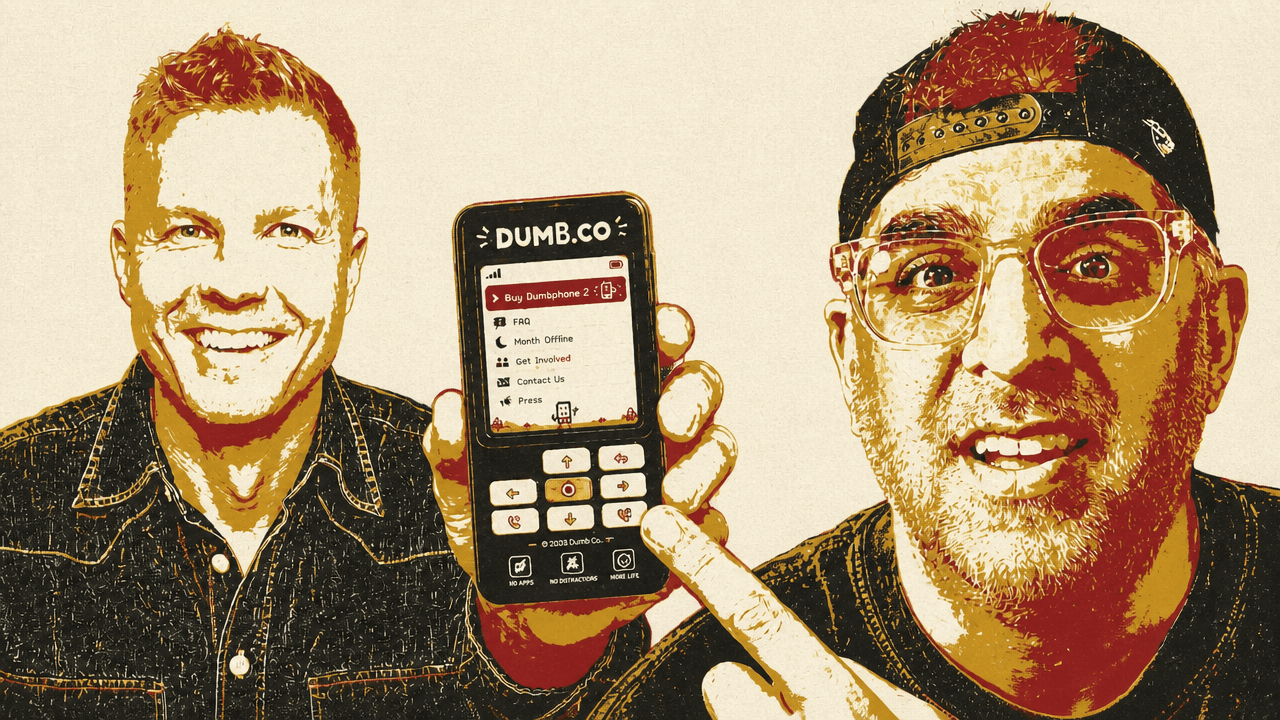
Sam Parr’s strongest trend call was not a new app but a family of products designed to make the smartphone less central. He had bought a device from dumb.co, a company whose site says it began in Washington, DC, in 2025 after a group of neighbors formed “Month Offline,” a 30-day challenge to ditch smartphones. The product shown on the site, the dumbphone 2, is described as “a companion device” that syncs with a smartphone and includes maps, music, Uber, and messages, “but only if u want.”
Parr described his own setup as a TCL flip phone that cost $25, with service costing $20 a month afterward. He framed it less as a true replacement phone than as a forwarding phone. Through an app on the iPhone, he can switch between “dumb mode” and “smart mode.” In dumb mode, calls and texts route to the flip phone. Responding to texts is intentionally inconvenient, with old multi-tap typing like a Nokia keypad. The friction is not incidental; it is the product.
The useful distinction is that dumb.co is not selling total disconnection. It is trying to preserve the handful of functions modern life still requires while removing the reflexive loop around everything else. The company’s own copy frames the device as “just dumb enough.” Parr said the original one-month-without-a-phone challenge proved not particularly feasible, which pushed the founder toward a more practical product: a cheap flip phone turned into a partial iPhone substitute.
The cohort element matters as much as the hardware. The Month Offline page shown on screen described a 30-day challenge with weekly meetups, creative challenges, mutual encouragement, conversation prompts, and old-school tools for offline exercises. Another page listed July 2026 locations in New York City and Washington, DC. In that framing, the product is partly a device, partly a behavior-change program, and partly a local social club.
Parr had called the company’s customer-service number that morning to learn the story. He said he believed he was speaking with the CTO and could hear the small-team environment in the background. Based on that call, he relayed that the founder had previously sold a company, was self-funding this one, and that the company had four full-time employees. The company’s smallness was part of what made the signal interesting to him: it looked like the kind of niche, slightly odd consumer behavior that large companies might ignore until it becomes too visible to dismiss.
The demand signal he pointed to was r/dumbphones. The screenshot showed 201,000 members and 2,200 weekly contributors, with posts about Android dumb phones, feature requests, WhatsApp, Maps, two-factor authentication, and carrier shutdowns. The category is not simply “people want no phone.” It is more precise: people want less phone while preserving the few functions that work, school, navigation, authentication, and family logistics require.
Parr also described a CNN segment that, in his view, functioned as the best possible advertisement for dumb.co. As he told it, a presenter took focus and memory tests, used the phone for two weeks, then repeated the tests and showed significant improvement in focus and memory. Parr did not claim to understand the science behind the tests. His point was the marketing force of the before-and-after: a physical product promising a measurable improvement in attention.
Shaan Puri agreed with the size of the problem. He called it “gargantuan” and said nearly everyone with a phone seems addicted to it. In his own network, he estimated a 95% to 98% addiction rate. The open question, as he framed it, is what becomes the nicotine patch or AA for smartphone addiction.
Parr predicted that big companies currently view dumb phones as niche and silly, but that in 10 years the category will not look niche. Puri said that if Apple released a version of this, it could sell a billion units. Parr then said he believed Apple was working on a flip or fold-style phone, but he was not certain about the details and immediately softened the point: maybe it was rumors, maybe it had been announced, but the exact device was not what mattered. To him, the breadcrumbs pointed toward a mega-trend rather than a fringe movement.
The same anti-phone pattern appeared in CatGPT’s physical phones. Parr described CatGPT as an Instagram creator who became popular through AI education and then built vintage-style Bluetooth landline phones. The site shown on screen sold a rotary phone, wall-mounted phone, and handset under the line “Vintage feel. Modern tech. Home of the original Bluetooth landline phone,” with prices of $119 for the rotary and wall mount and $99 for the handset.
According to Parr, CatGPT tried the idea in 2023 without much demand, revisited it later with a larger audience, used ChatGPT to help with design and approval processes, and launched in 2025. Parr said she sold $800,000 in five months and is now aiming for, or tracking toward, $5 million in annual revenue in 2026. Those numbers were relayed as Parr’s description of the business, not as audited financials.
What Parr saw was not just a phone accessory business. He suggested a broader company for “undoing” the phone: physical GPS devices, old-school alarm clocks, phone jails, and other single-purpose hardware. Puri especially liked the phone jail idea, but stressed that it should be designed as an actual phone jail, not merely a timed Tupperware container.
Puri connected the same theme to Zach Yadegari, the teenage founder previously behind Cal AI. Puri said Yadegari had built Cal AI while in high school, appeared on the podcast between classes, reached a few million in ARR at the time, later grew to something like $20 million to $30 million in ARR, and sold the company for an amount Puri loosely placed between $50 million and $100 million. The phrasing was deliberately approximate.
Yadegari’s next company, Flow, is an alarm-clock product. The site shown on screen described it as “the alarm that forces you out of bed” with over 100 alarm sounds and displayed 1,377 reviews. The setup is simple: create an alarm in the app, place the Flow Dock somewhere away from the bed, let the alarm ring, and stop it only by walking to the dock and scanning it with the phone.
Parr initially asked how that stops doomscrolling. Puri explained the behavioral loop: many people wake up to a phone alarm, see notifications, snooze, and then spend 20 or 30 minutes scrolling in bed. Flow makes the alarm impossible to dismiss from bed. The user has to get up, move to another room, and physically interact with the dock. Parr’s reaction was simple: “Awesome.”
For Puri, Yadegari’s move strengthened the signal. He had already been receptive to the anti-phone trend, but seeing a young founder who had successfully used TikTok and consumer-app mechanics move into physical habit hardware made the category feel more validated to him. It also matched what Yadegari had reportedly said he wanted next: a hardware challenge in a less crowded space, as app and content creation become easier and more competitive.
Parr’s own use of phone-limiting tools showed why this category is hard. Brick, a separate device or system for restricting phone use, had stuck with him. He keeps it at his front door and configures his phone differently depending on the outing. If he is going out with family, he allows Maps, texts, calls, and Uber. If he is working out, he allows only his workout app and Spotify.
Puri said he had simply deleted social media from his phone and found there was not much else to do. Parr replied that it was too easy to visit twitter.com. Even beyond social media, he found himself asking Claude questions just to satisfy the habit of pulling out a phone in the elevator. For him, the problem was not only the apps. It was the hand-to-pocket reflex itself. To break it, sometimes “nothing working” was the only solution.
The business implication Parr and Puri kept circling is that the moat is not necessarily technology. Parr compared it to Liquid Death: the underlying product may not be technically hard, but the brand can carry the business. Puri framed the position as “the anti of the main thing.” If smartphones are the main thing, a small percentage of people will want the opposite: less stimulation, more physicality, more intentional use, and products visual enough to spread on TikTok.
Wellness becomes more valuable when it changes state in public
The Cleveland Schvitz was the cleanest example of wellness turning into a social outing rather than a solitary optimization routine. Puri described it as a 98-year-old Jewish bathhouse in Cleveland combining Russian-style steam, cold plunge, massages, giant T-bone steaks, and cocktails. The Cleveland Magazine page shown on screen described “New Generations” discovering “the Sweat, Steaks and Fun of the Cleveland Schvitz” as it approached its 100th anniversary. A Barstool Sports post shown on screen called it “the hottest reservation in the country this winter.”
Puri said the offer is $165 per person for drinks, steam, cold plunge, and a full meal. The ritual is straightforward: a group books a slot, alternates between steam and cold for a couple of hours, gets massages, then eats steak and drinks cocktails. It is part spa, part steakhouse, part private club.
Parr’s reaction was immediate: “I’m in. That’s awesome.” Puri said it was not even crazy, just “downright spectacular.”
The point was not simply that cold plunges and saunas are popular. Puri argued that a place like the Schvitz can replace the bar, restaurant, spa, or nightclub for an outing. It is “the new going out.” That framing turns wellness from a recovery chore into an experience product: something booked with friends, photographed, talked about, and repeated.
The at-home hyperbaric chamber idea sat near the same pattern, but with a more complicated execution path. Puri compared hyperbarics to saunas, cold plunges, and red-light therapy: categories that once belonged in gyms, clinics, or specialized facilities and then moved into the home as expensive wellness objects. He said at-home sauna brands now do hundreds of millions in revenue, and that cold-plunge companies have reached large direct-to-consumer scale.
The proposed next entrant is the hyperbaric chamber. The visual shown was a person sitting in a dark, enclosed chamber with a circular window. Parr said it looked like a device “you would be put to death” in; Puri thought it looked like an astronaut chamber. That visual distinctiveness mattered to Puri. Cold plunges and saunas became shareable not only because of their claimed benefits but because they became visible discipline symbols. A hyperbaric chamber, if designed with enough visual identity, could become the next wellness flex.
Parr connected hyperbarics to endurance training and altitude adaptation. He described how Olympic runners have long gone to places like Flagstaff for months at a time to train at altitude, and how the idea of sleeping in lower-oxygen or “thinner air” environments became associated with improved oxygen efficiency and endurance performance. He was uncertain on the exact terminology, but clear on the association: athletes sought altitude effects; consumer wellness now borrows from that logic.
Puri’s caution was regulatory and practical. Hyperbaric oxygen therapy, or HBOT, is a medical device category, he said. Claims require clearance. Pressurized oxygen in an enclosed space carries safety risks. Unlike a cold plunge, which is basically a tub of water, a home hyperbaric product has to solve for both demand and compliance.
Parr’s alternative version was more sleep-product than wellness pod. He described blackout tents used over cribs in hotel rooms, then imagined a sleep company creating a “king canopy” bed in which an adult could sleep in a controlled-air environment. Puri doubted whether the physics would allow a canopy format because of the need for pressurization. He also wondered whether the whole body needed to be inside at all, joking that perhaps only the head needed an astronaut helmet.
Parr connected the broader social-wellness idea to Othership, which he described as “SoulCycle for sauna.” He had attended an Othership session in Manhattan and described a room full of young people, part hippie and part yuppie-tech, moving through cold plunges and a large sauna while a leader guided breathwork, waved towels to move eucalyptus-scented air, and loud music created a trance-like environment. The sensory stack mattered: heat, smell, sound, wind, breath, and a crowd. Othership also offered singles nights, and Parr said he and his wife would consider it for a date night.
Puri disclosed that he is an investor in Othership and called it a great business. He said the company had opened in New York, thought it had opened another location, and had more in the works. He emphasized that the founder did not try to build a simple, easily replicated “Subway sandwiches” version of sauna. The ambition, in Puri’s telling, was to create the most epic sauna-breathwork experience possible as a place people can go. He also said Dana White visited a location, went live on Instagram afterward, and called it incredible.
That gave Puri a broader thesis: “state” is going to become an important consumer concept over the next decade. By state, he meant how a person feels and experiences the world. A person in a bad mood can go to a good thing and have a bad time; a person in a great mood can go somewhere ordinary and have a great time. Most people, he argued, are poor at managing or controlling their state.
“The body can drag the mind,” Puri said. His claim was that people do not need to think their way into a different state if the body can move them there. Hot, cold, breath, music, scent, and communal ritual can change how a person feels quickly. He compared that to SoulCycle, Barry’s Bootcamp, CrossFit, and hot yoga. Their value is not primarily that they are optimal workouts; in some cases, he argued, they are not. Their value is that they place people in a dark room with other people, strong music, a leader, sweat, temperature, and a structure that changes their state.
Parr tied the language of “state” back to pickup-artist material they read as teenagers, where people were taught to enter a positive state before approaching someone and then bring the other person into that state. He joked that “generative” is out and “state” is in. Puri agreed: state is going to be in.
The Schvitz, Othership, and hyperbaric idea all sit inside the same business question Puri kept returning to: can a product reliably change how someone feels, and can that change become visible or social enough to become a repeatable outing? The Cleveland Schvitz and Othership have the easier answer because the product is already a plan. Hyperbarics may have the wellness pattern, but also the medical-device problem.
Physical media makes screen-free attention feel like play
The Funday Press was Puri’s example of screen-free media packaged as play. It is a monthly physical newspaper with games, puzzles, fun facts, lifehacks, and art, but no news. The site shown on screen described “20 handcrafted games and puzzles,” “10 fun facts, lifehacks, & art pieces,” and “hours of screen-free fun to make your brain feel good.” Puri described it as the fun parts of a newspaper without the depressing material.
The creator, according to Puri, is a prolific board-game designer. Puri had met him and seen a backdrop not of books but of thousands of board games. Puri said the creator had made one of the large best-selling party games, though he was uncertain which one. The important detail was not nostalgia for print alone; it was the creator’s fluency in games as a medium.
Parr initially assumed the product was for children and compared it to Highlights magazine. Puri corrected him: this is for adults. He connected it to the “kidulting” trend, which he defined as a multibillion-dollar industry of giving adults childhood-like objects and activities that help them de-stress. Parr hated the word “kidulting,” comparing it to adults saying they are “adulting” because they scheduled a doctor’s appointment. Puri pointed out that Parr himself buys elaborate Lego sets and collects miniature foods from LOL dolls. Parr accepted the behavior while rejecting the label.
The business comparison was New York Times Games. Puri said the New York Times’ games-only product has a million paying subscribers at $5 per month, which he translated to $60 million in annual recurring revenue. The Funday Press is, in his framing, a physical printed version of that broader no-news, games-only idea. He also mentioned a competitor called The Sunday Club with a similar all-games, no-news model.
Parr widened the category to physical newsletters. He cited a Wall Street Journal article shown on screen with the headline “This Snail Mail Side Gig Pays $14,000 a Month.” According to Parr, the subject was a crossing guard named Christine who sends a physical newsletter about her experiences as a crossing guard—silly, entertaining, and personal—and has built meaningful monthly revenue without starting from a large audience.
Parr’s view is that the best physical newsletters may be deliberately janky. Stapled paper, manila folders, and handmade texture are not defects; they are part of the appeal. The Funday Press fits that pattern because it does not ask the buyer to become more disciplined or more productive. It offers a finite object, sent in the mail, that gives adults something to do with their hands and attention.
That puts The Funday Press near the anti-phone hardware trend, but with a softer promise. It is not telling the buyer to fix an addiction, optimize focus, or become a better person. It offers a low-stakes object that makes screen-free time feel fun.
Simulation can train scarce labor without pretending to be entertainment
Puri’s strongest conviction outside consumer hardware came through on VR training for blue-collar trades. He described Meta Quest applications that teach skills such as HVAC repair, welding, plumbing, electrical work, solar, and data center operations through hands-on simulation. The visual showed the Meta Quest page for Interplay Learning, including a VR diagnostic exercise with a multimeter and a question about whether 200μF was measured across start capacitor terminals.
The pitch was practical: put on a headset, diagnose a broken AC unit, assemble an EV battery pack, practice procedures repeatedly, and do it without damaging expensive equipment or putting trainees at risk. Puri compared it to a flight simulator. The point is not that every trainee wants to “play HVAC.” The point is that simulation can compress training, lower danger, and make scarce instruction more repeatable.
Puri said there are 500,000 unfilled HVAC and plumbing jobs in the United States. He also said training on real equipment can be slow, expensive, and dangerous. Those constraints explain why the buyer is likely not a casual gamer but an employer, trade school, training program, or worker trying to qualify for a job.
Puri cited Interplay Learning in Austin as a leading player, with hundreds of hours of HVAC, solar, plumbing, and electrical training. He also mentioned Skillveri for welding and painting simulations. He said these tools could actually get someone certified as a technician or an associate using Quest, but the source treats that as Puri’s description of the product landscape, not as a verification of any particular credential.
Parr resisted the idea as entertainment. He said he likes simulators, including war simulators and even a trucking simulator he finds relaxing, and used to enjoy taking apart old motorcycles in college. But he did not personally want to play an HVAC game. That objection clarified the market. This is not competing with leisure gaming. It is training infrastructure for employers and workers.
Parr’s direct experience with an HVAC business made him more receptive. A friend who owns an HVAC company runs “Hoffman University,” a training program for new recruits that lasts weeks or months. Parr had visited the facility and said seeing it made the labor need more concrete. He still would not play the game for fun, but conceded that if he wanted the job—or wanted to hire for the job—the idea made sense.
The business model implied by the discussion is a training sale, not a consumer-game sale. The user may be the technician-in-training, but the economic buyer could be the company that needs more technicians and cannot rely on slow apprenticeship alone. The risk is adoption: employers have to believe the simulation produces useful labor outcomes, and the product has to be realistic enough to replace or supplement hands-on training. Puri’s final verdict was unambiguous: good crazy.
Prediction markets turn clinical-trial uncertainty into a tradable product
Endpoint Arena was Puri’s most highbrow example: a prediction market for clinical-trial outcomes. He described it as combining two things he only partially understands, prediction markets and biotech clinical trials. The on-screen interface called it “The prediction market for clinical trials” and listed trials with “YES” and “NO” percentages, catalyst dates, and event types. One Phase 3 metastatic prostate cancer trial showed 33% yes and 67% no. Another pediatric diabetes trial involving Afrezza inhaled insulin showed 76% yes and 24% no in one frame, then 66% yes and 34% no in another frame sorted by earliest catalyst.
The financial logic was clear enough even if the product was unfamiliar. Public pharmaceutical companies can move substantially based on Phase 1, Phase 2, or Phase 3 trial results. Puri said his cousin had worked at a hedge fund where the goal was to estimate the true probability of trial success better than the market. A dedicated prediction market could surface expectations from people with knowledge, incentives, and capital at risk.
Puri framed Endpoint Arena as “a Polymarket essentially” for clinical trials. The site lets users take positions on whether specific trial-related events will occur. He said someone could either hedge positions by betting on Endpoint Arena in addition to holding the relevant stock, or use the market’s probabilities as a signal.
Parr asked how prediction markets work: whether two users are directly taking opposite sides of a bet or buying stakes. Puri explained that there is a price for a yes contract. When people buy yes, the yes price rises unless there is corresponding pressure on the no side. There is no bookie setting the price; the market sets it through yes and no demand. It is not exactly a stock market where one person simply buys another person’s shares, but money moving into yes or no changes the price and can incentivize others to take the other side.
The potential buyer or user is narrower than the phrase “prediction market” might suggest. The obvious users are people already exposed to biotech outcomes: investors, analysts, people following trial catalysts, and perhaps domain experts with a view on the science. Puri also invoked the common argument that prediction markets can be more accurate than individual experts because they aggregate the wisdom of crowds with skin in the game.
Parr found the product “super fascinating” and immediately noticed a strange branding detail: the website displayed “Season 5.” He wondered whether Endpoint Arena was trying to make clinical-trial outcomes feel like a series: “Will this drug get approved or not?” Puri did not know, but found the framing interesting.
The skepticism arrived when Puri read aloud from an unidentified article or writeup about Endpoint Arena CEO Michael Fisher, whom he described from the piece as a PhD who studied economics and computer science at Stanford. Fisher’s stated interest, as Puri read it, was experimentation and encouraging people to think about and place bets on what will happen if certain experiments are run. Puri read that Fisher argues clinical-trial-focused prediction markets can “democratize” the trial process, motivate participants to become experts, and improve experimentation.
Both hosts reacted negatively to the word “democratize.” Parr called it a trigger word. Puri agreed.
The more ambitious claim was that prediction markets could eventually provide scientific benefit. Puri summarized a hypothetical: if a known GLP-1 drug is being studied for a new indication, people already taking it for diabetes or obesity might notice improvements related to that condition and incorporate that firsthand information into their predictions. In theory, patterns in those predictions could become early signals about a drug’s potential before trial results are released, allowing more focused trials with fewer people and fewer resources.
Neither host fully bought it. Puri said he did not fully understand or buy the claim. Parr said that when he does not understand something, his instinct is to call it stupid, then landed on “bad crazy.”
The narrower business case—markets around trial outcomes for people who already care financially or scientifically—was compelling enough to hold their attention. The weakness was the elevated mission language. Parr reduced it bluntly: the “why” sounded like a lot of words for “we want to gamble.”
Some products work because the claim is hard to check
PetChat, described by Puri as a Chinese startup selling an AI dog collar that translates barks and meows into full sentences, was the clearest example of a product whose claim is difficult to audit. The on-screen post claimed the collar cost $118, had 10,000 preorders, used microphones, motion sensors, and AI to read body language and vocalizations, and could interpret pets’ speech with “up to 95% accuracy.” A later frame showed the product positioning itself as “the world’s first real-time pet translator” with “94.6% Accuracy.”
Parr’s first reaction was positive. He called it “amazing stupid,” then landed on “good crazy.” He was a dog owner for 15 years and understood the emotional appeal immediately: if a product even plausibly helped owners understand their pets, many would want to try it.
Puri was more skeptical, and his skepticism rested on what he called the “My First Million rule” about pet businesses: the “who knows” factor. Pet supplements, calming products, gut-health products, and AI translation can make claims that customers struggle to independently verify. If a product says a dog is calmer, healthier, or asking for something specific, the owner often has no objective way to know.
That does not mean the product has no value. Both Puri and Parr acknowledged that dog owners can distinguish some vocalizations. Parr said he could tell from another room whether his dog was barking because someone was at the door, because he needed to go outside, or because he wanted attention. Puri said he could distinguish water, food, and the urgent “I have to poop and it’s your problem” bark.
But that familiarity also became Puri’s reason for putting PetChat in “bad crazy.” The most valuable use case may already be solved by attentive owners. A collar that converts barks into polished sentences may be delightful, viral, and commercially viable, but the claimed precision is the weakest part of the pitch. If nobody knows what the pet actually wants, what is the 95% being checked against?
Super Brain pushed the same hard-to-audit problem into grief. Puri described it as a handheld device, almost like a baseball card or Tamagotchi, containing an AI clone of a deceased loved one. The user uploads video, audio, and personality data, then chats with the person after they have died. The on-screen post described an “AI startup called super brain” charging $38 in China for a clone of a deceased loved one.
Parr’s reaction was immediate: “That’s messed up man. That would break my heart.” But he did not reject it outright. He said he would want it, especially for a grandparent, while also expecting it would make him cry constantly. His final judgment was “good crazy.”
The tension is obvious and central to the product. AI memorials are not productivity tools or novelty gadgets. They attach themselves to grief. A good version could preserve voice, memory, mannerism, and access. A bad version could trap a person in a recurring emotional wound. Puri did not make a deep ethical case for or against it. The business judgment stayed closer to demand: people miss loved ones, and a portable AI interface could satisfy a powerful desire. Parr’s view was more visceral. The emotional intensity was exactly why it might work and why it might hurt.
PetChat and Super Brain are very different products, but the source treated them as adjacent kinds of “crazy.” Both sell an interface to something the buyer cannot fully verify: an animal’s intention or a dead person’s presence. That uncertainty did not make the ideas uninteresting to Parr and Puri. It made the business judgment harder.